

 Answers to common questions about baptism
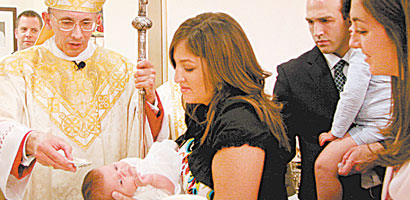 Answers to common questions about baptism
Q: How should a Catholic reply to the question, "Have you been saved?"
A: As the Bible says, I am already saved (Rom. 8:24, Eph. 2:5-8), but I'm also being saved (1 Cor. 1:8, 2 Cor. 2:15, Phil. 2:12), and I have the hope that I will be saved (Rom. 5:9-10, 1 Cor. 3:12-15). Like St. Paul, I am working out my salvation in fear and trembling (Phil. 2:12), with hopeful confidence in the promises of Christ (Rom. 5:2, 2 Tim. 2:11-13).
Q: Can people be re-baptized?
A: No. Baptism is a once-for-all sacrament that washes away original sin, gives sanctifying grace, and imparts a supernatural character upon the soul that makes a person a Christian. An attempt to "redo" a valid baptism would be useless: the second baptism would not "take" because the first was valid. Furthermore, it would be an objective sacrilege because it would cast aspersion on the validity of the first baptism. Even if you have not lived a Christian life until recently, if you were validly baptized then you are a Christian. Your status as a Christian does not depend upon how well you have lived. The proper sacrament to wash away personal sins you have committed since your baptism is confession.
Q: Should we baptize babies, considering they don't know what baptism is?
A: On the contrary, baptism is the best thing you could do for a baby. Baptism is a grace from God, not something we do for God. Grace does not depend on our intellectual achievements any more than it depends on any other human achievement. This is one of the many ironies inherent in opposition to the ancient Christian practice of infant baptism. To refuse baptism to a baby on the grounds that "the child isn't able to understand what is happening" is to presume that God gives grace only to those who are smart or old enough to figure out how to get it.
Q: Why does the Catholic Church recognize Protestant baptism?
A: Since baptism is necessary for salvation and God wills the salvation of all, the Church recognizes all validly administered baptisms, even if Protestant. The Catechism of the Catholic Church states: "The ordinary ministers of baptism are the bishop and priest and, in the Latin Church, also the deacon. In case of necessity, anyone, even a non-baptized person, with the required intention, can baptize by using the Trinitarian baptismal formula. The intention required is to will to do what the Church does when she baptizes. The Church finds the reason for this possibility in the universal saving will of God and the necessity of baptism for salvation." (CCC 1256)
To be valid, the baptism prayer has to contain the Trinitarian formula "In the name of the Father, and of the Son, and of the Holy Spirit," and water has to be used. The person can be baptized by pouring or by immersion.
Q: Why is baptism outside the Church valid but marriage outside the Church is not?
A: When administered outside of the Church, both of these sacraments may be considered valid. But Church law imposes on Catholics an obligation to wed in the Church or to obtain formal permission to wed outside of it.
While the Church sees the necessity for laws concerning the form of marriage, baptism is a different story. Jesus willed that everyone be baptized (Matt. 28:19). Issues surrounding marriage (e.g., public character, one's suitability and readiness, appropriate catechesis, immediate preparation, minimal ecclesial and liturgical dimensions) are not applicable to baptism. Therefore, any baptism administered according to Jesus' instructions is valid.
Q: Can my child be baptized even if I'm not Catholic?
A: Yes, you are permitted to request baptism for your child even if you are not yet a Catholic. The Code of Canon Law states, "For the licit baptism of an infant it is necessary that: 1) the parents or at least one of them or the person who lawfully takes their place gives consent; 2) there be a founded hope that the infant will be brought up in the Catholic religion; if such a hope is altogether lacking, the baptism is to be put off according to the prescriptions of particular law and the parents are to be informed of the reason."
Your consent and the presence of a founded hope that the child will be raised Catholic are what is necessary for the baptism to take place. To establish that there is a founded hope of the child's being raised Catholic, the priest you talk to will question and advise you.
Q: Can our child be baptized even if we are not married?
A: As Catholic parents, you have an obligation to have your child baptized. The Code of Canon Law states, "Parents are obliged to take care that infants are baptized in the first few weeks; as soon as possible after the birth or even before it, they are to go to the pastor to request the sacrament for their child and to be prepared properly for it."
However, to baptize your child licitly, the Church requires that "there must be a founded hope that the (child) will be brought up in the Catholic religion; if such hope is altogether lacking, the baptism is to be delayed according to the prescripts of particular law after the parents have been advised about the reason."
Q: Why should we pick saints' names for our children's baptism?
A: In the creed we say at Mass, we say we believe in the Communion of Saints. This means we are spiritually united with those who have died and are now in heaven. They can act as intercessors – they have the ability to assist us and pray for us. By choosing a saint's name, you acknowledge this fact and ask a particular saint to assist you in bringing up the child. The saint becomes the child's patron, and a role model for the child.
Q: Can we have our granddaughter baptized if her parents won't?
A: Unless your granddaughter is in danger of death, the Church does not allow you to have her baptized against both her parents' will. However, an infant of Catholic parents or even of non-Catholic parents may be baptized even against the will of the parents if the baby is in danger of death.
Q: Is faith necessary for adults to be baptized?
A: Adults must have faith for baptism, but it need not be a fully developed faith. The Catechism explains: "The faith required for baptism is not a perfect and mature faith but a beginning that is called to develop. The catechumen or the godparent is asked: 'What do you ask of God's Church?' The response is: 'Faith!' For all the baptized, children or adults, faith must grow after baptism. (CCC 1253–1254)
Q: If baptism is necessary for salvation, shouldn't we baptize everyone whether they like it or not?
A: On the contrary, baptism is grace – not magic. Since grace perfects nature (as distinct from magically annihilating it), our response matters a great deal. Recall that Creator and Redeemer are one and the same God. Creation is so ordered by the Creator that parents are responsible to communicate life (biological, emotional, moral, and spiritual) to their children. To baptize either an unwilling adult or somebody else's child against the wishes of the parents is an act of spiritual kidnapping.
In Catholic understanding, to baptize anybody validly, the baptizer must intend to baptize according to the mind of the Church. This means he must baptize in water using the Trinitarian formula and he must have the permission of the candidate, or, if he is incompetent to give such permission, the permission of the candidate's parent or guardian. God the Redeemer's grace does not violate the nature made by God the Creator, especially the sacred nature of the bond between parent and child. Neither, when dealing with someone who is now independent of parental or guardian authority, does God the Redeemer's grace force baptism against the will of any human person made by God the Creator.
— Catholic Answers
What does the Catechism of the Catholic Church say about baptism?
 Baptism is the first sacrament: "Our Lord tied the forgiveness of sins to faith and baptism: Go into all the world and preach the gospel to the whole creation. He who believes and is baptized will be saved. Baptism is the first and chief sacrament of forgiveness of sins because it unites us with Christ, who died for our sins and rose for our justification, so that 'we too might walk in newness of life.'" — CCC 977
In baptism sin is forgiven, but... "Yet the grace of baptism delivers no one from all the weakness of nature. On the contrary, we must still combat the movements of concupiscence (lust and strong desire) that never cease leading us into evil." — CCC 978
What about sin after baptism? "It is through the sacrament of penance that the baptized can be reconciled with God and with the Church: Penance has rightly been called by the holy Fathers 'a laborious kind of baptism.' This sacrament of penance is necessary for salvation for those who have fallen after baptism, just as baptism is necessary for salvation for those who have not yet been reborn." — CCC 980
The seven sacraments
The seven sacraments, instituted by Christ and administered by the Church, are comprised of the sacraments of initiation, the sacraments of healing, and the sacraments at the service of communion.
The sacraments of initiation, in which a Catholic is welcomed into the Church, are, in order of their reception: baptism, confirmation and Holy Eucharist.
The sacraments of healing are reconciliation (also called confession or penance) and anointing of the sick.
Sacraments at the service of communion are holy orders and matrimony.
Recent sacramental statistics in the Diocese of Charlotte
Baptisms: 6,867
Infant 6,028
Minors 528
Adults 311
First Communions: 5,643
Confirmations: 4,063
Marriages: 882
Catholic 574
Interfaith 308
— Source: The Official Catholic Directory 2013