


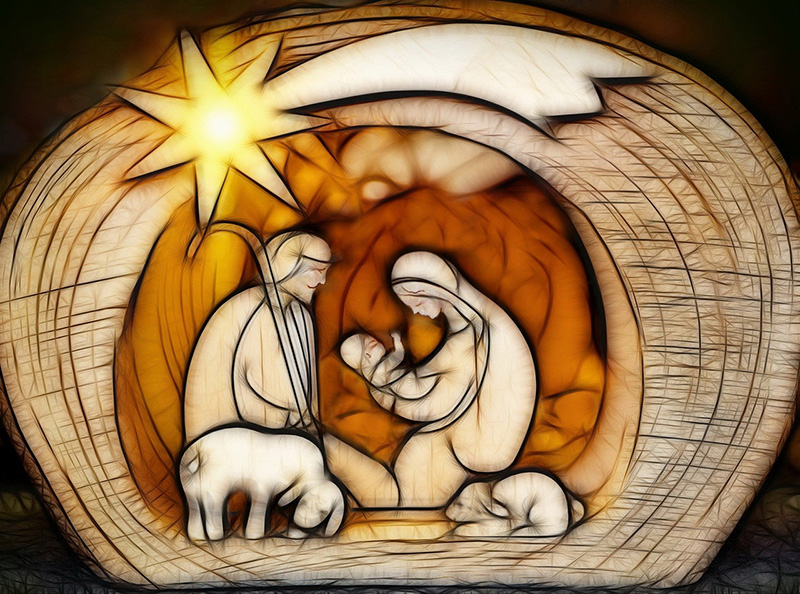
 We are now in the final month of the 2025 Jubilee year, which will officially conclude on Tuesday, Jan. 6, 2026, on the Feast of the Epiphany. Pope Francis opened this Jubilee in December 2024 with the theme, “Pilgrims of Hope.” In this Advent season, I find myself reflecting on the relationship between the Jubilee, hope and the coming of Christ.
For us to understand what a Jubilee means for us today, we have to first understand what it meant to the people of Israel. According to the Law of Moses, every seventh day was to be observed as a day of rest. This is a pattern we are still familiar with, as the Church has retained the practice of maintaining a day of rest once each week to worship God. But in ancient Israel, the idea of a sabbath rest was not limited to a weekly observance. The people observed a sabbath year of rest every seven years.
This might sound nice at first, but it was not a year-long vacation. Think about what a year of no work meant to the people of that time. It meant fields didn’t get planted. It meant vineyards were not pruned. It meant crops were not harvested. The land itself was allowed to rest. That made sabbath years times when Israel had to learn to trust God to provide for them and for their needs.
 A sacred year
Every 49 years, Israel would complete a full cycle of seven sabbath years, so the year after that, the 50th year, was something very special. That was the Jubilee Year that we read about in Leviticus. “You shall treat this fiftieth year as sacred. You shall proclaim liberty in the land for all its inhabitants. It shall be a jubilee for you, when each of you shall return to your own property, each of you to your own family” (Lv 25:10).
The restoration of ancestral land was of extreme significance. Every tribe of Israel had received a portion of the land of Canaan that was to be their inheritance. The land was something sacred that had been given to them by God. If economic hardship forced any family to sell or trade their land, it would be restored to them on the Jubilee. This guaranteed no tribe would ever be displaced by another.
This was a great blessing for the people because it meant that the hardship of losing your land would never be permanent.
Something similar was done for human labor, with slaves being set free on Jubilee years. In ancient Israel, the institution of slavery existed as a safeguard for people who were destitute. If someone could not take care of themselves, they could enter into indentured servitude of a more prosperous family. In exchange for their service, their basic needs would be met. But the hardship of entering bonded servitude was also temporary. No person can ever own another because we all belong to God. So every slave was to be set free in the Jubilee year.
Hope in times of struggle
Jubilee years were more than just times of rest. They were times of liberation and restoration, reminders that God has sovereignty over His land and His people and that nothing would really be lost forever. Eventually everything would be restored, no matter how bad things might get in the interim. That was the Jubilee promise of God. Trust in that promise would nurture in their hearts the virtue of hope.
But eventually, the hope instilled by the Jubilee year would look ahead past another 50 years for its fulfillment to some future year of grace. Things would get bad for Israel. The tribes of Israel began to war among themselves, tearing the kingdom in two. Their kings turned to worship of foreign gods. The Assyrians would invade, wiping the 10 northern tribes off the map. The Babylonians would follow, sending Judah into exile. The walls of Jerusalem were torn down. The temple was destroyed. What would be rebuilt would be just a shadow of its former glory. Then would come the Greeks and later the Romans to rule over them.
How could a Jubilee year restore land that was occupied by a foreign invader? How could it restore freedom to a people enslaved by a pagan empire? What does hope for restoration look like for a people in exile? You see the challenge here. But the hope instilled in their hearts by God did not die. It just looked further ahead to a future time of restoration when all would definitively be set right; not just for a year, but for all time.
This future messianic kingdom of justice and righteousness is prophesied in many places in the Hebrew scriptures. Isaiah speaks of a shoot from the stump of Jesse blossoming forth (cf. Is 11:1), saying, “For to us a child is born, to us a son is given; and the government will be upon his shoulder, and his name will be called ‘Wonderful Counselor, Mighty God, Everlasting Father, Prince of Peace’” (Is 9:6).
Later in Isaiah we read of the promised messiah saying, “The Spirit of the Lord God is upon me, because the Lord has anointed me; He has sent me to bring good news to the afflicted, to bind up the brokenhearted, to proclaim liberty to the captives, release to the prisoners, to announce a year of favor from the Lord and a day of vindication by our God” (Is 61:1-2). This “year of favor” would be a Jubilee to end all others; the ultimate time of restoration which all the Jubilees of the past foreshadowed.
Luke’s gospel records Jesus entering the synagogue in Nazareth and reading this passage from Isaiah. Then, in what is perhaps both the shortest and most profound sermon ever preached, he says to the assembly, “Today this Scripture passage is fulfilled in your hearing” (Lk 4:20).
The fulfillment of Israel’s hope arrived in Bethlehem over 2,000 years ago when a child was born to a virgin. He is the fulfillment of our hope, as well. We look around and continue to see war, poverty, disease and death. But we also see the light of Christ shining into the darkness, like the dawn of a coming day, and the darkness will not overcome it.
Like the season of Advent, Jubilees foster a longing for a time when God’s kingdom is made fully manifest, and at the same time they remind us that the promised kingdom is already here, in the Church founded by Christ, and in the sacraments He gave us to sustain our hope until the day He comes again in glory. Come, Lord Jesus!
Deacon Matthew Newsome, Catholic campus minister at Western Carolina University and regional faith formation coordinator for the Smoky Mountain Vicariate, is the author of “The Devout Life: A Modern Guide to Practical Holiness with St. Francis de Sales,” available from Sophia Institute Press.