

 There are several common misconceptions regarding the principles and practice of Natural Family Planning. Check out the realities behind frequent myths.
MYTH
NFP is based on guesswork: it's what people used before modern science developed contraception.
REALITY
Natural Family Planning (NFP) is not based on folktales! NFP is a general title for the methods of family planning that are science-based, accurate, natural, healthy, reliable and moral. There are many NFP methods and all can be used to achieve, or to postpone, a pregnancy naturally.
NFP is based on scientific research about women's cycles of fertility. Over a century ago, scientists discovered cyclic changes in cervical mucus and their relation to ovulation. In the 1920s, scientists identified the temperature rise that signals ovulation. But it wasn't until the 1950s, that scientists developed programs to teach others how to observe and interpret these fertility signs.
NFP methods are grouped according to which signs of fertility are being observed and charted. They are as follows: the basal body temperature method (BBT) monitors changes in a woman's temperature when she wakes up each morning; the cervical mucus method ( more commonly called "Ovulation Method" or "OM") monitors changes in a woman's cervical mucus; the Sympto-Thermal Method (STM) combines observations of temperature and cervical mucus with other indicators, such as changes in the cervix and secondary fertility signs; and the Sympto-Hormonal Method (SHM), which is similar to the STM, includes the self-detection of reproductive hormones in the urine with the assistance of an ovulation predictor kit or fertility monitor.
MYTH
NFP can be used only by women with regular cycles.
REALITY
NFP does not depend on a woman having regular menstrual cycles. NFP treats each woman and each cycle as unique. These methods rely on daily observations of the woman's signs of fertility.
NFP works with menstrual cycles of any length and any degree of irregularity. NFP can be used during breastfeeding, just before menopause, and in other special circumstances. NFP allows a woman to understand the physical signals her body gives her to tell her when she is most likely to become pregnant (around the time of ovulation). Once the woman understands this information, she and her husband can use the information according to their family planning intentions (i.e., to either achieve or postpone pregnancy).
Instruction in NFP provides women with information about their bodies that is specific and observable. The natural methods can be used throughout a woman's reproductive life. These methods teach couples to monitor current, daily fertility signs of the woman's menstrual cycle. When special circumstances occur, (e.g., stress, illness, breastfeeding, post-miscarriage, perimenopause, etc.), NFP instructors can provide additional guidance in interpreting signs of fertility.
MYTH
NFP is too complicated to be used by most people.
REALITY
NFP can be used by anyone who learns the method and is motivated to apply the guidelines.
NFP information is easy to learn. In fact, the methods have been successfully adapted to suit the needs of people and cultures all around the world. The key to using NFP effectively is for couples to learn together the information about their combined fertility, and to change their behavior, applying the guidelines according to whether they wish to achieve or postpone pregnancy. This process is learned in NFP education, where the couple can practice observing and charting the wife's signs of fertility. This is not hard to learn, but will take effort. NFP couples say that NFP is worth the effort because many benefits will be gained, including stronger communication, mutual responsibility and greater respect for each other.
MYTH
NFP is not a reliable method of family planning.
REALITY
NFP is not only reliable, but it is the only authentic method of family planning.
Since NFP methods are not contraception, their effectiveness works both ways—for achieving and postponing pregnancy. When couples wish to achieve a pregnancy they can time sexual intercourse to the fertile window of the menstrual cycle, thereby optimizing the possibility of becoming pregnant.When wishing to avoid pregnancy, studies show that couples who follow their NFP method's guidelines correctly, and all the time, achieve effectiveness rates of 97-99%. Others, who are unclear about their family planning intention (i.e., spacing or limiting pregnancy) or are less motivated, will not consistently follow the method's guidelines and have a lower effectiveness rate of 80-90%.
Effectiveness of Natural Family Planning in Avoiding Pregnancy
Couples who carefully follow all the rules for avoiding pregnancy all the time: 97%-99%
Couples who do not follow all the rules for avoiding pregnancy all the time: 80%-90%
*Note: these percentages represent the range of effectiveness provided by NFP studies. They are based on the number of pregnancies among 100 couples in one year of NFP method use.
MYTH
There is no difference between NFP and contraception.
REALITY
NFP methods are different from and better than contraception.
NFP methods:
• have no harmful side effects
• are environmentally friendly
• are virtually cost free
• cooperate with, rather than suppress, a couple's fertility
• can be used both to achieve and avoid pregnancy
• call for shared responsibility and cooperation by husband and wife
• require mutual communication
• foster respect for and acceptance of the total person
• encourage maturity and the virtue of chastity
• value the child
• honor and safeguard the unitive and procreative meanings of married love.
In other words, there is a big difference between NFP and contraception. NFP, as opposed to contraception, does not deliberately frustrate the procreative potential of sex. So, NFP is morally acceptable while contraception is actually sinful and never morally right. NFP is unique because it enables its users to work with the body rather than against it. Fertility is viewed as a gift and reality to live, not a problem to be solved. Ultimately, NFP respects God's design for married love.
MYTH
NFP does not allow for sexual "spontaneity."
REALITY
Most of the time, "spontaneity" in sex is itself a myth!
Modern culture is awash in sexual messages. This may fool us into thinking that "everyone" is having sex as often as possible and always "spontaneously!" Even married couples may fall into this trap. Or, they may think that their sex lives would be more spontaneous "if only" their spouse wanted sex at the same time they did. The reality is that most marital sexual encounters are planned, or at least happen in situations favorable to love-making that are setup by agreement regardless of the family planning method used. Otherwise, in the press of daily life with jobs, household chores, social commitments, children's demands, etc., a husband and wife would rarely have sex!
It's not necessarily bad news that married couples often plan on a time to have sexual relations. A loving invitation given in advance means a time of healthy anticipation for both husband and wife. For NFP couples who are trying to postpone a pregnancy, such an invitation in the days of sexual abstinence can mean living a "chaste courtship" that will be followed by a "mini-honeymoon." NFP couples often talk about how the times of sexual abstinence have helped them deepen their expressions of love for each other through loving gestures, "date nights," significant conversations and so forth. This is not to say that the times of abstinence are not challenging. They can be! With a positive attitude and living through it together, husband and wife can use periodic sexual abstinence to grow individually and as a couple. Such self-mastery fosters authentic freedom where one's desires are put in service to the other—a necessary ingredient for marriage! Real sexual spontaneity depends upon real freedom—and NFP fosters such freedom.
MYTH
Couples who use NFP have sex less often than couples who use contraception.
REALITY
Frequency of sexual intercourse is based on a couple's intention and desire, not on the family planning method.
NFP couples have sex as much as other married couples. They just have it on a different schedule according to whether they wish to avoid pregnancy or not. When spacing births, they would abstain from sexual intercourse during the fertile time of the woman's menstrual cycle. Keeping in mind that every woman is unique and every cycle is unique, the days of sexual abstinence will vary. But it's important to ask if the "frequency" of sexual intercourse is the right measure of fulfillment in a marital relationship. Most married couples would say that it is more important for their sexual relationship to reflect the quality of their marriage, that is, healthy, loving, intimate and respectful. NFP can be a great help to couples who are interested in building a strong marriage because NFP supports the gift of one's spouse, the gift of life and God's design for married love!
MYTH
The Catholic Church wants people to have as many babies as possible.
REALITY
In fact the Catholic Church encourages people to be both generous and responsible stewards over their fertility.
In this view of "responsible parenthood" married couples carefully think about the just reasons they may have to postpone pregnancy. When making decisions about the number and spacing of children in their family, they weigh their responsibilities to God, each other, the children they already have, and the world in which they live.
Responsible parenthood is lived within the structures that God has established in human nature. The nature of sexual intercourse, which is both life-giving (pro-creative) and love-giving (unitive), reflects a Divine plan. That is why the Church teaches that husband and wife must not actively intervene to separate their fertility from their bodily union. NFP methods respect the Divine plan and are at the service of authentic married love.
MYTH
The Catholic Church does not want married couples to have sex just for pleasure.
REALITY
The Catholic Church wants married couples to have the best sex possible!
Sexual pleasure in marriage is good. Pleasure is a part of intercourse, however, not its sole focus. There is, after all, a difference between simply "having sex," which includes actions aimed at one's own pleasure, and "making love," which involves giving oneself to another. Put another way, there is a difference between "self-taking" and "self-giving."
"Making love" as God planned it for marriage, means that husband and wife offer themselves to each other as a gift. This sexual gift is faithful and exclusive. It rejoices in the other person, is respectful of God's design, and welcomes a child who may come from their union. It thus has the potential to build the family. In expressing the mutual love and commitments of husband and wife, sexual intercourse becomes a lasting source of joy in their marital relationship.
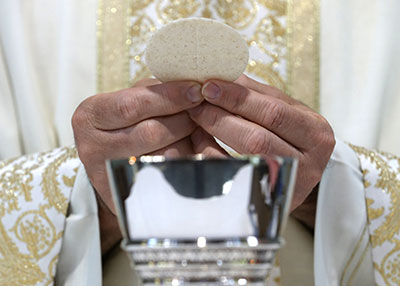 The Eucharist is the summit of our faith, in which the entire story of our salvation is made real in a miraculous and powerful way. The Roman Missal calls the Holy Eucharist the “Sacred Banquet, in which Christ is received; the memory of His Passion is renewed; the mind is filled with grace; and a pledge of future glory is given unto us.”
Yet how often do we have a moment to reflect on this priceless gift? Even in Mass we can become distracted, and what is miraculous and precious becomes routine. The National Eucharistic Revival can be such an opportunity for reflection and for deepening our love for what God has given us – His Son, Jesus, who we receive into our hearts. During this time, we can make a point to focus on the Eucharist – in the Mass, in our reading, in our faith formation classes, and in the quiet of our own hearts.
The Eucharist and the Mass
At every Mass we are witnesses to a miracle. The Eucharist is not a symbol of Our Lord; the bread and wine actually become the Body, Blood, Soul and Divinity of Christ. At the altar, He truly comes to us, again and again, in His real presence.
Christ Himself instituted the Eucharist at the Last Supper as a “memorial of His death and resurrection: a sacrament of love, a sign of unity, a bond of charity, a paschal banquet in which Christ is consumed, the mind is filled with grace, and a pledge of future glory is given to us” (“Sacrosanctum Concilium,” 47).
The Eucharist calls us to memorialize Christ’s passion and death on the cross, the sacrifice in which He won for us our salvation and eternity with the Father. It also is a tremendous sign of our unity as believers. We call it Holy Communion because when we approach the altar, we are acknowledging our unity with Christ, His Church, and one another.
Yet these words can only partially express a mystery that is beyond words: “If you understood Him, it would not be God,” writes St. Augustine. So, too, with the Eucharist. During the National Eucharistic Revival, we can plumb this mystery more and more deeply.
The Church asks all of us to examine our consciences to make sure we are truly prepared to receive Jesus: Are we in a “state of grace,” that is, not aware of any unconfessed grave sin? If not, then we should celebrate the sacrament of reconciliation first. Have we observed the one-hour fast from food and drink (except for water and medicine) before receiving Our Lord? Do we believe in the Real Presence; do we believe that Christ is present, Body and Blood, Soul and Divinity?
Ways to celebrate the Eucharistic Revival
- Adoration of the Blessed Sacrament: Churches regularly offer Exposition and Benediction of the Blessed Sacrament. During Exposition, Catholics spend time praying and worshiping the Lord in the Eucharist while the Host is exposed on the altar.
- At Mass: When we recognize that Jesus Himself is present in the Blessed Sacrament, we come to realize that participation every week at Mass is more than an obligation – it is a privilege. When you are in the presence of the Consecrated Host, pray with heartfelt sincerity, “Lord, I am not worthy to receive you, but only say the word and my soul shall healed.” With St. Thomas, who touched the wounds of the Lord, simply say, “My Lord and my God.”
- Make a spiritual communion: When we desire to receive Jesus in the Eucharist but are unable to do so, we may make what is called a “spiritual communion.” Wherever we may be, we need only ask the Lord to come into our hearts and renew His life within us. We can then spend a few moments in prayer and praise, and then resolve to receive Communion as soon as possible.
- Before the tabernacle: Jesus is present in the Host reserved in the tabernacle. We can take time out regularly to visit a church and talk to Him there. Make it a “Holy Hour.”
- In an adoration chapel: Many churches provide a place where the Blessed Sacrament remains exposed for prayer and adoration every day – sometimes even around the clock (the latter is known as “perpetual adoration”). This arrangement provides an excellent and ongoing opportunity to draw close to Jesus in His Eucharistic presence outside Mass. If possible, sign up for a regular time to visit the church or chapel.
- Cultivating an attitude of gratitude: Finally, keep in mind that the word “Eucharist” literally means “thanksgiving.” In Holy Communion, as Jesus gives Himself to us, we give ourselves to Him as well in gratitude. His sacrifice on the cross – presented on the altar – takes away the sins of the world and makes possible for us a life of intimate union with God.
— OSV News
Learn more
At www.eucharisticrevival.org: Find Church resources, videos, educational materials, prayers and more at the National Eucharistic Revival movement’s website – designed to restore understanding and devotion to the Eucharist