

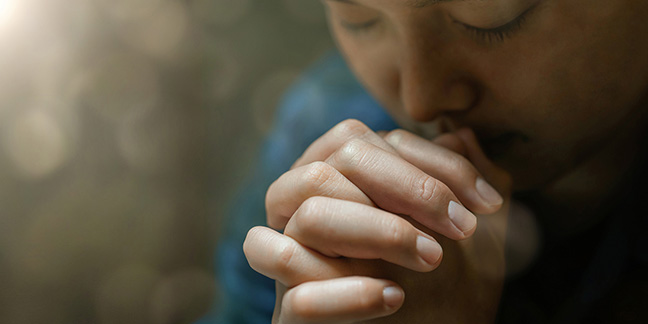
 What is prayer all about? Clement of Alexandria, a popular teacher of the early Church, put it simply: “Prayer is conversation with God.” Centuries later, St. Thérèse of Lisieux offered a similar sentiment, only more poetically:
“For me, prayer is a surge of the heart; it is a simple look turned toward heaven, it is a cry of recognition and of love, embracing both trial and joy.”
Like any conversation, it goes both ways. We talk to God, and He talks to us.
God loves us more than we can imagine. He wants us to get to know and love Him as a Father. Like any loving parent, He wants to spend time talking with His children. As we begin the Jubilee Year in which many are focused more on prayer, here are some commonly asked questions about the topic:
Q. What kind of conversation am I supposed to have?
A. Think of it this way: Imagine that someone saved your life through an act of great personal sacrifice. What kind of conversation would you want to have with that kind of benefactor?
You would no doubt want to offer an earnest thank you. You would be eager to praise the person’s kindness, generosity and selflessness. You would probably ask, “How can I ever repay you?”
Now think about what God has done for us. He created us and gives us life. Every good gift we have is from Him. When the human race turned away from Him and lost its way because of sin,
He made the most precious sacrifice possible to save us and bring us back to Himself: He sent His own son, Jesus Christ, to die for us.
What kind of conversation should you have with that kind of benefactor? For starters, you can express to Him sincere praise and thanks.
Q. Doesn’t prayer include asking God for something?
A. Of course! Think of a small child who is hungry. If the child comes to his father asking for food, the dad is delighted to answer that request. And if human fathers, Jesus reminded us, know how to give good gifts to their children when asked, “How much more will your Father who is in heaven give good things to those who ask Him!” (Mt 7:9-11).
In fact, most of the Our Father is devoted to this important aspect of prayer: petition. We ask God to provide for us (“our daily bread”), guide us (“lead us not into temptation”) and protect us (“deliver us from evil”). He cares about us, and He’s delighted to answer our prayers. “Have no anxiety about anything,” St. Paul insisted, “but in everything by prayer and supplication with thanksgiving let your requests be made known to God” (Phil 4:6). Just tell God what you need.
Q. What about praying for others?
A. Another important aspect of praying is intercession, which is prayer for others. St. Paul urged that intercessions “be made for all” (1 Tm 2:1).
Everyone has some need for God’s help. It’s your privilege to ask for it on their behalf. Even if you know that they themselves are praying, you can join them in their requests. Our heavenly
Father is pleased to see His children helping one another that way.
When you pray for others, you find that your own life changes. Your heart grows warmer toward people in need. You’re not as upset by the difficulties in your own life, because you’re more aware of the troubles other people have. You find yourself more willing to help people in other ways as well.
It’s not easy, but God calls us to pray even for our enemies. Jesus set the example. As He died on the cross, He prayed for His killers: “Father, forgive them” (Lk 23:34). Praying for people who have offended or injured us actually makes it easier to forgive them and to see them more as God sees them.
Q. Does God always hear our prayers?
A. We can have the same confidence Jesus had when he prayed: “Father … I (know) that you always hear me” (Jn 11:42). And God not only hears our prayers; He answers them as well. Nevertheless, His answer isn’t always the one we’re hoping to hear.
Sometimes we ask for the wrong things – things we would regret having if He gave them to us. Sometimes what we want doesn’t fit into the bigger, wiser plan He has for us and for those around us. Sometimes He’s allowing us to develop patience or to grow in some other way.
In any case, we can always pray to God in faith. That doesn’t mean we try to convince ourselves that everything we ever ask for, we’ll receive. Instead, it means that we pray with trust in the
Father who listens to our prayers, confident that He wants what’s best for us; He knows what’s best for us; and He’s able to give us what’s best for us. Our prayers should always ask for God’s will.
Q. How do I find the right words to pray?
A. God listens even when we’re not sure what to say. Catholics often pray using composed prayers. It’s called formal prayer, because it has a set “form,” rather than being spontaneous.
Jesus gave us a formal prayer when He taught his disciples the Lord’s Prayer (Mt 6:9-12). He and His apostles used formal prayers in worship, often from the Psalms, because this was the ancient custom of the Jewish people. The Church has followed their example in the Mass and in other settings. When Catholics pray using the words given us in Scripture and tradition, we are guided by these formal prayers as we search for words to express ourselves to God.
When we make these common prayers our own, we find ourselves praying in unity with the whole Church. We become part of a timeless, global community of prayer, a sign that we all belong
to “the household of God” (Eph 2:19).
An easy way to remember the different kinds of prayer is ACTS: A= Adoration; C= Contrition; T = Thanksgiving; and S = Supplication.
Q. How do I know when God is talking?
A. First, it’s important to give Him time to talk, a few quiet moments when you’re listening for him. On those occasions you may have thoughts or impressions come into your mind from God: a word of comfort, a solution to a problem, a prompting to take a particular action.
There are other ways to listen to God as well. Reading Scripture or spiritual books may allow Him to speak to you through the printed word. God may speak through others who say that you came to mind during their own prayer time. Sometimes God simply answers you through situations.
If you think God is saying something that puzzles or disturbs you, it’s a good idea to talk it over with a priest or another trusted friend.
Q. When should I pray?
A. We can pray anytime, of course, since God is always listening. Many Catholics even say little “mini-prayers” throughout the day as they go about their business, such as “Thank you, Lord,” or “Jesus, help me.” But over the centuries believers have also developed habits of praying at certain hours because they found it helped them to recognize God and seek His will at important junctures of the day.
Many people, for example, dedicate the day to God as soon as they wake up. Asking God’s blessing is an important way to begin meals and recognize our dependence on His provision. At bedtime, many Catholics review the day as it closes, examine their consciences, and say a prayer of confession and contrition.
— OSV News
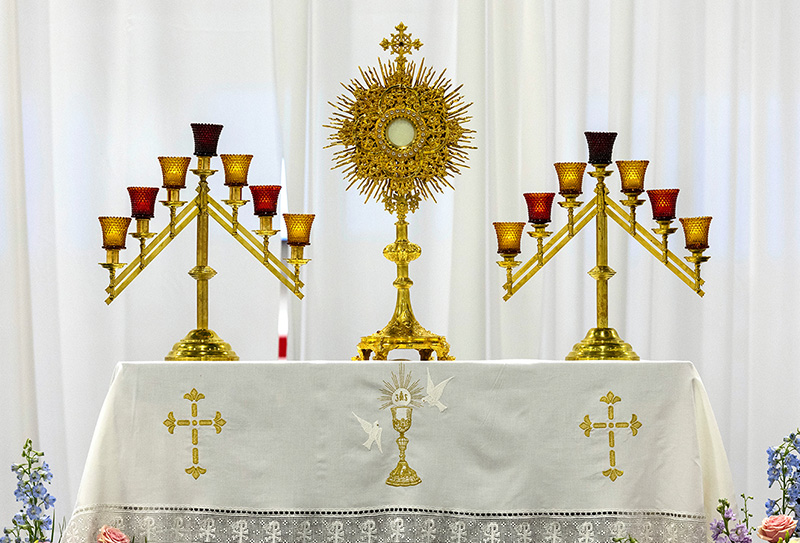
 Eucharistic Adoration is one of the more popular devotions among Catholics today, and it’s not hard to see why. The Second Vatican Council calls the Eucharist the “source and summit of the Christian life.” If you think about what that means, it’s pretty amazing. It means that the Eucharist is both where our life of faith begins and simultaneously the highest pinnacle to which we can ascend here on earth.
It rightly calls to mind Jesus saying, “I am the Alpha and Omega, the first and the last, the beginning and the end” (Rev 22:13). The Eucharist is the source and summit because the Eucharist is truly Christ present among us.
The normal context for celebrating and receiving the Eucharist is in the liturgy of the Mass, so where did the practice of Eucharistic Adoration start? According to Fr. John Hardon, SJ, in The History of Eucharistic Adoration, there is evidence of hermits keeping the Blessed Sacrament reserved in their cells from at least the third century. Since the earliest faith of the Apostolic Church testifies to belief in the Real Presence of Christ in the Eucharist, it follows that the reserved Eucharist would become a focal point of prayer and worship.
According to the Catechism of the Catholic Church, adoration is defined as “the first act of the virtue of religion” and the acknowledgement of God as “God, the Creator and Savior, the Lord and Master of everything that exists” (CCC 2096). In other words, adoration is what we commonly call “worship” today. Eucharistic Adoration simply means worship of God present in the Holy Eucharist. This is true whether the Eucharist is exposed on the altar or veiled within the tabernacle.
The Church encourages the faithful to make frequent visits to the Blessed Sacrament reserved in parish churches and chapels in order to “draw them into an ever deeper share in the paschal mystery” (Order for the Solemn Exposition of the Holy Eucharist).
Even if a church has limited scheduled times for Eucharistic exposition, any time spent worshiping Jesus sacramentally present in the tabernacle is a time of Eucharistic Adoration.
That being said, the practice of exposing the Eucharist on the altar for veneration by the faithful is to be encouraged. There are certain requirements for Eucharistic exposition, however. Even though there is a great degree of flexibility in what sorts of prayers or devotions may take place exposition, the rite of exposition is regulated by the liturgical norms of the Church.
The ordinary minister of exposition is a priest or deacon, although “if they are prevented by some good reason” the Eucharist may be exposed by “an [instituted] acolyte or by another extraordinary minister of Holy Communion, or someone deputed by the local Ordinary” (HC 91). Only an ordained minister may impart a blessing with the sacrament, which we call “benediction.” Most importantly, exposition of the Eucharist “may take place only if a suitable number of the faithful is expected to be present” (HC 86). The Church does not envision Eucharistic exposition as something done for individual devotion, but as an act of communal worship. There can be no adoration without adorers.
The liturgical texts of the Church allow for various forms of Eucharistic exposition, some more solemn and others more simple.
Many are accustomed to seeing the Eucharist exposed in a monstrance – a liturgical item that resembles a sunburst. Alternatively, the Eucharist may be simply exposed on the altar in a ciborium (the vessel used to hold the consecrated Eucharist in the tabernacle).
Whether simple or solemn, silent or full of Scripture and song, the time spent in prayer before Christ in the Sacrament is meant to, in the words of the Church, “extend that union with him, which [we] have reached in Communion, and renew that covenant, which urges [us] to maintain in [our] morals and [our] life what [we] have received in the celebration of the Eucharist” (HC 81).
In other words, the practice of Eucharistic Adoration is meant to extend our worship of Christ that flows from the sacrifice of the Mass, to deepen our desire for Holy Communion, and renew our commitment to live in such a way that bears witness to the presence of God among us and within us.
Deacon Matthew Newsome is the Catholic campus minister at Western Carolina University and the author of “The Devout Life: A Modern Guide to Practical Holiness with St. Francis de Sales,” available from Sophia Institute Press.