

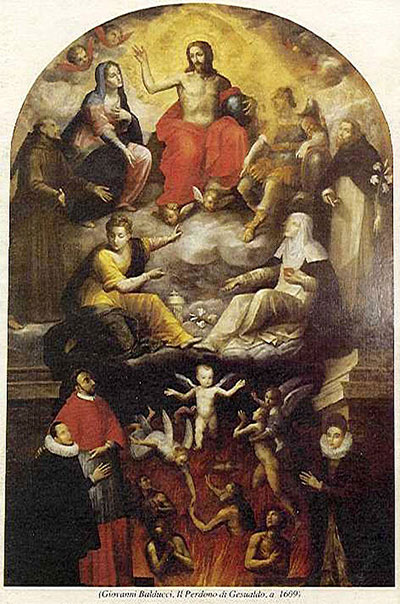
 In November, the Church celebrates the feast day of St. Charles Borromeo, whose contributions to the Council of Trent are noteworthy. The saint also had an interesting family tree: His uncle was Pope Pius IV and his nephew was Carlo Gesualdo, a composer who became infamous as a murderer.
Gesualdo, prince of Venosa, had incredible religious figures on both sides of his family. Besides his great-uncle the pope and St. Charles Borromeo, for whom he was named, he had a paternal uncle who served as dean of the College of Cardinals and later as archbishop of Naples.
Despite these holy family relations, Gesualdo led a troubled, inglorious life. He married his cousin at a young age and, when he discovered she was being unfaithful, he surprised his wife and her lover in an amorous moment. He killed them both on the spot. A widely publicized investigation of the sordid incident determined that the killing was justified, and Gesualdo was not charged.
His second marriage was only marginally more successful. He was physically abusive and unfaithful with a mistress who was accused and convicted of witchcraft. His second wife was terribly unhappy and went to great lengths to avoid living with him. Highly unstable, Gesualdo was a masochist who hired men to stay in his vicinity and ferociously beat him several times a day.
What is most interesting is his relationship to his uncle, the future St. Charles Borromeo, who was canonized in 1610. The composer died shortly afterwards in 1613, and his final wishes included a church to be built in his late uncle’s honor. Additionally, the composer commissioned a painting in 1609: “Il Perdono” (“The Pardon”), for its Santa Maria delle Grazie chapel. At the top of the painting is Christ, and counterclockwise to Him is Our Blessed Mother and St. Francis, to whom Gesualdo had a strong devotion. In the bottom left of the painting, Gesualdo kneels penitentially next to Borromeo, who is presenting him to Christ.
The fame of Gesualdo’s music lies primarily in his secular madrigals, which are extremely dissonant – so much so that nearly 200 years after they were composed, the famous English historian Charles Burney found them impossible to understand. Gesualdo also published three volumes of sacred music, all after 1600, in a style that is less dissonant than his secular music. A fine example is “O vos Omnes,” with a text from Lamentations 1:12, that Gesualdo wrote 10 years before his death in 1613. There are five voice parts – soprano, alto, tenor, quintus (or tenor II) and bass – with a scoring that focuses on the lower ranges to provide a darker sound. Also standard is the text painting with harsh intervals on “dolor” (sorrow).
Although it is only speculative, some scholars have viewed such works as “O vos Omnes” as evidence of Gesualdo’s remorse. The translation “O all ye that pass by the way, attend and see if there be any sorrow like to my sorrow” certainly gives one pause.
One may think it would be easy to become a saint if two of your uncles were archbishops and your great-uncle was a pope, yet Gesualdo shows us that holiness is not genetic.
— Christina L. Reitz, Ph.D.
More online
Listen to “O vos Omnes” by Carlo Gesualdo, the nephew of St. Charles Borromeo.
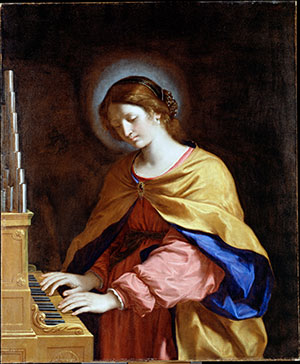 Because St. Cecilia is the patron saint of music, countless young girls, the author included, have chosen her for their patron saint. Other saints are connected to music, of course, such as St. Gregory the Great, for whom Gregorian chant is named, and St. Hildegard von Bingen, a phenomenal medieval composer. But St. Cecilia maintains a special place in the heart of Catholic musicians. November is a fitting month to feature St. Cecilia, whose feast day is Nov. 22.
Music has been written in her honor by both Catholic and non-Catholic renowned composers, such as Henry Purcell, F.J. Haydn and Benjamin Britten. G.F. Handel’s “Ode for St. Cecilia’s Day,” an extended work for chorus, soloists, orchestra and organ, is of particular interest.
The Baroque composer was born in Halle, Germany, where he studied organ with Friedrich Zachow. Handel was considerably more mobile than his contemporaries, absorbing musical influences from his native Germany as well as Italy, where he lived for a short time, and finally England, where he made his eventual home. When the English public lost interest in Italian opera, he turned to oratorios, the genre for which he is most remembered today. “Ode for St. Cecilia’s Day” dates to the late 1730s between two of his most important oratorios: “Israel in Egypt” and “Messiah.”
The text for Handel’s work derives from the 1687 “Song for St. Cecilia’s Day” by John Dryden, where each stanza is dedicated to a specific instrument – in order of appearance: the trumpet, flute, violin and organ.
The organ is the instrument that remained significant throughout the composer’s life, and it is the instrument with which St. Cecilia is most associated. Thus, the stanza mentioning the organ places it in the foreground rather than its usual place in the oratorio, filling in background harmonies beneath the orchestra and chorus.
The stanza about the organ, as printed in the 1865 Deutsche Händelgesellschaft edition, reads: “But oh! What art can teach, What human voice can reach The sacred Organ’s praise? Notes inspiring holy love, Notes that wing their heav’nly ways to join the choirs above.”
The movement begins with the organ playing sustained chords while the rest of the small orchestra (strings, bassoon and harpsichord) accompanies. Once the soprano enters with the text, the voice is given the place of primacy, which allows the listener to clearly understand the text. However, after each vocal statement of “sacred organ’s praise,” there is a small response echoed by the organ. A quiet, but profound, organ solo closes the work.
As the “Ode” progresses, a soprano sings a very brief number explaining how when St. Cecilia’s organ played, an angel heard the beautiful sound and confused earth with heaven. This is then followed by a grand chorus as only Handel could write.
The premiere of this work occurred on the Feast Day of St. Cecilia, Nov. 22, 1739. The immense popularity of Handel’s other choral works has certainly eclipsed the “Ode for St. Cecilia’s Day,” but it is still a profound work worthy of attention, particularly as we celebrate her feast day.
— Christina L. Reitz, Ph.D., Special to the Catholic News Herald. Christina L. Reitz, Ph.D., is a professor of music at Western Carolina University in Cullowhee.
Watch online
The Dunedin Consort, a Baroque ensemble based in Edinburgh, Scotland, performs the aria “But O! What Art Can Teach” from Handel’s “Ode for St. Cecilia’s Day.”