

 The feast day of St. Gregory on Sept. 3 falls at the time of year when church choirs are reconvening for rehearsal. Thus it is a good time to look into the music named after that saint: Gregorian chant.
Gregorian chant is often the most dreaded topic in music history; the notation, melodic style and language are foreign even to those who are “cradle Catholics.” The most significant developments in music history, however, can be found simply by following the evolution of chant from an oral to a notated tradition.
The history of chant is a complicated one, but the most comprehensive, accurate, modern scholarship is found with the Solesmes Benedictines, who played a significant role in the 19th-century restoration of chant.
Gregorian chant (or plainsong or plainchant) is named after St. Gregory the Great, who served as pope from 590 to 604. A legend emerged in the 9th century that St. Gregory received the chants from the Holy Spirit in the form of a dove who whispered them into his ear, and that they were written down by a scribe. However, we know that is impossible, since music notation did not exist during the 6th century. The current belief is that chant was organized and revised during Pope Gregory’s reign under his supervision. (Some scholars have speculated it was not even this Pope Gregory, but the 8th century Popes Gregory II and/or III).
Initially, chant was preserved through oral tradition, and different regions had their own repertoire (Gallican, Ambrosian, etc). The earliest notation was imprecise but eventually featured a single, horizontal line with the pitch name to the left of the line. Visible traces of this notation remain in the modern F and G clefs (bass and treble, respectively).
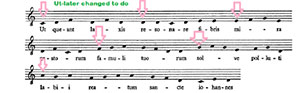
In approximately the year 1000, the idea of using multiple lines and spaces for notation emerged. Around the same time, Guido of Arezzo developed the sight-singing solfege syllables (do-re-mi-fa-sol-la-ti). He used a Latin chant from the Nativity of St. John the Baptist, where each phrase began with the next melodic step.
The original Latin reads: UT (now substituted with “do”) queant laxis REsonare fibris MIra gestorum FAmuli tuorum, SOLve polluti, LAbii reatum Sancte Johannes.
The seventh syllable, “ti,” was added later. Even today, musicians are singing part of this chant when using solmization (solfege).
Rather than “notes,” “neumes” were used for early notation. Similar to modern circular notes, neumes are square shaped and initially designated pitch only, not rhythm. Notating the length of each note became necessary only when a second melodic line was added.
The original chant (“vox principalis,” or principal voice) was initially the top line, but around the year 1100, it was moved to the bottom line and referred to as the “cantus firmus” (“fixed melody”). Because the chant was sacred, the pitches could not be changed, and thus the “melody” was “fixed.” With more musical lines, rhythmic notation was necessary to avoid harsh intervals sounding together. One interval in particular, the tritone, was called the “diabolus in musica” – the “devil in music.”
Chant remains relevant in contemporary Catholic Masses. When performed in tune by a professionally trained, literate musician, it provides reverence to the liturgy.
The month when St. Gregory the Great is honored would be a perfect time to prayerfully consider joining your parish’s music ministry.
— Christina L. Reitz
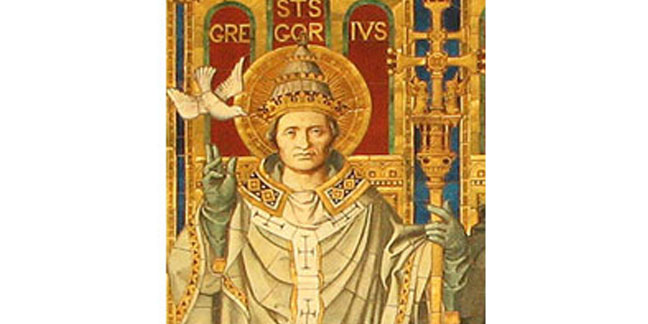 St. Gregory the Great, a central figure of the medieval western Church and one of the most admired popes in history, is commemorated in the Ordinary Form of the Roman Catholic liturgy on Sept. 3.
Born near the middle of the 6th century into a noble Roman family, Gregory received a classical education in liberal arts and the law. He also had strong religious formation from his devout family, particularly from his mother Silvia, also a canonized saint. By around the age of 30, Gregory had advanced to high political office in Rome, during what was nevertheless a period of marked decline for the city.
Some time after becoming the prefect of the former imperial capital, Gregory chose to leave the civil administration to become a monk during the rise of the Benedictine order. In reality, however, the new monk's great career in public life was yet to come.
After three years of strict monastic life, he was called personally by the pope to assume the office of a deacon in Rome. From Rome, he was dispatched to Constantinople to seek aid from the emperor for Rome's civic troubles and to aid in resolving the Eastern Church's theological controversies. He returned to Rome in 586 after six years of service as the papal representative to the eastern Church and empire.
Rome faced a series of disasters caused by flooding in 589, followed by the death of Pope Pelagius II the next year. Gregory, then serving as abbot in a monastery, reluctantly accepted his election to replace him as the Bishop of Rome.
Despite this initial reluctance, however, Pope Gregory began working tirelessly to reform and solidify the Roman liturgy, the disciplines of the Church, the military and economic security of Rome, and the Church's spreading influence in western Europe.
As pope, Gregory brought his political experience at Rome and Constantinople to bear in the task of preventing the Catholic Church from becoming subservient to any of the various groups struggling for control of the former imperial capital. As the former abbot of a monastery, he strongly supported the Benedictine movement as a bedrock of the western Church. He sent missionaries to England and is given much of the credit for the nation's conversion.
He is known above all for his magnificent contributions to the Liturgy of the Mass and Office. He is one of the four great Doctors of the Latin Church.
In undertaking these works, Pope Gregory saw himself as the "servant of the servants of God." He was the first of the Bishops of Rome to popularize the now-traditional papal title, which referred to Christ's command that those in the highest position of leadership should be "the last of all and the servant of all."
Even as he undertook to consolidate papal power and shore up the West during the crumbling of the Roman empire, St. Gregory the Great maintained a humble sense of his mission as a servant and pastor of souls from the time of his election until his death on March 12, 604. He is the patron of teachers.
— Catholic News Agency