

 I BELIEVE IN ONE GOD
Christians, like Jews and Muslims, believe that only one God exists. The creed states the assumption of the ancient Shema: "Hear O Israel, the Lord our God is one Lord." It begins with "I believe," because reciting the creed is ultimately an individual confession of belief, although the creed also expresses the collective beliefs of the Church.
THE FATHER ALMIGHTY
Jesus frequently calls God "Father" in the Scriptures, and this usage tells us that God is a loving God active within His creation. God the Father is the first person (Greek "hypostasis," "individual reality"), or distinction, within the Godhead. The Father is the "origin" or "source" of the Trinity. As such, God the Father is often called "God Unbegotten" in early Christian thought.
MAKER OF HEAVEN AND EARTH, OF ALL THINGS VISIBLE AND INVISIBLE
Catholics believe that God created the visible world (created matter) and the invisible one (spiritual world of angels, etc.). Thus, God created everything. Some early sects, such as the Gnostics, believed that God the Father created the spirit world, but that an "evil" god (called the "demiurge") created the similarly evil material world. The creed dispels such a notion.
I BELIEVE IN ONE LORD JESUS CHRIST
Jesus Christ is the Lord of all. The title Lord means that Jesus is master of all, and has connotations of deity, since the Hebrew word "adonai" and Greek word "kyrios" (both meaning Lord) were applied to Yahweh in the Old Testament. However, unlike earthly rulers, Jesus is a friend to the oppressed and a servant.
THE ONLY BEGOTTEN SON OF GOD
Jesus is in a unique relationship with God the Father. While Hebrew kings were sons of God symbolically (see Psalm 2), Jesus is the only Son of God by nature.
BORN OF THE FATHER BEFORE ALL AGES
Begotten has the meaning of born, generated, or produced. God the Son is born out of the essence of God the Father. Just as a child shares the same humanness as his or her parents, the Son shares the essential nature of God with the Father. Since God is eternal, the Son, being begotten of God, is also eternal.
GOD FROM GOD, LIGHT FROM LIGHT
God the Son exists in relation to God the Father. The Son is not the Father, but they both are God. Just as a torch is lit one to another, the Father and Son are distinct, but both light. Some Christians, called Sabellians or Modalists, wrongly said that the Father, Son, and Holy Spirit were one God who changes roles. So when God creates, He is Father, while on earth, He is Son, and so forth. However, the Scriptures have all three persons – Father, Son, and Holy Spirit – interacting at the same time, as shown at Jesus' baptism. St. Athanasius, writing during the Nicene era, said the Father and Son are one as "the sight of two eyes is one."
TRUE GOD FROM TRUE GOD
God the Son is not a half-god or inferior to God the Father. God the Son is fully and utterly God, distinct from the Father, yet not divided from the Father. The Arians said Jesus could be called god but not true God. In other words, they wrongly believed the Logos (the "Word," a popular title for Jesus in early Christian literature) was the first creation of God.
BEGOTTEN, NOT MADE
Some non-Christian people today (Jehovah's Witnesses) and in the past (Arians) have suggested God created Jesus like God would an angel. The creed tells us that just as when a woman gives birth she does not create a child out of nothing, being begotten of God, the Son is not created out of nothing. Since the Son's birth from the Father occurred before time was created, begotten refers to a permanent relationship as opposed to an event within time.
CONSUBSTANTIAL WITH THE FATHER
God the Father and God the Son are equally divine, united in substance and will. Father and Son share the same substance or essence of divinity. That is, the Father and Son both share the qualities and essential nature that make one in reality God. However, sharing the same substance does not mean they share identity of person.
THROUGH HIM ALL THINGS WERE MADE
The Bible tells us that through the Son, as Word of God, all things have been created.
FOR US MEN AND FOR OUR SALVATION, HE CAME DOWN FROM HEAVEN
Jesus came from heaven, from a spiritual reality other than our own. While the creed says "down," it is important to remember that our language is limited by time and spatiality. Heaven is not "up," just as God is not a biologically male father.
AND BY THE HOLY SPIRIT, WAS INCARNATE OF THE VIRGIN MARY, AND BECAME MAN
God the Son became incarnate in the person of Jesus of Nazareth. He was born of a virgin through the Holy Spirit. God truly became human in Jesus Christ. Catholics believe that Jesus of Nazareth was and is a real human being, not simply a spirit or ghost. The incarnation of God in Christ is the ultimate act of love, because rather than sending an angel or good human to accomplish the redemption and restoration of creation, God Himself became human.
FOR OUR SAKE HE WAS CRUCIFIED UNDER PONTIUS PILATE; HE SUFFERED DEATH AND WAS BURIED
Jesus died on a cross, suffered as humans do, truly died, and was laid in a tomb. Despite what some critics will level against it, the Nicene Creed is more than just metaphysical speculation, and includes important historical confessions. Notice that in addition to being "true God from true God," Jesus is fully human as well. The early Docetists, named from the Greek word "dokeo" ("to seem"), heretically believed Jesus only seemed to be human, but was not.
AND ROSE AGAIN ON THE THIRD DAY IN ACCORDANCE WITH THE SCRIPTURES
Jesus was resurrected bodily, as the Scriptures say. Just as Jesus truly died, He truly rose from the dead three days later. The bodily resurrection is the keystone of Christian doctrine and experience. However, Jesus was not just physically resuscitated (as was Lazarus), but rather His body was transformed at the Resurrection. Rejection of the bodily resurrection is a rejection of the foundation of Catholic Christianity. The word "again" is used because Jesus' first "rising" was His birth. To "rise again" is be alive again.
HE ASCENDED INTO HEAVEN AND IS SEATED AT THE RIGHT HAND OF THE FATHER
In ancient science, heaven was thought to be situated above the sky dome. So in the Scriptures, Jesus is said to ascend to heaven. Whatever happened that day, Luke had to render the event into his own scientific paradigm, so he said Jesus "went up" to heaven.
HE WILL COME AGAIN IN GLORY TO JUDGE THE LIVING AND THE DEAD, AND HIS KINGDOM WILL HAVE NO END
Jesus is coming again to righteously judge the living and dead. His kingdom cannot be destroyed, despite all of humanity's efforts. The creed says Jesus is coming; it does not say when or how, nor does it say to speculate on the date of His return.
I BELIEVE IN THE HOLY SPIRIT, THE LORD, THE GIVER OF LIFE
The Holy Spirit is also called "Lord." The Holy Spirit sustains our lives as Christians, illuminating us after the new birth. The original Creed of Nicaea simply ended with "We believe in the Holy Spirit." The other additions were approved at the Council of Constantinople in 381 A.D. However, most scholars believe that the text of the full creed dates prior to this council, and that the bishops simply gave their approval to a local creed already in use. The reason these additions were included in the Nicene Creed is that some heretics of the 4th century denied the full divinity of the Holy Spirit.
WHO PROCEEDS FROM THE FATHER AND THE SON
The Son is said to be begotten, while the Spirit is said to proceed. Both words convey that the Son and Spirit are in special relationships to the Father, yet also fully divine. The phrase "and the Son" (in Latin, "filioque,") was not in the original text of the creed, but was added in many Western Churches in the late 6th century. The addition likely developed over time as a tool against Arianism. There are theological and historical justifications for the addition or exclusion of the filioque. The Eastern Churches oppose the addition of the filioque, while many Western churches accept it. Actually, despite current division on the matter, the issue has been pretty much theologically resolved. The Catholic Church acknowledges the Father is the sole source within the Trinity, and admits that "proceeds from the Father and the Son" means "proceeds from the Father through the Son."
WHO WITH THE FATHER AND THE SON IS ADORED AND GLORIFIED
The Holy Spirit is God as are the Father and the Son, and worthy of the same worship.
WHO HAS SPOKEN THROUGH THE PROPHETS
The Spirit inspired the prophets of old and inspires the Church today.
I BELIEVE IN ONE, HOLY, CATHOLIC AND APOSTOLIC CHURCH
The creed requires belief in the Catholic (universal) Church, whose origins go back to the Apostles themselves. The Church is "holy" on account of Christ's holiness and grace, and not because its members or leaders are perfect. In fact, at times throughout history, the Church has remained holy in spite of its members.
I CONFESS ONE BAPTISM FOR THE FORGIVENESS OF SINS
Catholics believe that sacramentally, through the waters of baptism, God forgives us of our sins, and we are born again. This belief is universally acknowledged in early Christian writings. If someone has been validly baptized in the name of the Trinity, re-baptism is unnecessary.
AND I LOOK FORWARD TO THE RESURRECTION OF THE DEAD, AND THE LIFE OF THE WORLD TO COME. AMEN.
Christians always hope for the end of this fractured system, when the universe is fully reconciled to God in Christ Jesus. The Nicene Creed affirms both the existence of a soul-filled heaven and the later resurrection of the dead when soul meets glorified body.
— SOURCE: "THE NICENE CREED: SYMBOL OF THE CATHOLIC FAITH," BY DAVID BENNETT, CO-EDITOR OF THE WEBSITE ANCIENT AND FUTURE CATHOLICS, ONLINE AT WWW.ANCIENT-FUTURE.NET
Where did the Nicene Creed come from?
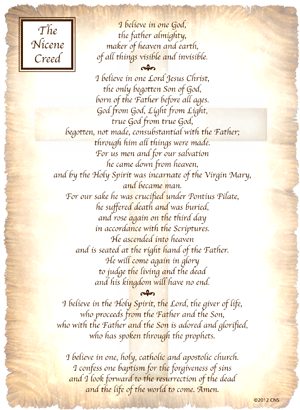 The Nicene Creed is the declaration of the Christian faith for all Catholics and Orthodox as well as many Protestants. It is also called the Niceno-Constantinopolitan Creed, because it was defined at the Councils of Nicaea (325 A.D.) and Constantinople (381 A.D.).
The Nicene Creed explains the Church's teachings about the Trinity and affirms historical realities of Jesus' life. The creed does not directly quote Scripture, but it is based on biblical truths.
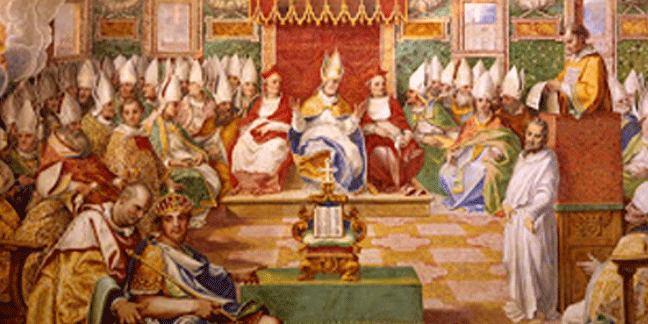
The Council of Nicaea was the first general council of the Church since the Apostolic Council of Jerusalem, which set conditions for Gentiles to join the Church. Roman persecution of Christians had just ended 12 years earlier, but now the Church was divided over the question of Jesus' divinity. Heretics led by a priest named Arius in Alexandria, Egypt, claimed that if Jesus was begotten by God, He must have had a beginning like every other part of God's creation – therefore, Jesus was not fully God.
The theological dispute threatened the peace of the Roman empire, so Emperor Constantine – at the request of several concerned bishops – called for a meeting of all the Church's bishops in the easily accessible town of Nicaea (present-day Iznik, Turkey), organized like the Roman Senate with himself as a non-voting observer. The council met in Senatus Palace (which now lies under Lake Iznik).
An estimated 318 bishops came from Rome, Jerusalem and Palestine, Egypt, Syria, Greece, Asia Minor, Persia, Georgia, Armenia, Gaul, Hispania and the Danube. Among them were Pope St. Silvester, St. Nicholas of Myra, St. Eusebius of Caesarea (considered the Church's first historian), St. Athanasius and St. Alexander of Alexandria. Each bishop could bring up to two priests and three deacons, so the total attendance could have been as many as 1,800.
Many of the bishops had the marks of persecution on their faces – they had faced the threat of death for their faith and they were sensitive to details of doctrine. These were not wishy-washy men.
The council's main purpose was to quash the Arian heresy and settle the doctrine of the Trinity – that God, Jesus and the Holy Spirit were three divine persons in complete union. The term "Trinity" was not new, of course. Besides Jesus' references to it in Scripture, many early Church fathers had written about it from the 1st century onward.
Besides the Arian heresy, the council fathers wanted to settle the date for celebrating Easter, and they had to contend with various practical problems such as usury and self-castration.
On May 20, 325, the council opened. It is likely they had a draft from Bishop Hosius of Cordova to consider, as several creeds were already in use by Christians to identify themselves, and as a means of inclusion and recognition, especially at baptism. In Rome, for example, the Apostles' Creed was popular.
After being in session for an entire month, the council promulgated on June 19 the original Nicene Creed, written in Greek. All but two of the bishops, who were Arian sympathizers, approved the text. Those two bishops, as well as Arius, were excommunicated and exiled.
Besides the creed, the council decided that the date for Easter should be calculated uniformly and separate from the Jewish calendar, using the lunar calendar instead. But it took centuries for the calculations to be worked out in practice, and disagreement remains between Catholics in the West and Orthodox in the East.
The council also promulgated 20 new church laws, called canons. These included: prohibiting self-castration (which some had thought was a path to greater holiness), prohibiting young women from entering a cleric's home; requiring bishops to be ordained in the presence of at least three other bishops; prohibiting the removal of priests; forbidding usury among the clergy; determining the order of bishops, then priests, then deacons receiving Holy Communion; declaring invalid any baptisms done by heretics; acknowledging the special authority of the patriarchs of Rome, Alexandria and Antioch in their respective regions; and setting a minimum time frame for catechumens to prepare for baptism.
The long-term effects of the Council of Nicaea were significant. For the first time, leaders of the Church convened to agree on a doctrinal statement. In the short term, however, the council did not stamp out the heresy it was convened to discuss, and upheaval continued for some time even after Arius himself died.
It was only a few years after the Council of Nicaea that Arius returned to Constantinople and asked to be readmitted to the Church. But Arius did not renounce his heresy, so the Church refused. Emperor Constantine intervened in the dispute, setting a date for Arius to attend Mass and be forcibly readmitted to Communion. While he was waiting for Constantine to arrive so he could go into Mass, Arius stopped to relieve himself. His bowels burst out of his body, and he died instantly.
The Nicene Creed did not become a part of Mass until the early 6th century, when Patriarch Timothy of Constantinople started the practice to combat heresy. Its popularity spread throughout the Byzantine Empire, then to Spain, France and northern Europe. In 1114 Emperor Henry II, who had come to Rome for his coronation as Holy Roman Emperor, was surprised that they did not recite the creed. He was told that since Rome had never erred in matters of faith there was no need for the Romans to proclaim it at Mass. However, it was included in deference to the new emperor and has pretty much remained ever since – not at daily Mass, but on Sundays and feast days.
The Nicene Creed expressed what the early leaders of the Church found to be Biblical, traditional and orthodox in their Christian faith – a faith in Jesus Christ that we continue to proclaim 1,700 years later.
— Sources: The Catholic Encyclopedia, "The Seven Ecumenical Councils of the Undivided Church" edited by Philip Schaff, David Bennett of Ancient and Future Catholics, Dr. Steve Brandt of Columbia University (New York), Wikipedia
The Nicene Creed: The prayer for the Year of Faith
The Vatican has issued special prayer cards for the Year of Faith featuring the Nicene Creed on one side and the image of Christ Pantocrator on the other.
The Nicene Creed is the ultimate prayer of our Catholic Christian faith, and so it is the prayer for this Year of Faith: "It is by believing with the heart that you are justified, and by making the declaration with your lips that you are saved. May the Year of Faith lead all believers to learn by heart the Creed and to say it every day as a prayer, so that the breathing agrees with the faith," the Vatican's Year of Faith website states.
To obtain copies of this prayer card, contact the Libreria Editrice Vaticana at This email address is being protected from spambots. You need JavaScript enabled to view it.
 How often should we go to Mass? Practicing Catholics know that it’s important to attend Mass on Sundays, but every now and then a “holy day of obligation” may sneak up on us if we aren’t paying attention to the liturgical calendar.
These are days that usually carry the same obligation to participate at Mass as a Sunday. Coming out of the holiday season, we just had two of them: The Nativity of the Lord on December 25 and the Solemnity of Mary, Mother of God, on January 1. It seems fitting to mark both the end and beginning of the year with special days of worship.
In addition to those, there are four other days in the United States when the faithful are obliged to worship at Mass. Those are the solemnities of the Ascension of the Lord on Thursday of the sixth week of Easter (which is transferred to Sunday in many provinces), the Assumption of Mary on August 15, All Saints Day on November 1, and the Immaculate Conception on December 8. These are the days, in addition to Sundays, that the Church has decided also carry a special obligation due to the importance of the mysteries they commemorate.
According to Canon Law, our obligation on Sundays and these certain other holy days is to participate in the Mass and “to abstain from those works and affairs which hinder the worship to be rendered to God, the joy proper to the Lord’s day, or the suitable relaxation of mind and body” (CIC 1247). This is how Christians observe the divine command to “remember the sabbath and keep it holy” (Ex 20:8). We refrain from servile work so that we may be free to worship, but also to celebrate and relax. The joy and rest of the Lord’s Day should be something of a foretaste of the joy and rest of heaven.
A blessing or a burden?
That the Church obliges us to set aside certain days for worship and rest sounds like a blessing – and it is – but the sad reality is that many Catholics receive it as more of a burden. According to the Pew Research Center, only 28% of Catholics surveyed in the United States say they attend Mass weekly, and at most parishes, the pews are emptier on other holy days than they are on Sundays, Christmas being the lone exception.
To be fair, the obligation to worship on Sundays and holy days is not an absolute obligation. If it were, there would never be a valid reason to miss Mass. But it is a serious obligation, which means Mass should only be missed for serious reasons. The Catechism of the Catholic Church mentions illness or the care of infants as examples (CCC 2181). Dangerous travel conditions would be another. It is no sin if you cannot get to Mass due to circumstances beyond your control.
A matter of justice
But many who can come to Mass simply don’t. The reasons are many, but one is a modern tendency to eschew the notion of obligation. We don’t like having expectations forced upon us or being told what to do. This is why some have taken to speaking of “holy days of opportunity” in an attempt to make worship sound like more of a gift than a chore.
To be able to worship the Almighty God in the Eucharistic sacrifice is indeed a great gift. But it is also something we are bound to do as a matter of justice, which is why the Church rightly speaks of an obligation to participate at Mass. Justice imposes obligations on us in many arenas. Justice obliges us to obey laws as members of a society. It obliges us to care for our home as members of a family. If obliges us to perform our job duties well.
The virtue of charity also comes with obligations. It may sound loving to say, “I cook dinner for my family not because I have to but because I want to,” but it is more reflective of charity to say,
“I cook dinner for my family even when I don’t want to because I love them.” Being dutiful in our obligations even when it’s inconvenient is an important way we show our love for others.
Perhaps we don’t appreciate our obligation to worship because we have forgotten that it is not principally for ourselves.
For the good of all
People today often speak about what they “get out of” going to Mass – and indeed, the spiritual benefits are great! But the priests of ancient Israel chiefly offered sacrifice to God on behalf of others. They understood their work of worship to be for the good of the people. This is why Israel adopted the Greek word “leitourgia” (a public work) to describe their sacred worship. It is from this term that we derive the word “liturgy.” Liturgical worship is not a matter of private piety but a work done for the good of the people.
Christ offered himself as the perfect sacrificial offering to the Father once and for all. By virtue of our baptism, Christians are made part of His Body and part of His offering. That means we have a part to play in Christ’s sacrifice. The Eucharist is how we participate sacramentally in that offering. The liturgy is the work of the whole Body of Christ, and when part of the Body is missing, it affects the whole. This is why the Church obliges us to participate in Mass on certain days; not out of an authoritarian need for control, but because our presence matters. You matter – and when you are not there, you are missed! See you at Mass!
— Deacon Matthew Newsome is the Catholic campus minister at Western Carolina University and the author of “The Devout Life: A Modern Guide to Practical Holiness with St. Francis de Sales,” available from Sophia Institute Press.