

‘Veni Sancte Spiritus’
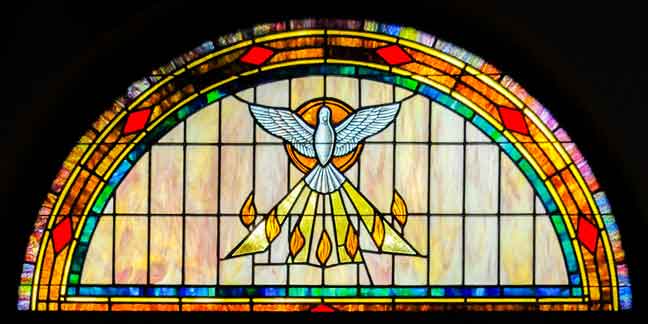 Pentecost is the feast of the universal Church that commemorates the descent of the Holy Spirit upon the Apostles, 50 days after the Resurrection of Christ, on the ancient Jewish festival called the “feast of weeks” or Pentecost (Ex 34:22; Deut 16:10), which marks the end of Passover. Jews celebrate the gift of the law to Moses at Mount Sinai on this day, but we as Catholics celebrate the birth of the Church.
At Pentecost, Peter, Mary, the apostles and their followers were gathered in a room in Jerusalem, where Jews from all over the world were still in town celebrating the end of Passover.
At this time, a great wind blew and a flame appeared as a tongue of fire, which split itself into many individual flames above the heads of all those present. The Holy Spirit came upon these people and each began to speak in tongues. Despite the fact many had no common language, they were perfectly able to understand one another.
Others, who were not so blessed, accused those speaking in tongues of being drunk, but Peter arose and addressed the crowd, explaining that it was only 9 o’clock, and that this phenomenon was not intoxication, but rather was the work of the Holy Spirit, prophesied in the Scriptures. Peter then called all those present to be baptized, and about 3,000 people were baptized that day.
These people were among the first Catholics, and Peter is the first pope of the Church.
The symbols of Pentecost are the flame, wind and the dove, which represent the Holy Spirit. The color of Pentecost is red, and the priest wears red vestments on this day. Parishioners are also invited to wear red. Red decorations as well as celebrations are appropriate, similar to any other birthday.
Pentecost is also called Whitsunday, so called from the white garments worn by catechumens remaining after Easter who were baptized during the vigil Mass. Whitsunday dates back to the first century, although there is no evidence that it was observed as there is in the case of Easter; the passage in 1 Corinthians (16:8) probably refers to the Jewish feast.
— Catholic Encyclopedia, Catholic Online
Did you know?
“Veni Sancte Spiritus” (“Come Holy Spirit”) sometimes called the “Golden Sequence,” is a sequence hymn prescribed in the Roman liturgy for the Masses of Pentecost. A sequence hymn is sung just before the Alleluia (Gospel acclamation).
It is usually attributed to either the 13th-century Pope Innocent III or to the Archbishop of Canterbury, Cardinal Stephen Langton. (Cardinal Langton was a central figure in the dispute between King John of England and Pope Innocent III that helped lead to the issuing of the Magna Carta in 1215, one of the first charters that guaranteed the rights of commoners and restricted the “divine right” of kings. He is also credited with having divided the Bible into the standard arrangement of chapters still used today.)
It is one of only four medieval sequences preserved in the Missale Romanum published in 1570 following the Council of Trent (1545-1563). Before Trent, many feasts had their own sequences. It is still sung today, having survived the liturgical changes following the Second Vatican Council. The other feasts with sequence hymns are: Easter,
“Victimae Paschali Laudes” (“To the Paschal Victim give praise”); Corpus Christi, “Lauda Sion” (“Praise O Sion”); and All Souls, “Dies Irae” (“Day of Wrath”).
Come, Holy Spirit, come!
And from your celestial home
Shed a ray of light divine!
Come, Father of the poor!
Come, source of all our store!
Come, within our bosoms shine.
You, of comforters the best;
You, the soul’s most welcome guest;
Sweet refreshment here below;
In our labor, rest most sweet;
Grateful coolness in the heat;
Solace in the midst of woe.
O most blessed Light divine,
Shine within these hearts of yours,
And our inmost being fill!
Where you are not, we have naught,
Nothing good in deed or thought,
Nothing free from taint of ill.
Heal our wounds, our strength renew;
On our dryness pour your dew;
Wash the stains of guilt away:
Bend the stubborn heart and will;
Melt the frozen, warm the chill;
Guide the steps that go astray.
On the faithful, who adore
And confess you, evermore
In your sevenfold gift descend;
Give them virtue’s sure reward;
Give them your salvation, Lord;
Give them joys that never end.
Amen. Alleluia.
 Catholics honor St. Athanasius on May 2. The fourth century bishop, Father of the Church and Doctor of the Church is known as "the father of orthodoxy" for his absolute dedication to the doctrine of Christ's divinity.
St. Athanasius was born to Christian parents living in the Egyptian city of Alexandria in 296. His parents took great care to have their son educated, and his talents came to the attention of a local priest who was later canonized as St. Alexander of Alexandria. The priest and future saint tutored Athanasius in theology, and eventually appointed him as an assistant.
Around the age of 19, Athanasius spent a formative period in the Egyptian desert as a disciple of St. Anthony in his monastic community. Returning to Alexandria, he was ordained a deacon in 319, and resumed his assistance to Alexander, who had become a bishop. The Catholic Church, newly recognized by the Roman Empire, was already encountering a new series of dangers from within.
The most serious threat to the fourth-century Church came from a priest named Arius, who taught that Jesus could not have existed eternally as God prior to His historical incarnation as a man. According to Arius, Jesus was the highest of created beings, and could be considered "divine" only by analogy. Arians professed a belief in Jesus' "divinity," but meant only that He was God's greatest creature.
Opponents of Arianism brought forth numerous scriptures which taught Christ's eternal pre-existence and His identity as God. Nonetheless, many Greek-speaking Christians found it intellectually easier to believe in Jesus as a created demi-god, than to accept the mystery of a Father-Son relationship within the Godhead. By 325, the controversy was dividing the Church and unsettling the Roman Empire.
In that year, Athanasius attended the First Ecumenical Council, held at Nicea to examine and judge Arius' doctrine in light of apostolic tradition. It reaffirmed the Church's perennial teaching on Christ's full deity, and established the Nicene Creed as an authoritative statement of faith. The remainder of Athanasius' life was a constant struggle to uphold the council's teaching about Christ.
Near the end of St. Alexander's life, he insisted that Athanasius succeed him as the Bishop of Alexandria. Athanasius took on the position just as the Emperor Constantine, despite having convoked the Council of Nicea, decided to relax its condemnation of Arius and his supporters. Athanasius continually refused to admit Arius to communion, however, despite the urgings of the emperor.
A number of Arians spent the next several decades attempting to manipulate bishops, emperors and Popes to move against Athanasius, particularly through the use of false accusations. Athanasius was accused of theft, murder, assault, and even of causing a famine by interfering with food shipments.
Arius became ill and died gruesomely in 336, but his heresy continued to live. Under the rule of the three emperors that followed Constantine, and particularly under the rule of the strongly Arian Constantius, Athanasius was driven into exile at least five times for insisting on the Nicene Creed as the Church's authoritative rule of faith.
Athanasius received the support of several popes and spent a portion of his exile in Rome. However, the Emperor Constantius did succeed in coercing one Pope, Liberius, into condemning Athanasius by having him kidnapped, threatened with death, and sent away from Rome for two years. The pope eventually managed to return to Rome, where he again proclaimed Athanasius' orthodoxy.
Constantius went so far as to send troops to attack his clergy and congregations. Neither these measures, nor direct attempts to assassinate the bishop, succeeding in silencing him. However, they frequently made it difficult for him to remain in his diocese. He enjoyed some respite after Constantius' death in 361, but was later persecuted by Emperor Julian the Apostate, who sought to revive paganism.
In 369, Athanasius managed to convene an assembly of 90 bishops in Alexandria, for the sake of warning the Church in Africa against the continuing threat of Arianism. He died in 373, and was vindicated by a more comprehensive rejection of Arianism at the Second Ecumenical Council, held in 381 at Constantinople.
St. Gregory Nazianzen, who presided over part of that council, described St. Athanasius as "the true pillar of the Church," whose "life and conduct were the rule of bishops, and his doctrine the rule of the orthodox faith."
— Catholic News Agency
Read more about the Doctors of the Church and the Fathers of the Church