

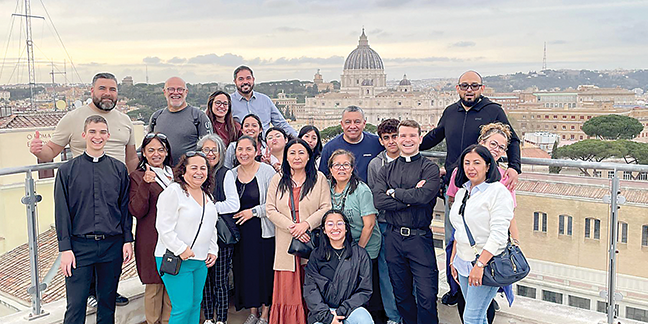
 Deacon Matthew Newsome and pilgrims from Charlotte are pictured in Rome with the dome of St. Peter’s Basilica in the background. What you pack – and choose to leave behind – can help shape your faith journeys, both physically and spiritually. (Photo provided by Deacon Matthew Newsome) I wrote this just a few short days before I led a Jubilee Year pilgrimage to Rome and other shrines in Italy. That meant I had some packing to do. So naturally, I opted to write about packing as a means of procrastination.
My habit when I fly is to limit myself to one carry-on. This propensity to travel light grew out of my first experience backpacking. When I was newly out of college, a friend invited me to join him on a multi-day excursion in the Great Smoky Mountains National Park. It was my first time undertaking such an endeavor, and not knowing what to expect, I took the Boy Scout motto to heart: “Always be prepared.”
The problem was, I was no Boy Scout. Had I been, I would have known that being prepared has more to do with physical and mental readiness than strapping an entire general store to your back.
All those “just in case” items I carried through the mountains only weighed me down and wore me out. Rather than helping me along the way, they made the journey more difficult. Ever since then, I have been more judicious about what I take with me.
What do you need?
Packing lightly forces me to be more discerning about what is and isn’t necessary. Do I need a different outfit for every day of my trip, for example? The answer is no. Some things, like medications, are a must, but many other items are luxuries. I find it a useful challenge to see how much I can do without, especially when it’s only a matter of days.
Jesus imposed rather strict baggage limits for His missionary disciples: “Take nothing with you for your journey, no staff, nor bag, nor bread, nor money; and do not have two tunics” (Lk 9:3). The classic interpretation of this text is that Christ was teaching His apostles to rely on God, trusting that He would provide for them through the hospitality of others.
Later He instructs them, “Do not be anxious about your life, what you shall eat, nor about your body, what you shall put on. For life is more than food, and the body more than clothing. Consider the ravens: they neither sow nor reap, they have neither storehouse nor barn, and yet God feeds them. Of how much more value are you than the birds!” (Lk 12:22-24).
He imparts this wisdom after telling the parable of a rich man who builds larger and larger barns to store his surplus crops, thinking he would “eat, drink and be merry,” until God says to him, “Fool! This night your soul is required of you; and the things you have prepared, whose will they be?” (Lk 12:16-20). Jesus provides the moral of this parable up front: “Beware of covetousness; for a man’s life does not consist in the abundance of his possessions” (Lk 12:15).
As Job so poignantly observed, “Naked I came from my mother’s womb, and naked I shall return” (Jb 1:21). We all enter this world with nothing, and so shall we leave it. The wise Christian ought therefore to have a sense of detachment from the goods of this world, most of which cannot fit in an overhead compartment.
Learning to travel with only the bare necessities can help us not only learn to rely on God’s providence, but also teach us to receive His blessings with greater gratitude. Not being weighed down by either physical or spiritual baggage allows our hearts to soar more freely to the heights.
Most of our baggage isn’t material
As the Church reminds us in this Jubilee Year of Hope, our time on earth is meant to be a pilgrimage to heaven. Most of the baggage we carry on life’s journey isn’t material.
We carry around things like grudges, anger, hurt feelings, resentment, a sense of entitlement or self-righteousness. These are heavy burdens that only serve to weigh us down. Why do we cling to them so dearly?
We can grow so accustomed to carrying our personal baggage around with us that we forget who we are without it. The prospect of letting go can be frightening, but learning to do so is a vital part of our pilgrimage.
My earliest memories of packing are of preparing for weekend trips to my grandparents’ house. Mom and Dad would make sure we had the necessities, such as toothbrushes and clean clothes, while we children focused on packing toys and other diversions. Afraid of being bored, we wanted to bring as many playthings with us as we could. Of course, we were never bored at Grandma’s house. There were always cousins to play with, backyard adventures to be had and story books to read on Grandaddy’s lap. More often than not, we would forget all about our toys, leaving them packed away in our bags, untouched. All the things we thought we couldn’t live without proved to be unimportant once we reached our destination.
In the Father’s house, all our needs will be met. We needn’t worry about lacking a thing. Therefore, as we travel along our earthly pilgrimage, let us travel lightly, letting go of our burdens so that our hands and hearts may be open to receive all the blessings our Lord can give us. Godspeed to each of you along the journey.
Deacon Matthew Newsome is the Catholic campus minister at Western Carolina University and the author of “The Devout Life: A Modern Guide to Practical Holiness with St. Francis de Sales,” available from Sophia Institute Press.
 Doctors of the Church are great saints known for their defense and explanation of the truths of the Catholic faith. The original eight Doctors of the Church were named by acclamation, or common acknowledgment; the rest have been named by various popes, starting with the addition of St. Thomas Aquinas to the list by Pope St. Pius V in 1568.
This title indicates that the writings and preachings of such a person are useful to Christians "in any age of the Church." Such men and women are also particularly known for the depth of understanding and the orthodoxy of their theological teachings. While the writings of the Doctors are often considered inspired by the Holy Spirit, this does not mean they are infallible. It does mean that they contributed significantly to the formulation of Christian teaching in at least one area.
Today, there are 35 Doctors of the Church: 27 from the West and 8 from the East; four women; 18 bishops, 12 priests, one deacon, three nuns and one consecrated virgin; 26 from Europe, three from Africa, six from Asia. Who are they? (Follow the links below to read more about each doctor.)
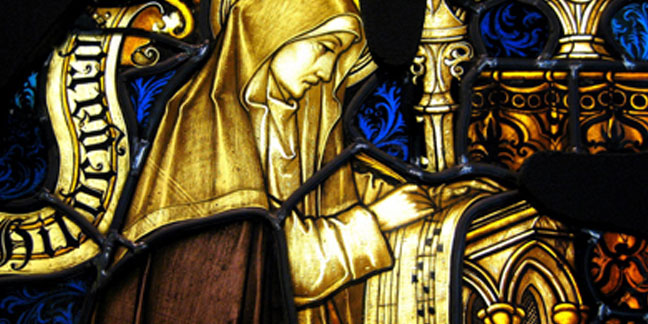
Pictured: A stained-glass image of St. Hildegard of Bingen, the newest Doctor of the Church, depicting her at work composing hymns
LATIN (WESTERN) DOCTORS
1 – St. Ambrose, 340-397 (Pastoral Doctor): Archbishop of Milan, one of the most influential Church figures of the 4th century.
2 – St. Jerome, 345-420 (Doctor of Biblical Science): A Christian apologist, best known as the translator of the Bible from Greek and Hebrew into Latin, what's known as the Vulgate.
3 – St. Augustine, 354-430 (Doctor of Grace): Bishop of Hippo, philosopher and theologian, and one of the most important figures in the Church.
4 – Pope St. Gregory the Great, 540-604 (Doctor of Hymnology): The first pope with a monastic background.
GREEK (EASTERN) DOCTORS
5 – St. Athanasius, 295-373 (Doctor of Orthodoxy): Remembered for his role in the conflict with Arianism and for his affirmation of the Trinity. He argued against political leaders and errant theologians so much and was exiled so often that he earned the nickname "Athanasius Contra Mundum" (Athanasius Against the World").
6 – St. Basil the Great, 330-379 (Doctor of Monasticism): Noted scholar, lawyer and public speaker, he converted from paganism in a dramatic fashion: selling everything he had, giving the money to the poor, and becoming a monk. His Monastic Rule forms the basis of virtually all religious life in the Eastern Churches. He, his brother, St. Gregory of Nyssa, and his best friend, St. Gregory Nazianzus, are known as "the Cappadocian Fathers" after the region of Asia Minor (modern Turkey) from which they came.
7 – St. Gregory Nazianzus, 330-390 (Doctor of Theologians, Doctor of the Trinity): Archbishop of Constantinople who once was attacked during Mass by an Arian mob, which wounded him and killed a fellow bishop. Convened the Ecumenical Council in Constantinople in 381 to resolve questions about the Nicene Creed and help unify the Eastern and Western Churches, but got so frustrated that he resigned in the middle of it.
8 – St. John Chrysostom, 345-407 (Doctor of Preachers): Perhaps the greatest preacher in Church history. Known for his eloquence in preaching and public speaking, he was nicknamed "chrysostomos" (Greek for "golden tongued"). The themes of his talks were always practical, explaining how to apply the Bible in everyday life, and he lived a simple, unpretentious lifestyle even after being pushed into becoming archbishop of Constantinople. There he denounced the lavish lifestyles of local Church and political leaders – making him popular with the laity but causing his exile to a desolate area along the Black Sea, where he died from ill health.
EARLY CHURCH DOCTORS
9 – St. Ephraem, 306-373 (Doctor of Deacons and Poets): Died tending plague victims in 373.
10 – St. Hilary of Poitiers, 315-368 (Doctor of Christ's Divinity): Sometimes called the "Hammer of the Arians," so popular that he was unanimously elected bishop of Poitiers in Gaul (modern France) in about 353.
11 – St. Cyril of Jerusalem, 315-387 (Doctor of Faith and against Heresy): Bishop of Jerusalem who was deposed and exiled more than once by jealous opponents. Disagreed at first with the Nicene Creed's clause that Jesus is "consubstantial with the Father," but by the Ecumenical Council of 381 he voted for the wording, seeing no better alternative to unifying the Eastern and Western Churches.
12 – St. Cyril of Alexandria, 376-444 (Doctor of the Incarnation): Bishop of Alexandria when the city was at its height of influence and power within the Roman Empire. He wrote extensively and was a leading defender of Christ's identity as fully divine and fully human.
13 – Pope St. Leo the Great, 390-461 (Doctor of Doctrine): First pope to have been called "the Great," reaffirmed papal authority, perhaps best known for having met Attila the Hun in 452 and persuading him to turn back from his invasion of Italy.
14 – St. Peter Chrysologus, 400-450 (Doctor of Homilies): Made Bishop of Ravenna, Italy, in about 433 by Pope Sixtus III, after Sixtus had a vision of St. Peter and St. Apollinaris (the first bishops of Rome and Ravenna) showed him a young man and said he would be the next Bishop of Ravenna. When Sixtus met Peter shortly afterwards, he recognized him as the young man in his vision and consecrated him as bishop even though he was only a deacon at the time.
15 – St. Isidore, 560-636 (Doctor of Education): Archbishop of Seville for more than three decades. At a time when the remnants of the Roman Empire were crumbling and aristocratic violence and illiteracy were spreading, he helped convert the royal Visigothic Arians to Catholicism and played a prominent role in developing Visigothic legislation – regarded by historians as having influenced the beginnings of representative government.
16 – St. Bede the Venerable, 673-735 (Doctor of English History)
17 – St. John Damascene, 676-749 (The Icon or Image Doctor, or Doctor of the Assumption): A Syrian Christian monk and priest, and the last of the Church Fathers. Wrote extensively on the Assumption of Mary.
18 – St. Peter Damian, 1007-1072 (Doctor of Reform and Renewal)
MIDDLE AGE CHURCH DOCTORS
19 – St. Anselm, 1033-1109 (Doctor of Scholasticism)
20 – St. Bernard of Clairvaux, 1090-1153 (Devotional and Eloquent Doctor)
21 – St. Anthony of Padua, 1195-1231 (Evangelical Doctor)
22 – St. Albertus Magnus, 1200-1280 (Doctor of Science)
23 – St. Bonaventure, 1217-1274 (Seraphic Doctor)
24 – St. Thomas Aquinas, 1225-1274 (Angelic Doctor)
25 – St. Catherine of Siena, 1347-1379 (Doctor of Unity)
COUNTER REFORMATION CHURCH DOCTORS
26 –Teresa of Avila 1515-1582 (Doctor of Prayer): The first woman to be named a Doctor, in 1970.
27 – St. Peter Canisius, 1521-1597 (Doctor of Catechetical Studies)
28 – St. John of the Cross, 1542-1591 (Mystical Doctor)
29 – St. Robert Bellarmine, 1542-1621 (Doctor of Church State Relations)
30 – St. Lawrence of Brindisi, 1559-1622 (Doctor of Conversions and Missions)
31 – St. Francis de Sales, 1567-1622 (Doctor of Authors and the Press)
MODERN ERA CHURCH DOCTORS
32 – St. Alphonsus Liguori, 1696-1787 (Morality and Marian Doctor)
33 – St. Thérèse of Lisieux, 1873-1897 (Doctor of Confidence and Missionaries)
34 – St. John of Avila, 1500-1569: Missionary, preacher, and reformer of clerical life in Spain. Pope Benedict said he was a "profound expert on the sacred Scriptures ... a man of God, he united constant prayer to apostolic action. He dedicated himself to preaching and to the more frequent practice of the sacraments, concentrating his commitment on improving the formation of candidates for the priesthood, of religious and of lay people, with a view to a fruitful reform of the Church."
35 – St. Hildegard of Bingen, 1098-1179: German Benedictine nun who was a named composer when most music was anonymous, a visionary who wrote three books describing the mystical visions she had since the age of 3, a preacher at a time when canon law forbade women to preach, prolific letter-writer to popes, and early scientist, botanist, herbalist, physician and healer. Even invented her own coded language.
— Sources: The Catholic Encyclopedia, www.catholiconline.com
More online
At www.annusfidei.va: Read Pope Benedict XVI's take on Doctors of the Church including St. Augustine, St. Thérese of Lisieux, St. Jerome, St. John Chrysostom, St. Teresa of Avila, St. Ambrose and others. (Click on "We Believe.")