

On Feb. 2 the Church celebrates the feast of the Presentation of the Lord, which occurs 40 days after the birth of Jesus and is also known as Candlemas, since the blessing and procession of candles is included in the day's liturgy.
The feast was first observed in the Eastern Church as "The Encounter." In the sixth century, it began to be observed in the West: in Rome with a more penitential character and in Gaul (France) with solemn blessings and processions of candles, symbolizing Christ as the light of the nations – hence the name "Candlemas." The Presentation of the Lord concludes the celebration of the Nativity and with the offerings of the Virgin Mother and the prophecy of Simeon, so the feast points toward Easter.
In the Canticle of Simeon (also known as "Nunc Dimittis," for the first two words of the prayer in Latin), Simeon prays, "Now dismiss Thy servant, O Lord, in peace, according to Thy word: For mine own eyes hath seen Thy salvation, Which Thou hast prepared in the sight of all the peoples, A light to reveal Thee to the nations and the glory of Thy people Israel."
The day's first reading gives an important insight to understand profoundly the mystery of the Lord's Presentation in the Temple by Mary and Joseph, in accordance with the canons of Mosaic Law. The text, taken from the Prophet Malachi, says, "I am sending my messenger to prepare the way before me; and suddenly there will come to the temple the Lord who you seek" (Mal 3:1). From all the Gospels, we know that it is the Precursor, St. John the Baptist, who was born six months before Jesus, that God sent to prepare His way. Putting these evangelical facts together, we can comprehend the words of the Prophet Malachi. The Lord God promised He would send a Precursor to prepare His way. Since there are only six months between the birth of St John the Baptist and Jesus, it is clear that the prophecy meant that suddenly after the Precursor, the Lord Himself will come. So, soon after the Baptist's birth, God entered His temple. Jesus' presentation signifies God's entrance into His temple – another epiphany. God made man entered His temple, presenting Himself to those who were really searching for Him.
Today's Gospel introduces different people and events that in themselves provide numerous themes for reflection. First of all, Mary and Joseph respect the Mosaic Law by offering the sacrifice prescribed for the poor: a pair of turtledoves or two young pigeons.
Simeon and Anna were two venerable, elderly people dedicated to prayer and fasting, so their strong religious spirit rendered them able to recognize the Messiah. In this sense we can see in the Presentation of Jesus in the Temple an extension of the "Pro Orantibus Day" ("For those who pray") celebrated on the feast of the Presentation of Mary (Nov. 21).
In the figure of the venerable Simeon, Jesus' presentation in the temple also reminds us that prayer and contemplation are not just a waste of time or an obstacle to charity. On the contrary, time could not be better spent than in prayer as true Christian charity is a consequence of a solid interior life. Only those who pray and offer penance, like Simeon and Anna, are open to the breath of the Spirit. They know how to recognize the Lord in the circumstances in which He manifests Himself because they possess an ample interior vision, and they have learned how to love with the heart of the One whose very name is Charity.
At the end of the Gospel, Simeon's prophecy of Mary's sufferings is emphasized. Blessed Pope John Paul II taught that, "Simeon's words seem like a second Annunciation to Mary, for they tell her of the actual historical situation in which the Son is to accomplish His mission, namely, in misunderstanding and sorrow." ("Redemptoris Mater," 16) The archangel's announcement at Christmas was a fount of incredible joy because it pertained to Jesus' messianic royalty and the supernatural character of His virginal conception. The announcement of the elderly in the temple, instead, spoke of the Lord's work of redemption that He would complete, associating Himself through suffering to His Mother. Therefore, there is a strong Marian dimension to this feast, so in the liturgical calendar of the Extraordinary Form it is called the Purification of the Blessed Virgin Mary. This refers to the other aspect of the presentation that consists of the ritual purification of Jewish women after they had given birth. In Mary's case this purification was not necessary, but it indicates the renewal of her total offering of herself to God for the accomplishment of His Divine Plan.
— www.catholicculture.org, excerpted from Congregation for the Clergy, and "Ceremonies of the Liturgical Year"
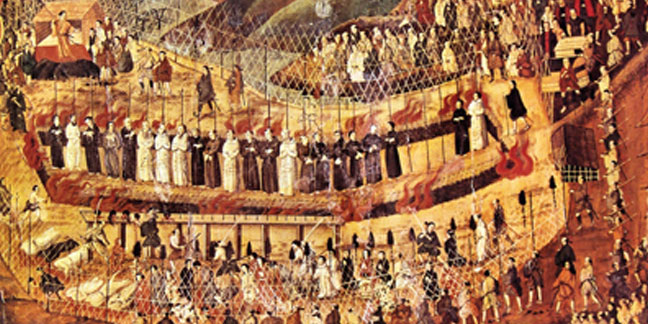 Born to a wealthy military leader in 1562 at Tounucumada, Japan, Paul Miki felt called to religious life at a young age. He became a Jesuit in 1580 and was soon widely known as a successful evangelist. In 1587, the political climate became hostile to Christianity, when the Japanese emperor became suspicious of the Catholic missionaries that had followed in St. Francis Xavier's footsteps a few decades earlier and were converting large numbers of Japanese. He accused the missionaries of "corrupting and stirring up the lower classes" and ordered them all out of the country. Miki and 25 other missionaries and laypeople, including three teenaged boys, were arrested in 1597 for disobeying his edict.
Over the next 30 days, they were forcibly marched 600 miles through the snow from Kyoto to Nagasaki so that they could be a warning to other Japanese Christians. On Feb. 5, 1597, as the group approached the hill in Nagasaki where they were to be tied to crucifixes measured especially for each of them, they all sang the Te Deum. More than 4,000 residents of Nagasaki – many of them Catholics who were crying and praying – witnessed the executions.
Miki's last sermon was delivered from the cross: "All of you who are here, please, listen to me... I have committed no crime, and the only reason why I am put to death is that I have been teaching the doctrine of Our Lord Jesus Christ. I am very happy to die for such a cause, and see my death as a great blessing from the Lord. At this critical time when, you can rest assured that I will not try to deceive you, I want to stress and make it unmistakably clear that man can find no way to salvation other than the Christian way. The Christian religion tells us to forgive our enemies and those who do harm us, and so I say that I forgive the emperor and those responsible for my death. I have no hatred for the emperor; indeed, I wish that he and all the Japanese would become Christians."
In another account of his final preaching, he was recorded as also saying, "The only reason for my being killed is that I have taught the doctrine of Christ. I thank God it is for this reason that I die. I believe that I am telling the truth before I die. I know you believe me and I want to say to you all once again: Ask Christ to help you become happy. I obey Christ. After Christ's example, I forgive my persecutors. I do not hate them. I ask God to have pity on all, and I hope my blood will fall on my fellow men as a fruitful rain."
Like his 25 companions, Miki died on the cross after being stabbed through the chest with a lance. He was just 30 years old, but he was not the youngest in the group: St. Louis Ibaraki was 12, St. Anthony was 13, and St. Thomas Kozaki was 14. St. Anthony's parents were at the foot of his cross to witness their son's bloody killing.
Persecution of Christians continued for another 300 years. Thousands of Catholic missionaries and the faithful – including their spouses and children – were imprisoned, tortured, burned alive, drowned, buried alive, hung or beheaded for the faith. More than 650 martyrs were killed on Martyrs Hill in Nagasaki alone. Japanese Christianity was driven underground until the 1860s, when European missionaries returned and found the faith still alive. In 1889, Japan constitutionally recognized freedom of religion, and in 1919 the country established diplomatic relations with the Vatican.
Miki and his 25 companions, called "The 26 Martyrs of Japan," were canonized in 1862 by Pope Pius IX, and a shrine was built on the hill in 1962.
— Sources: Catholic News Agency, Catholic Online, 26 Martyrs Museum
More online
To learn more about the day in 1597 when the 26 Martyrs were crucified and the memorial that now stands in Nagasaki, go online to www.26martyrs.com.