


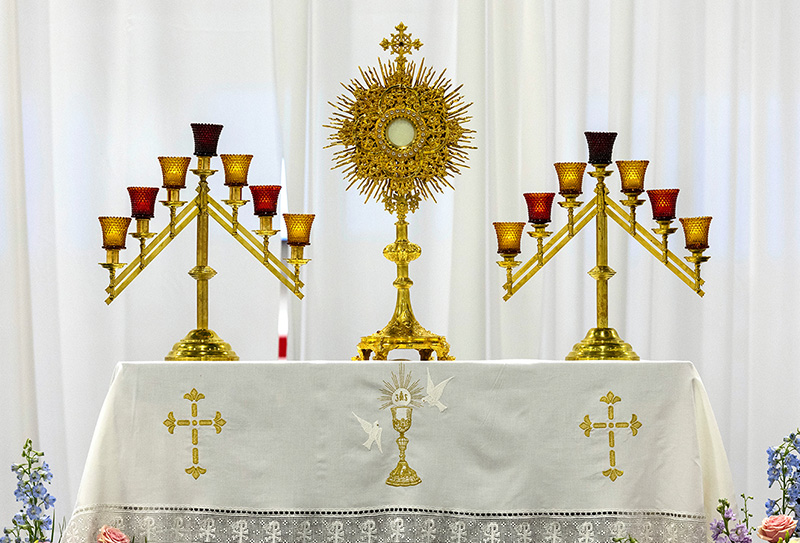
 Eucharistic Adoration is one of the more popular devotions among Catholics today, and it’s not hard to see why. The Second Vatican Council calls the Eucharist the “source and summit of the Christian life.” If you think about what that means, it’s pretty amazing. It means that the Eucharist is both where our life of faith begins and simultaneously the highest pinnacle to which we can ascend here on earth.
It rightly calls to mind Jesus saying, “I am the Alpha and Omega, the first and the last, the beginning and the end” (Rev 22:13). The Eucharist is the source and summit because the Eucharist is truly Christ present among us.
The normal context for celebrating and receiving the Eucharist is in the liturgy of the Mass, so where did the practice of Eucharistic Adoration start? According to Fr. John Hardon, SJ, in The History of Eucharistic Adoration, there is evidence of hermits keeping the Blessed Sacrament reserved in their cells from at least the third century. Since the earliest faith of the Apostolic Church testifies to belief in the Real Presence of Christ in the Eucharist, it follows that the reserved Eucharist would become a focal point of prayer and worship.
According to the Catechism of the Catholic Church, adoration is defined as “the first act of the virtue of religion” and the acknowledgement of God as “God, the Creator and Savior, the Lord and Master of everything that exists” (CCC 2096). In other words, adoration is what we commonly call “worship” today. Eucharistic Adoration simply means worship of God present in the Holy Eucharist. This is true whether the Eucharist is exposed on the altar or veiled within the tabernacle.
The Church encourages the faithful to make frequent visits to the Blessed Sacrament reserved in parish churches and chapels in order to “draw them into an ever deeper share in the paschal mystery” (Order for the Solemn Exposition of the Holy Eucharist).
Even if a church has limited scheduled times for Eucharistic exposition, any time spent worshiping Jesus sacramentally present in the tabernacle is a time of Eucharistic Adoration.
That being said, the practice of exposing the Eucharist on the altar for veneration by the faithful is to be encouraged. There are certain requirements for Eucharistic exposition, however. Even though there is a great degree of flexibility in what sorts of prayers or devotions may take place exposition, the rite of exposition is regulated by the liturgical norms of the Church.
The ordinary minister of exposition is a priest or deacon, although “if they are prevented by some good reason” the Eucharist may be exposed by “an [instituted] acolyte or by another extraordinary minister of Holy Communion, or someone deputed by the local Ordinary” (HC 91). Only an ordained minister may impart a blessing with the sacrament, which we call “benediction.” Most importantly, exposition of the Eucharist “may take place only if a suitable number of the faithful is expected to be present” (HC 86). The Church does not envision Eucharistic exposition as something done for individual devotion, but as an act of communal worship. There can be no adoration without adorers.
The liturgical texts of the Church allow for various forms of Eucharistic exposition, some more solemn and others more simple.
Many are accustomed to seeing the Eucharist exposed in a monstrance – a liturgical item that resembles a sunburst. Alternatively, the Eucharist may be simply exposed on the altar in a ciborium (the vessel used to hold the consecrated Eucharist in the tabernacle).
Whether simple or solemn, silent or full of Scripture and song, the time spent in prayer before Christ in the Sacrament is meant to, in the words of the Church, “extend that union with him, which [we] have reached in Communion, and renew that covenant, which urges [us] to maintain in [our] morals and [our] life what [we] have received in the celebration of the Eucharist” (HC 81).
In other words, the practice of Eucharistic Adoration is meant to extend our worship of Christ that flows from the sacrifice of the Mass, to deepen our desire for Holy Communion, and renew our commitment to live in such a way that bears witness to the presence of God among us and within us.
Deacon Matthew Newsome is the Catholic campus minister at Western Carolina University and the author of “The Devout Life: A Modern Guide to Practical Holiness with St. Francis de Sales,” available from Sophia Institute Press.