

The First Sorrowful Mystery - The Agony in the Garden
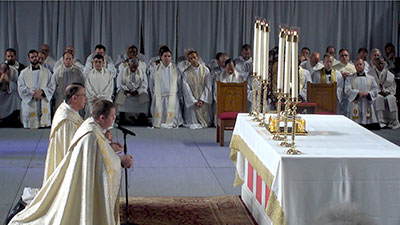 After the Passover supper with His Apostles Jesus went out to Gethsemane and He became very sad and sorrowful. He said to Peter and James and John, “My soul is exceedingly sorrowful, even unto death. Wait here and watch with Me.’[i]
In that moment, the sins of the whole world from all time pressed upon Him, including sins that would be committed by the members of His Church.
We call to Him from the depths of our hearts: “Kyrie eleison. Have Mercy on your Church.”[ii]
The Second Sorrowful Mystery – The Scourging at the Pillar
Pilate said to the crowds, “What then shall I do with Jesus, who is called the Christ?” And they all said, “Let Him be crucified!” So Pilate released Barabbas and had Jesus scourged.[iii]
“He was stripped of His garments, tied to a pillar, and His flesh lacerated from head to foot with cruel scourges until His body could bear no more.”[iv] The body of Jesus, the Church, has again been scourged by the sins of some of its members.
We call to Him from the depths of our hearts: “Kyrie eleison. Have mercy on Your Church.”[v]
The Third Sorrowful Mystery – The Crowning with Thorns
The soldiers fashioned a crown of thorns and fastened it on His head, driving the thorns deeply into His head. They mocked His kingship, kneeling before Him crying, “Hail, King of the Jews.”[vi]
“Jesus, our true king, does not reign through violence, but through a love which suffers for us and with us.”[vii] Jesus, You are now suffering with us, Your Body the Church, because of the sins of abuse, misconduct and abuse of power and position. O King, by Your passion, cleanse and purify the Church.
We call to you from the depths of our hearts: “Kyrie eleison. Have mercy on Your Church.”[viii]
The Fourth Sorrowful Mystery – Jesus Carries the Cross
“We cannot conceive the sufferings, the insults, the indignities Jesus experienced”[ix] “as He was dragged, weak and suffering through the streets.”[x] “The weight of all of our sins presses upon Him.”[xi]
Jesus, Your Body the Church experiences the sufferings, the insults, the indignities of the way of the cross. Only Your grace and power can lift us up when we have fallen – once, twice, three times and many times. O suffering Savior, by your passion cleanse and purify your Church.
We call to you from the depths of our hearts: “Kyrie eleison. Have mercy on Your Church.”[xii]
The Fifth Sorrowful Mystery – The Crucifixion of Our Lord
When they came to the place called Golgotha, that is the Place of the Skull, they crucified Him.[xiii]
“The unbelievable cruelty of this procedure of being nailed to a cross cannot even be imagined.”[xiv] Through Your passion, crucifixion, death and resurrection, Jesus, you have brought us the gift of forgiveness of sins. Cleanse and purify the Church You love of the sins of abuse and misconduct which have seriously wounded the Church. Bring healing and love to victims.
Help us all to rededicate ourselves to the pursuit of true holiness.
— Catholic News Herald
[i] Matthew 26: 36-38.
[ii] Joseph Cardinal Ratzinger, Way of the Cross at the Colosseum (Ninth Station), March 24, 2005.
[iii] Matthew 27: 22, 26.
[iv] Charles V. Lacey, Rosary Novenas to Our Lady (U.S.A.: Benziger Brothers, 1954), p. 25 (The Scourging).
[v] Ratzinger, Way of the Cross (Ninth Station).
[vi] Lacey, Rosary Novenas, p. 27 (The Crowning with Thorns).
[vii] Ratzinger, Way of the Cross (Second Station).
[viii] Ratzinger, Way of the Cross (Ninth Station).
[ix] Holy Hour of Reparation (Oak Lawn, Ill: CMJ Marian Publishers, 2001), p. 19.
[x] Lacey, Rosary Novenas, p. 29 (The Carrying of the Cross).
[xi] Holy Hour of Reparation, p. 3.
[xii] Ratzinger, Way of the Cross (Ninth Station).
[xiii] Matthew 27: 33, 35.
[xiv] Ratzinger, Way of the Cross (Eleventh Station).
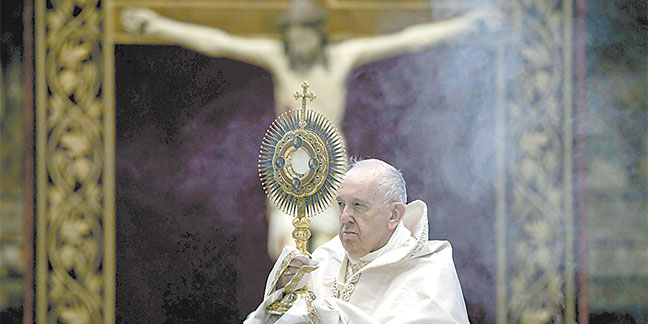 Pope Francis leads Benediction as he celebrates Mass marking the feast of Corpus Christi in St. Peter's Basilica at the Vatican in this June 14, 2020, file photo. (CNS | Vatican Media)When most people hear the words “Corpus Christi,” it is the coastal Texas town they might think of first. However, for Catholics, these words have a far deeper meaning.
Corpus Christi Sunday, also known as the Solemnity of the Most Holy Body and Blood of Christ, falls on Sunday, June 11, this year.
Each year on this solemn feast, the Church honors Our Lord, celebrating the Real Presence of the Body, Blood, Soul and Divinity of Jesus Christ in the Eucharist.
Corpus Christi is Latin for “Body of Christ.”
The feast day was established in 1246 by Bishop Robert de Thorte of Liege at the suggestion of St. Juliana of Mont Carvillon. It was extended to the universal Church by Pope Urban IV in 1264 after St. Thomas Aquinas, a Doctor of the Church, proposed a feast focused solely on the Holy Eucharist that emphasized the joy of the Real Presence of Jesus. Having recognized in 1264 the authenticity of a Eucharistic miracle in Bolsena, the pontiff, then living in Orvieto, established the feast of Corpus Christi on August 11, 1264, as a solemnity for the whole Roman Catholic Church. The office was composed by St. Thomas Aquinas, and the procession was approved by Popes Martin V and Eugene IV.
Corpus Christi is a “moveable” feast: originally observed on the Thursday after Trinity Sunday. In 1970 it was shifted to the Sunday after Trinity Sunday for U.S. dioceses and most of the world.
Traditions of Corpus Christi
On this holy day that honors Our Lord’s Presence in the Eucharist, after Mass Our Lord is placed in a monstrance that is then carried by a priest to four different altars representing the four corners of the earth. While processing, the congregation follows and sings. At each altar there are readings and prayers.
The procession is followed by Benediction of the Blessed Sacrament.
Each year in Rome, the pope presides over a Eucharistic procession on the Feast of Corpus Christi. The procession begins at the Archbasilica of St. John Lateran and proceeds to the Basilica of St. Mary Major, where it concludes with Benediction.
Saints on Corpus Christi
Here are a few inspiring quotes from saints about the Body, Blood, Soul and Divinity of Christ.
St. Thomas Aquinas: “The Eucharist is the sacrament of love: it signifies love, it produces love. The Eucharist is the consummation of the whole spiritual life.”
St. Euphrasia: “To speak of the Blessed Sacrament is to speak of what is most sacred. How often, when we are in a state of distress, those to whom we look for help leave us; or what is worse, add to our affliction by heaping fresh troubles upon us. He is ever there, waiting to help us.”
St. John Chrysostom: “It is not the man who is responsible for the offerings as they become Christ’s Body and Blood; it is Christ Himself who was crucified for us. The standing figure belongs to the priest who speaks these words. The power and the grace belong to God. ‘This is My Body,’ he says. And these words transform the offerings.”
St. Maximilian Kolbe: “If angels could be jealous of men, they would be so for one reason: Holy Communion.”
St. Pio of Pietrelcina: “A thousand years of enjoying human glory is not worth even an hour spent sweetly communing with Jesus in the Blessed Sacrament.”
St. Angela of Foligno: “If we paused for a moment to consider attentively what takes place in this sacrament, I am sure that the thought of Christ’s love for us would transform the coldness of our hearts into a fire of love and gratitude.”
St. Augustine: “What you see is the bread and the chalice; that is what your own eyes report to you. But what your faith obliges you to accept is that the bread is the Body of Christ, and the chalice is the Blood of Christ. This has been said very briefly, which may perhaps be sufficient for faith; yet faith does not desire instruction.”
— Spencer K.M. Brown

At www.eucharisticrevival.org: Find Church resources, videos, educational materials, prayers and more at the National Eucharistic Revival movement’s website – designed to restore understanding and devotion to the Eucharist