

 Men and women considering marriage yearn for certain things. They want to be accepted unconditionally by each other. They want their marriage to be filled with love and happiness. They want a family. In short, they want their marriage to be a source of joy and fulfillment their whole life long. God’s plan for marriage, from the time He first created human beings as male and female, has always included all this and more.
What does the Church teach about married love?
Marriage is more than a civil contract; it is a lifelong covenant of love between a man and a woman. It is an intimate partnership in which husbands and wives learn to give and receive love unselfishly, and then teach their children to do so as well. Christian marriage in particular is a “great mystery,” a sign of the love between Christ and His Church (Eph 5:32). Married love is powerfully embodied in the spouses’ sexual relationship, when they most fully express what it means to become “one body” (Gn 2:24) or “one flesh” (Mk 10:8, Mt 19:6). The Church teaches that the sexual union of husband and wife is meant to express the full meaning of love, its power to bind a couple together and its openness to new life.
What does this have to do with contraception?
A husband and wife express their committed love not only with words, but with the language of their bodies. Married love differs from any other love in the world. By its nature, the love of husband and wife is so complete, so ordered to a lifetime of communion with God and each other, that it is open to creating a new human being they will love and care for together. Part of God’s gift to husband and wife is this ability in and through their love to cooperate with God’s creative power. Therefore, the mutual gift of fertility is an integral part of the bonding power of marital intercourse. That power to create a new life with God is at the heart of what spouses share with each other.
Suppressing fertility by using contraception or sterilization denies part of the inherent meaning of married sexuality and does harm to the couple’s unity. The total giving of oneself, body and soul, to one’s beloved is no time to say: “I give you everything I am– except ...” The Church’s teaching is not only about observing a rule, but about preserving that total, mutual gift of two persons in its integrity.
Are couples expected to leave their family size entirely to chance?
Certainly not. The Church teaches that a couple may generously decide to have a large family, or may for serious reasons choose not to have more children for the time being or even for an indefinite period (“Humanae Vitae,” 10).
What should a couple do if they have a good reason to avoid having a child?
A married couple can engage in marital intimacy during the naturally infertile times in a woman’s cycle, or after child-bearing years, without violating the meaning of marital intercourse in any way. This is the principle behind natural family planning. Natural methods of family planning involve fertility education that enables couples to cooperate with the body as God designed it.
What is natural family planning?
Natural family planning is a general name for the methods of family planning that are based on a woman’s menstrual cycle. A man is fertile throughout his life, while a woman is fertile for only a few days each cycle during the child-bearing years. Some believe that NFP involves using a calendar to predict the fertile time. That is not what NFP is today. A woman experiences clear, observable signs indicating when she is fertile and when she is infertile. Learning to observe and understand these signs is at the heart of education in natural family planning.
When a couple decides to postpone pregnancy, NFP can be very effective. NFP can also be very helpful for couples who desire to have a child because it identifies the time of ovulation. It is used by many fertility specialists for this purpose. Thus a couple can have marital relations at a time when they know that conception is most likely to take place.
Is there really a difference between using contraception and practicing natural family planning?
On the surface, there may seem to be little difference. But the end result is not the only thing that matters, and the way we get to that result may make an enormous moral difference. Some ways respect God’s gifts to us while others do not. Couples who have practiced natural family planning after using contraception have experienced a profound difference in the meaning of their sexual intimacy.
When couples use contraception, either physical or chemical, they suppress their fertility, asserting that they alone have ultimate control over this power to create a new human life. With NFP, spouses respect God’s design for life and love. They may choose to refrain from sexual union during the woman’s fertile time, doing nothing to destroy the love-giving or life-giving meaning that is present. This is the difference between choosing to falsify the full marital language of the body and choosing at certain times not to speak that language.
What has been the impact of contraception on society? On married couples?
Many would likely be surprised at how long all Christian churches agreed on this teaching against contraception. It was only in 1930 that some Protestant denominations began to reject this long-held position. Those opposed to this trend predicted an increase in premarital sex, adultery, acceptance of divorce and abortion. Later, in 1968, Pope Paul VI warned that the use of contraception would allow one spouse to treat the other more like an object than a person, and that in time governments would be tempted to impose laws limiting family size. Pope John Paul II called attention to the close association between contraception and abortion, noting that “the negative values inherent in the ‘contraceptive mentality’ ... are such that they in fact strengthen this temptation (to abortion) when an unwanted life is conceived” (“Evangelium Vitae,” 13).
These predictions have come true. Today we see a pandemic of sexually transmitted diseases, an enormous rise in cohabitation, one in three children born outside of marriage, and abortion used by many when contraception fails. A failure to respect married love’s power to help create new life has eroded respect for life and for the sanctity of marriage.
Conclusion
By using contraception, couples may think that they are avoiding problems or easing tensions, that they are exerting control over their lives. But the gift of being able to help create another person, a new human being with his or her own life, involves profound relationships. It affects our relationship with God, who created us complete with this powerful gift. It involves whether spouses will truly love and accept each other as they are, including their gift of fertility. Finally, it involves the way spouses will spontaneously accept their child as a gift from God and the fruit of their mutual love. Like all important relationships with other persons, it is not subject solely to our individual control. In the end, this gift is far richer and more rewarding than that.
The Church’s teaching on marital sexuality is an invitation for men and women – an invitation to let God be God, to receive the gift of God’s love and care, and to let this gift inform and transform us, so we may share that love with each other and with the world.
— Excerpted from the U.S. bishops’ 2006 statement “Married Love and the Gift of Life”
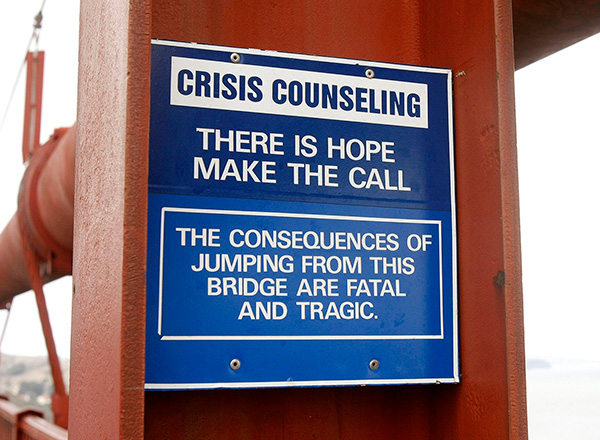 Everyday people, including Catholics, and churches can help those experiencing a mental health crisis and save lives, according to experts.
During National Suicide Prevention Month in September, ministry leaders and crisis experts are listing practical steps that individuals, families and churches can take to help.
In the United States, nearly 50,000 people died by suicide in 2023, which amounts to about one person every 11 minutes, according to numbers from the U.S. Centers for Disease Control and
Prevention. The government agency reports that many more think about or attempt: An estimated 12.8 million adults seriously considered taking their lives in 2022. The numbers are rising: rates increased roughly 36% between 2000 and 2022.
In the hopes of saving more lives, four experts shared their advice. Their comments come before November, when the pope’s prayer intention is for the prevention of suicide.
1. Take mental health seriously
These experts emphasized the importance of mental health.
“If you’re thinking of suicide, treat that the same way you would if you were having chest pains or maybe tingling in your arms,” said Deacon Ed Shoener, president of the International Association of Catholic Mental Health Ministers, a lay association dedicated to helping people with mental illness and their families.
“Similarly, if you’re having thoughts of suicide, don’t feel ashamed, just be concerned and make it a point to talk to your doctor, or if you know a therapist – but talk to someone about it,” he said.
2. Know the warning signs.
Learning the warning signs can help, according to experts like Wendy Martinez Farmer, vice president of 988 strategy, quality improvement and clinical standards at Vibrant Emotional Health.
Her nonprofit runs 988 Suicide & Crisis Lifeline, which provides 24/7 call, text and chat access to crisis counselors.
She listed signs that “may help determine if an individual is at risk,” especially if the behavior is new, has increased, or seems related to a painful event, loss or change, she noted. Those include:
- Looking for a way to harm themselves.
- Talking about feeling hopeless.
- Talking about feeling trapped or in pain.
- Talking about being a burden to others.
- Increasing use of alcohol or drugs.
- Withdrawing or isolating themselves.
3. Talk about it
These experts encouraged people to reach out to those who may be having a mental health crisis.
“If you think someone is suicidal or thinking of that, don’t be afraid to ask them,” Deacon Shoener said. “One, it signals that you’re open and willing to talk about mental health and matters such as that – and it also says you’re there, ready to help them.”
Elizabeth Leon, director of family support at Red Bird Ministries, a Catholic grief support ministry that runs a program called “Remember,” recommended practicing what to say. She suggested phrases such as, “I am concerned that you are so unhappy. Are you thinking about suicide?” and “Do you feel safe to be alone right now?”
Many people having a mental health crisis “will not ask for help, so having the courage to reach out to them is critical,” said Leon.
4. Don’t be afraid to act
Sometimes action is needed, experts said. Marian Sister Kathryn Maney, director of Red Bird Ministries’ “Remember” program, advised, “If someone expresses struggle with suicidal ideation, listen non-judgmentally and stay with them until they find help.”
If loved ones are exhibiting warning signs, Martinez Farmer also suggested, “Remove means, like weapons or pills.”
5. Use resources
These experts wanted people to know they are not alone. Among other resources, Sister Kathryn and Martinez Farmer recommended 988 Lifeline, which helps millions of people every year.
6. Act as a church to make a difference.
“Religious communities can be places of solace, where people turn for guidance through difficult times,” Martinez Farmer said. “Both the clergy and congregants can play a role in building a culture where everyone feels safe, seen and supported by leading with compassion, listening with care, serving one another and fostering belonging.”
— Katie Yoder, OSV News