

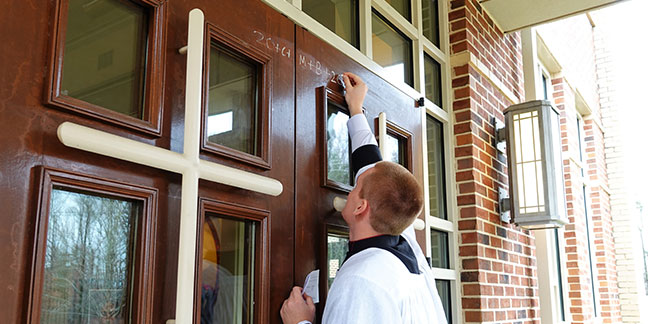
 BALTIMORE — The ancient Christian tradition of marking doorways with blessed chalk on the feast of the Epiphany will carry new meaning for many Catholics in 2021.
Following a year that saw families shaken by the coronavirus pandemic, the traditional home blessing will serve as a special symbol of hope and a visible reminder of faith.
"Many have fought COVID-19 and lived to tell about it," said Michael Carnahan, a parishioner of Sacred Heart of Mary Church in Baltimore, who has practiced the chalk blessing since he was a child.
"However, many people have suffered the loss of a loved one to this virus. The chalk, along with other symbols, will be an even stronger reminder of how important God is to us and of what an important factor Jesus is in our daily lives," he said.
The blessing, popular in Poland and other Slavic countries, has spread to many parts of the world. It takes place on the liturgical feast marking the visitation of the Magi to the Christ Child and the revelation that Jesus is the son of God.
The blessing involves taking simple chalk, usually blessed by a parish priest, and scrawling doorways with symbolic numbers and letters -- this year: "20+C M B 21."
The numbers represent the current year and the letters stand for the first letters of the traditional names of the magi: Caspar (sometimes spelled "Kaspar"), Melchior and Balthazar. The letters are also an abbreviation for "Christus Mansionem Benedicat," Latin for "May Christ bless this dwelling."
Participants typically read passages from the New Testament and may sing Epiphany hymns.
Carnahan, along with his wife, Malgorzata Bondyra, and their five children, plan to take part in the tradition this Epiphany, which is observed in the United States this year from Jan. 3-8. Of Polish background, they will say the blessing in Polish and English.
"We will use this as an opportunity to remember that living a Christ-like existence on a daily basis is important to all," Carnahan said. "Just as we took for granted our health and safety as a society, we are reminded of how we might sometimes take for granted the sacrifice Jesus made for all of us."
2021 won't be the first time the blessing has taken on extra meaning. Under Soviet-dominated Poland, for example, Catholics viewed the blessing as a means of spiritual resistance.
"During communist times, Polish people would use the chalk and other symbols as a statement of their beliefs and as an indication that communism can't take away their faith," said Carnahan, a longtime member of the Polish dance ensemble, Ojczyzna, based at Holy Rosary Church in Baltimore. "It sometimes would lead to trouble for them, but ultimately it was a way to be defiant while also being true to their faith."
Will and Amy Buttarazzi, parishioners of St. Joseph Church in Cockeysville, Maryland, have also practiced the chalk blessing at their home with their eight children. As the director of family ministry at their parish, Amy Buttarazzi encourages other families to adopt the practice. She made a video about the tradition and provided written instructions.
She remembers her elementary school, the School of the Cathedral of Mary Our Queen in Baltimore, maintaining the tradition when she was growing up.
"Our principal would bless all the doors of the school building every year after we returned from Christmas break," she said. "The blessing would be written on a sentence strip and taped to the top frame of each door in the building. Now, as a mom, I wanted to continue this tradition in my own home with my children."
The Buttarazzis write their Epiphany blessing above the door of their dining room, while Carnahan and his family write it above their front door, outside.
Carnahan noted that the magi traveled far, having faith they would find the infant Jesus. They did so knowing his mission, he said.
"The chalk is a daily visual symbol for us," Carnahan said, "just like seeing the crucifix hanging on the wall, helping us to keep within us thoughts of grace, love, peace, happiness, forgiveness and more."
— George P. Matysek Jr., Catholic News Service
More online:
A guide for doing a chalk blessing at home: bitly.com/chalkblessing
Pictured: An incensing and chalking all of the doors at St. Mark Church, St. Mark School and Christ the King High School was held Jan. 4, 2020. (Photo provided by Amy Burger)
‘Hope does not disappoint.’
 VATICAN CITY — Pope Francis urged Christians to examine their consciences in Lent by comparing their daily lives to the hardships faced by migrants, calling it a way to grow in empathy and discover God’s call to compassion.
“It would be a good Lenten exercise for us to compare our daily life with that of some migrant or foreigner, to learn how to sympathize with their experiences and in this way discover what God is asking of us so that we can better advance on our journey to the house of the Father,” the pope wrote in his message for Lent 2025.
The message, signed Feb. 6, before the pope was hospitalized Feb. 14 for treatment of double pneumonia, was released by the Vatican Feb. 25.
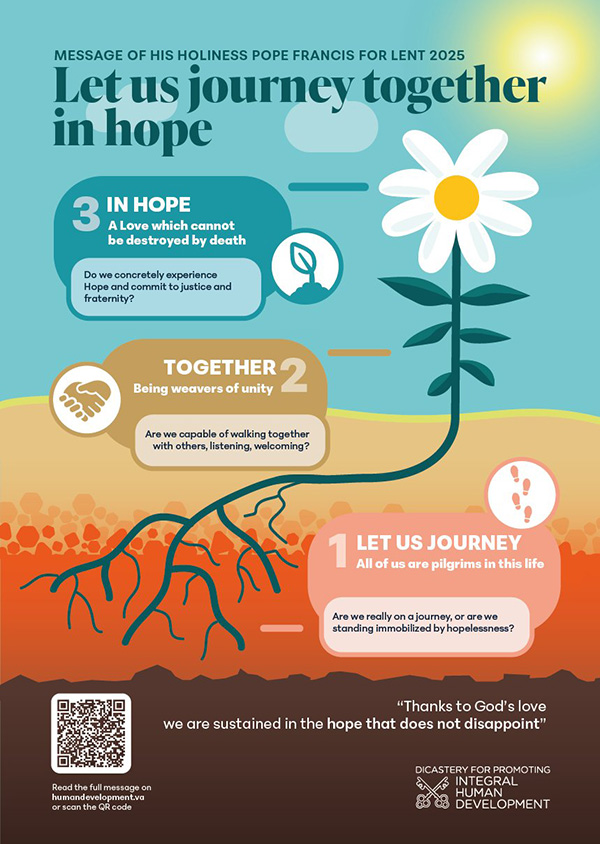
Reflecting on the theme “Let us journey together in hope,” the pope said that Lent is a time to confront both personal and collective struggles with faith and compassion.
Comparing the Lenten journey to the Israelites’ exodus from slavery in Egypt, he recalled “our brothers and sisters who in our own day are fleeing situations of misery and violence in search of a better life for themselves and their loved ones.”
“A first call to conversion thus comes from the realization that all of us are pilgrims in this life,” he wrote. “Am I really on a journey, or am I standing still, not moving, either immobilized by fear and hopelessness or reluctant to move out of my comfort zone?”
Pope Francis also emphasized the importance of journeying together, saying Christians are called to walk “side by side, without shoving or stepping on others, without envy or hypocrisy, without letting anyone be left behind or excluded.”
Christians, he said, should reflect on whether they are open to others or focused only on their own needs.
The pope called on Christians to journey together in hope toward Easter, living out the central message of the Jubilee Year: “Hope does not disappoint.”
Another Lenten call to conversion, he said, is to embrace hope and trust in God’s promise of eternal life, made possible through Christ’s resurrection.
Pope Francis encouraged Christians to consider whether they truly live in a way that reflects hope, trusting in God’s promise of eternal life, seeking forgiveness and committing themselves to justice, fraternity and care for creation.
“Christ,” he wrote, “lives and reigns in glory. Death has been transformed into triumph, and the faith and great hope of Christians rests in this: the resurrection of Christ!”