

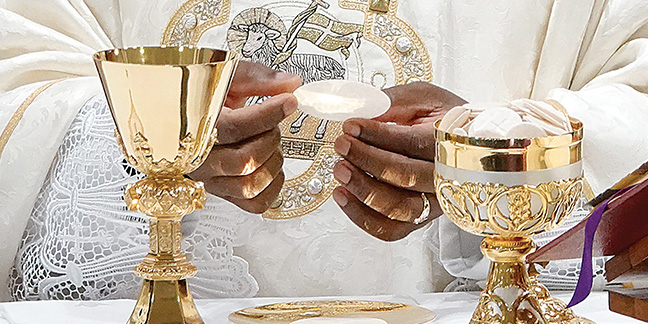
 Ask most practicing Catholics whether Jesus offers Himself to us in the Eucharist, and I imagine they’d say “yes.” It is true, in a certain sense: Jesus does give Himself to us in the Eucharist. In this sacrament, we receive His Body, Blood, Soul and Divinity – which is to say, all of Him. The very reason many people go to Mass is in order to receive Jesus. But there is another very important sense in which it is not true to say Jesus offers Himself to us: that is the sense of the Eucharist as a sacrifice.
Quoting “Sacrosanctum Concilium,” the Catechism of the Catholic Church states that Jesus “instituted the Eucharistic sacrifice … to perpetuate the sacrifice of the cross throughout the ages” (CCC 1323). The Eucharist is thus inextricably bound up with the crucifixion, which Christians universally recognize as a sacrifice made by Christ to God the Father for our salvation.
The roles of priests
Speaking of the crucifixion, St. Paul implores Christian disciples to imitate God and to “live in love, as Christ loved us and handed Himself over for us as a sacrificial offering to God for a fragrant aroma” (Eph 5:2). St. Paul understands Christ’s sacrifice as being offered “to God” and “for us.” On the cross, Jesus is not only the sacrificial victim but is Himself the High Priest offering the sacrifice.
This gets to the heart of priesthood. Many of us today have a weakened imagination when it comes to what a priest is and does. We think of our priests as men who run the parish, study the Bible, teach the faith, preach sermons and pray with us in our time of need. These are all very important things that priests indeed do, but none of them defines what a priest is.
The fundamental concept of priesthood runs deeper than this. A priest is a person who approaches God to offer sacrifice on behalf of the people. All other pastoral responsibilities flow outward from that.
We find the priests of ancient Israel acting in this way throughout the Old Testament. The books of Leviticus and Deuteronomy are full of liturgical instruction dictating how the priests were to offer sacrifices to God for the good of the people of Israel.
There were sacrifices of thanksgiving, sacrifices of praise and sacrifices of atonement. There were sacrifices of incense and cereal grains, but most typical were the animal sacrifices: a living creature giving its life for the sanctification of others.
Offering back to God
None of these sacrifices was for God’s benefit. The Creator of the universe already owns the universe and everything in it (see Ps 50:10). We can’t give God anything that isn’t already His. The purpose of the sacrifice was to offer back to God a portion of the blessing He has given to us, so that we might receive an even greater share of God’s grace.
This works because by offering the gift of a worthy sacrifice to God, we participate more fully in the life of God who is Love, and whose essence is therefore self-gift. Since everything God does is an act of gift, we become more like God by offering gifts, especially the gift of ourselves.
What I’m saying here is that while God doesn’t benefit from our sacrifices, we do. That’s why we say they are offered to God, but for us.
The quintessential sacrifice of Israel coincided with the annual Passover festival commemorating the freeing of Israel from bondage in Egypt. The final plague that convinced Pharaoh to evict Israel from his land was the death of the first born. To be spared this death, the Israelites were instructed to sacrifice an unblemished lamb to God. But to benefit from the sacrifice, the people also had to consume the flesh of the lamb and mark their doorposts with its blood. The flesh and blood of the sacrificial lamb caused the angel of death to pass over the houses of the Hebrews, thus saving them.
The Last Supper, at which Jesus instituted the Eucharist, was a Passover meal. Having celebrated this yearly feast their whole lives, the Apostles would have immediately noticed the absence of the sacrificial lamb. Just as Isaac asked his Father centuries earlier, they may have been wondering, “Where is the lamb for the sacrifice?” (Gen 22:7).
And just as Abraham prophetically answered his son, “God Himself will provide a lamb” (Gen 22:8).
Jesus does something new
In the context of this ritual, sacrificial meal, our Lord does something new. He takes the bread, blesses it, breaks it and gives thanks, saying, “This is My body which is given up for you” (Lk 22:19): given to God; given for us. And just like the Passover lamb of Exodus, this sacrifice must be consumed for us to benefit by it. By consuming the sacrificial offering, we ourselves participate in that offering.
This is reflected in the liturgical prayers of the Mass. For example, in the third Eucharistic Prayer, the priest prays, “Look, we pray, upon the oblation of your Church and, recognizing the sacrificial Victim by whose death You willed to reconcile us to Yourself, grant that we, who are nourished by the Body and Blood of your Son and filled with His Holy Spirit, may become one body, one spirit in Christ. May He make of us an eternal offering to You.”
When we understand the Eucharist to be not just Jesus’ gift of Himself to us, but rather the gift of Himself to the Father for us, it changes how we perceive our role in the Mass.
When you and I receive Christ in the Eucharist, we participate in the one perfect sacrifice of Christ the Savior (CCC 1330).
You can consider it this way: In the Eucharist, God offers the sacrifice, God receives the sacrifice, and God is the sacrifice. The whole of Christian worship is essentially a divine act in which you and I undeservedly get to participate through the mediation of Jesus Christ, who gives Himself as a spotless offering to the Father for us, for our sanctification and for our salvation.
Deacon Matthew Newsome, Catholic campus minister at Western Carolina University and regional faith formation coordinator for the Smoky Mountain Vicariate, is the author of “The Devout Life: A Modern Guide to Practical Holiness with St. Francis de Sales,” available from Sophia Institute Press.
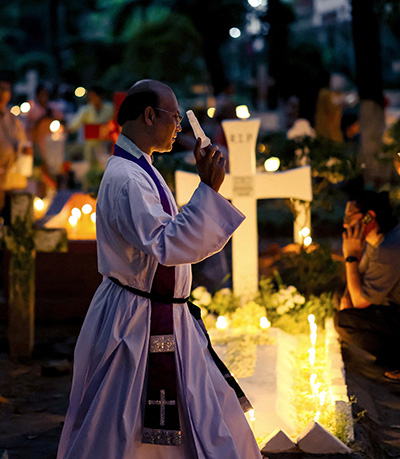 November is a time when Catholics are especially encouraged to pray for the souls of those who have gone before us in faith. The Catechism attests that, “from the beginning the Church has honored the memory of the dead and offered prayers in suffrage for them, above all the Eucharistic sacrifice. … The Church also commends almsgiving, indulgences and works of penance undertaken on behalf of the dead” (CCC 1032). But why do we pray for the dead? When a loved one dies, it is common to say, “They are with God now,” or, “They are at peace.” What need, then, have they of our prayers?
The answer to this question is the Catholic doctrine of purgatory. This ancient teaching is the very reason why we have funerals, offer Masses for the dead and celebrate All Souls’ Day. But many Catholics struggle to explain this important doctrine, especially when asked by Protestant friends who want to know, “Where is purgatory in the Bible?”
It is true that you do not find the word “purgatory” in the Scriptures; neither do we find the words “Trinity” or “Bible.” Yet the concepts these words describe are nevertheless biblical. The passage most commonly cited in support of the doctrine of purgatory is 2 Maccabees 12:38-45, in which a collection is taken up to make a sin offering for fallen soldiers who had been discovered carrying idolatrous amulets. Affirming belief in the resurrection, the Scripture calls it “a holy and pious thought” to pray for the dead.
Support for Purgatory
Praying for the dead implies there is some state after death in which our prayers may do souls some good. This cannot be heaven, as the souls in heaven have no need of our prayers. Neither can it be hell, as prayer would be useless to the souls of the damned. That the Scriptures say it is “holy and pious” to pray for the dead supports the doctrine of purgatory.
The problem is that 2 Maccabees is not recognized as canonical by Protestants. There are other passages that support the doctrine of purgatory. In Matthew’s gospel, Jesus admonishes us to be reconciled on the way to court, “lest your accuser hand you over to the judge, and the judge to the guard, and you be put in prison; truly I say to you, you will never get out till you have paid the last penny” (Mt 5:25-26). Jesus is alluding to our final judgment. But He would not describe heaven as a prison. Neither could this be a reference to hell, from which the damned will never be released.
Another New Testament passage supporting purgatory comes in St. Paul’s first letter to the Corinthians. Speaking of the Day of Judgment when “each man’s work will become manifest,” St. Paul writes, “it will be revealed with fire, and the fire will test what sort of work each one has done … If any man’s work is burned up, he will suffer loss, though he himself will be saved, but only as through fire” (1 Cor 3:13, 15). Being saved through fire suggests a removal of impurities. This corresponds with purgatory.
“Purgatory” means “purification.” As the Catechism explains, “All who die in God’s grace and friendship, but still imperfectly purified, are indeed assured of their eternal salvation; but after death they undergo purification, so as to achieve the holiness necessary to enter the joy of heaven. The Church gives the name Purgatory to this final purification of the elect” (CCC 1030-31).
I find the most useful Scripture verse to help explain the doctrine of purgatory to Protestants to be Revelation 21:27, which states that “nothing unclean” will enter heaven. I ask if they believe they will go to heaven if they believe in Jesus and repent They say yes. Then I ask whether they think believing in Jesus makes them perfectly pure. If they have any self-awareness, they will say no. When I point to this verse, they conclude that God must do something to purify the souls of the elect after death. I say, “That final purification before heaven is what Catholics call purgatory.”
Purgatory transforms
Heaven is not the dwelling place of unrighteous souls let in because Jesus paid the price of their admission: it is the final abode of the saints who have been transformed by the love of Christ. Pope Benedict XVI, in his encyclical on hope, “Spe Salvi,” describes purgatory as an encounter with Jesus that “burns us, transforms and frees us, allowing us to become truly ourselves.” This encounter is “a blessed pain, in which the holy power of (Christ’s) love sears through us like a flame, enabling us to become totally ourselves and thus totally of God” (47). Understood this way, the doctrine is an extension of Church teachings on mercy.
If the final purgation of the dead is primarily the work of Christ, what difference is made by our prayers for them? We will let Pope Benedict have the final word: “No one lives alone. No one sins alone. No one is saved alone. The lives of others continually spill over into mine ...So my prayer for another is not something extraneous to that person, something external, not even after death. In the interconnectedness of Being, my gratitude to the other – my prayer for him – can play a small part in his purification. … It is never too late to touch the heart of another, nor is it ever in vain” (“Spe Salvi,” 48).
Deacon Matthew Newsome, Catholic campus minister at Western Carolina University and regional faith formation coordinator for the Smoky Mountain Vicariate, is the author of “The Devout Life: A Modern Guide to Practical Holiness with St. Francis de Sales,” available from Sophia Institute Press.