

 The Great "O"Antiphons are brief prayers that are chanted or sung from Dec. 17 to 23. The origin of these prayers is not certain, but it is probable that they were composed in the seventh or eighth centuries when the monks put together texts from the Old Testament. The Church in Rome and the monastic communities throughout Western Europe chanted the "O" Antiphons during Evening Prayer, also known as Vespers.
Each antiphon begins with the acclamation "O" followed by a different title for the Messiah. In the Middle Ages it was traditional to ring the great bells of the church each evening as the "O" Antiphons were sung.
Today, in the Liturgy of the Hours, the Magnificat is preceded by one of the "O"Antiphons that links the prayer to the feast of the day or season of the year. In the last seven days of Advent, the antiphons are very special. Each begins with the acclamation "O" and ends with a plea for the Messiah to come. As Christmas approaches the cry becomes increasingly urgent.
It is interesting to note that the first letter of each antiphon – Sapientia, Adonai, Radix, Clavis, Oriens, Rex, Emmanuel – when read backwards forms an acrostic in Latin: "Ero cras." This can be understood as the words of Christ, responding to His people’s plea, saying, "Tomorrow I will be there."
Saying the "O" Antiphons as a family – during grace at meals, in front of the manger scene or the Christmas tree – is a wonderful Advent devotion and a time to read, meditate and reflect on the Scriptural texts which form the basis for the "O" Antiphons.
- Dec. 17 – O Sapientia: "O Wisdom you come forth from the mouth of the Most High. You fill the universe and hold all things together in a strong yet gentle manner. O come to teach us the way of truth."
- Dec. 18 – O Adonai: "O Adonai and leader of Israel, you appeared to Moses in the burning bush and you gave him the Law on Sinai. O come and save us with your mighty power."
- Dec. 19 – Radix Jesse: "O Stock of Jesse, you stand as a signal for the nations; kings fall silent before you whom the peoples acclaim. O come to deliver us, and do not delay."
- Dec. 20 – O Clavis David: "O Key of David and scepter of Israel, what you open no one else can close again; what you close no one can open. O come to lead the captive from prison; free those who sit in darkness and in the shadow of death."
- Dec. 21 – O Oriens: "O Rising Sun, you are the splendor of eternal light and the sun of justice. O come and enlighten those who sit in darkness and in the shadow of death."
- Dec. 22 – O Rex Gentium: "O King whom all the peoples desire, you are the cornerstone which makes all one. O come and save man whom you made from clay."
- Dec. 23 – O Emmanuel: "O Emmanuel, you are our king and judge, the One whom the peoples await and their Savior. O come and save us, Lord, our God."
— The Crossroads Initiative: A Ministry of Dr. Marcellino D’Ambrosio, online at www.crossroadsinitiative.com.
 The season of Advent developed in the Church over time. Here are 10 facts that you may not know about the roots and meanings of Advent:
1. Advent is a time of expectation and preparation for the birth of the Lord. The word “Advent” derives from the Latin word “adventus,” which means “coming,” and is associated with the four weeks of preparation for Christmas.
2. Advent has a changing start date, but it always contains four Sundays. It starts on the Sunday closest to the feast of St. Andrew the Apostle (Nov. 30). It can begin as early as Nov. 27th or as late as Dec. 3.
3. Advent marks the beginning of the liturgical year. Advent was chosen to begin the year as representative of the time in history that Christ was not known to us. With His birth the beginning of our faith was founded. The liturgical year ends with the feast of Christ the King, His reign over the universe.
4. The Advent season has two meanings. It emphasizes both the celebration of Christ coming into the world as a man and also the second coming when the Lord will return again. It blends together a penitential spirit, very similar to Lent, a liturgical theme of preparation for the Second and Final Coming of the Lord, called the Parousia, and a joyful theme of getting ready for the Bethlehem event. The traditional color of Advent is purple or violet, which symbolizes the penitential spirit. Religious traditions associated with Advent express all these themes.
5. Hope is a predominant theme of Advent. The Israelites hoped for a Messiah to come, and Christ entered the world. We are hopeful for the arrival of Christ again into the world.
6. Advent is a reminder of the Old Testament promises of the coming of the Messiah. The Advent tradition of the Jesse Tree consists of symbols of the Messiah coming from the line of Jesse (Lk 3: 23-38). Isaiah is often read during this season to remember that we are waiting for the day when the Messiah will come again.
7. Advent focuses on light as opposed to darkness. Christ enters our dark world and casts away the darkness of sin to redeem us. He will come again as the light of the world.
8. Advent has two parts. The first portion the First Sunday of Advent until Dec. 16 is preparation for the second coming of Christ. The second portion from Dec. 17 to 24 directly prepares us for the commemoration of the first coming of Christ, Christmas.
9. The origins of Advent can be traced back to the Church in France. In the 4th Century, the Church in France used the period before Epiphany as a time of preparation for baptism. It was called “St. Martin’s Lent” for the 40 days that started on Nov. 11, the feast of St. Martin of Tours.
10. Advent as we know today was developed in Rome. Pope Gregory I in the late 6th or early 7th Century composed many of the prayers, antiphons and psalm responses. Many themes and ideas we now know can be traced to the Roman Advent season.
— Reprinted from the Catholic Apostolate Center, online at www.catholicapostolatecenter.org, and from EWTN
More online
At www.catholicapostolatecenter.org/advent-resources.html: Get additional Advent resources for your family, including educational videos, prayers and reflections, and guides for examining one’s conscience before confession.
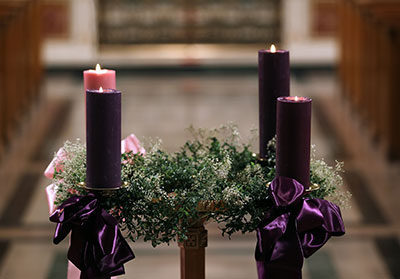
Pictured above: A lit candle is seen on an Advent wreath. Advent, a season of joyful expectation before Christmas, begins Nov. 28 this year. The Advent wreath, with a candle marking each week of the season, is a traditional symbol of the liturgical period. (CNS photo/Lisa Johnston, St Louis Review)