

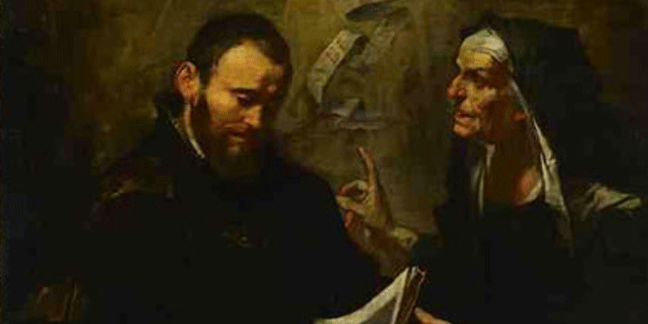
 Black Catholic history can be traced to the Acts of the Apostles (8:26-40) when St. Philip the Deacon converted the Ethiopian eunuch – one of the first moves the Apostles made to evangelize outside Jerusalem and thus sow the seeds for the universal Church.
Christianity spread throughout North Africa, and the region featured prominently in the early Church as the birthplace of saints, popes and Western monasticism.
What is Black Catholic History Month?
On July 24, 1990, the National Black Catholic Clergy Caucus of the United States designated November as Black Catholic History Month to celebrate the history and heritage of black Catholics. November is significant because two important black saints are commemorated within the month: St. Martin de Porres’ feast day (Nov. 3) and St. Augustine’s birthday (Nov. 13). With All Saints and All Souls’ Day, we also remember the saints and souls of Africa and the African Diaspora.
At www.nbccongress.org: Learn more about the National Black Catholic Congress and its upcoming events, download educational resources and get vocation information
African-American Catholics by the numbers
There are 3 million African-American Catholics in the United States.
Of Roman Catholic parishes in the United States, 798 are considered to be predominantly African-American. Most of those continue to be on the East Coast and in the South. About 76 percent of African-American Catholics are in diverse or shared parishes, and 24 percent are in predominately African-American parishes.
Currently, there are five living African American bishops and one African American cardinal. Two U.S. dioceses and one archdiocese are headed by African American prelates.
— USCCB
What is the diocese’s African American Affairs Ministry?
On May 17, 1985, a group of 10 people calling themselves the Committee for Concerned Black Catholics met to discuss issues and concerns that were particular to black Catholics in the diocese. They urged then Bishop John Donoghue to coordinate efforts of black Catholics in the diocese.
In July 1985, the ministry launched as the Diocesan Committee on Black Catholic Ministry and Evangelization, part of the diocese’s Ministry for Justice and Peace.
In 1989 it became a separate office to address and serve the needs of black Catholics in the diocese.
Since then, its goal has been to make visible the work, contributions, traditions and culture of black Catholics to the Church and to society, and to propose adequate diocesan responses to racism and other social injustices.
— www.charlottediocese.org
Three popes of the early Church were born in north Africa:
 — Pope St. Victor I (189-198 or 199): He was the first pope to celebrate the liturgy and write Church documents in Latin rather than Greek. He is most famous for decreeing that Easter be universally celebrated on a Sunday, a practice already common in the West, but not so in the East. His feast day is July 28.
 — Pope St. Miltiades (also called St. Melchiades) (311-314): He was pope when Constantine the Great defeated his enemies and assumed control over Rome, paving the way to the end of persecution of Christians. Constantine gave the pope the Lateran palace (now known as the Papal Archbasilica of St. John Lateran), which became the papal residence and seat of Christian governance. He was the last pope to be buried in a catacomb. His feast day is Dec. 10.
 — Pope St. Gelasius I (492-496): The first pope to be called the Vicar of Christ, he is most famous for affirming the primacy of the papacy based on Jesus' command naming Peter the "rock of the Church." He promoted a type of "separation of Church and State" but emphasized that Church authority is always superior to civil law. He ordered reception of the Eucharist under both species, and he used his own funds and the papal lands to feed the poor of Rome during a severe famine. His feast day is Nov. 21.
THE SCILLITAN MARTYRS
The Scillitan Martyrs were the first documented African martyrs. The 12 Christians, seven men and five women, were martyred in 180 in Scillium (in what is present-day Algeria and Tunisia) for refusing to call the Roman emperor their god. Unlike other Christians, they were not tortured but put on trial and offered 30 days to change their minds. When they still refused to recant their faith, they were put to death by the sword.
"The Acts of the Scillitan Martyrs," a contemporaneous account of their trial and execution, is considered to be among the earliest documents of the Church in Africa and also the earliest example of Christian Latin.
Their feast day is July 17.
ST. PERPETUA AND ST. FELICITY
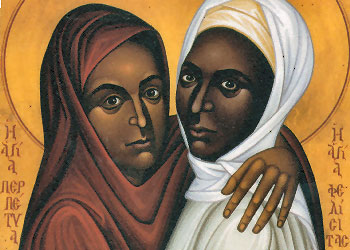 Just after the death of Pope St. Victor I, St. Perpetua and St. Felicity underwent their martyrdom in Carthage, around 203.
St. Perpetua was a young, well-educated noblewoman and mother living in Carthage in North Africa. Her mother was a Christian and her father was a pagan. Perpetua followed the faith of her mother. Despite the pleas of her father to deny her faith, Perpetua fearlessly proclaimed it.At the age of 22, she was jailed for her faith. While in prison she continued to care for her infant child and put up with tortures designed to make her renounce her faith. Perpetua remained steadfast until the end. St. Perpetua was sacrificed at the games as a public spectacle.
St. Felicity was a pregnant slave girl who was imprisoned with her. Little is known about her life because, unlike Perpetua, she did not keep a diary. After imprisonment and torture, Felicity was also condemned to die at the games.Only a few days before her execution, Felicity gave birth to a daughter, who was secretly taken away to be cared for by some of the faithful.
They share the feast day of March 7, and their names are forever mentioned together in the Roman Canon of the Mass.
ST. CYPRIAN
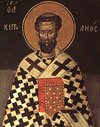 St. Cyprian of Carthage is second in importance only to St. Augustine as a figure and Father of the African Church.
He was born to wealthy pagans around the year 190, and was educated in the classics. Like St. Augustine after him, he questioned what truth was and searched for it in practicing law and rhetoric. He was curious about Christianity, and after much study he converted at the age of 56. He sold all of his property and was ordained a priest a year later, and bishop two years after that.
His writings are of great importance, especially his treatise on "The Unity of the Catholic Church," in which he argues that unity is grounded in the authority of the bishop, and among the bishops, in the primacy of the See of Rome. In it, he wrote, "You cannot have God for your Father if you do not have the Church for your mother.... God is one and Christ is one, and His Church is one; one is the faith, and one is the people cemented together by harmony into the strong unity of a body.... If we are the heirs of Christ, let us abide in the peace of Christ; if we are the sons of God, let us be lovers of peace."
He was martyred on Sept. 14, 258.
ST. ZENO
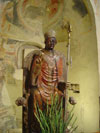 St. Zeno was born in north Africa, in what is present-day Morocco and Algeria. He received an excellent classical education and in 362 was named bishop of Verona, Italy. He was active in missionary work, converted many, and fought the heresy of Arianism, which denied Christ's divinity. He built a basilica at Verona, founded a convent that he directed, encouraged charities in his people, and wrote widely on a ecclesiastical subjects, particularly the virgin birth of Christ. He died in 371.
Either because of his well-known hobby to fish in the Adige River in Verona, or because of his success in baptizing people in the faith, he is known as the patron of fishermen, and he is often depicted with a fish hanging from his crozier. His feast day is April 12.
ST. ANTHONY OF EGYPT
St. Anthony of Egypt is also known as St. Anthony the Abbot, St. Anthony the Great and the "Father of All Monks."
His life is similar to that of St. Francis of Assisi. At 20, he was so moved by the Gospel message, "Go, sell what you have, and give to (the) poor" (Mark 10:21b), that he actually did just that with his large inheritance. He is different from Francis in that most of his life was spent in solitude. He saw the world completely covered with snares, and gave the Church and the world the witness of solitary asceticism, great personal mortification and prayer. But no saint is antisocial, and Anthony drew many people to himself for spiritual healing and guidance.
At 54, he responded to many requests and founded a sort of monastery of scattered cells. While he was not the first desert monk or hermit, the biography of his life by St. Athanasius of Alexandria later helped to spread the concept of monasticism, particularly in Western Europe through Latin translations.
At 60, he hoped to be a martyr in the renewed Roman persecution of 311, fearlessly exposing himself to danger while giving moral and material support to those in prison. At 88, he also fought against the heresy of Arianism.
He is often depicted with a Tau-shaped cross, a pig and a bell. In the Middle Ages the belief arose that praying to St. Anthony would effect a cure for ergotism, a type of skin inflammation now also called "St. Anthony's fire." An order devoted to caring for those afflicted with the disease, the Order of Hospitallers of St. Anthony of Egypt, wore the Tau cross and rang bells to beg for alms, and pigs belonging to the order were allowed to roam the streets freely.
He died in 356 in solitude at the age of 105, and his feast day is Jan. 17.
ST. MOSES THE BLACK
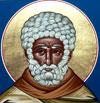 St. Moses the Black was a thief, murderer and adulterer who through the grace of conversion was transformed into a pacifist, priest and martyr.
Born in 330, he was a slave of a government official in Egypt who dismissed him for theft and suspected murder. A large, imposing figure, he became the leader of a gang of bandits who roamed the Nile Valley spreading terror and violence. Attempting to hide from authorities, he took shelter with some monks in the desert near Alexandria. The dedication of their lives, as well as their peace and contentment, deeply influenced him. He gave up his sinful ways and joined the community. While he struggled a long time with monastic discipline, he became renowned for his mercy and zealous love of God and neighbor.
At some point, he was ordained a priest and became the leader of a colony of desert hermits. At about age 75, about the year 407, word came that a group of renegades planned to attack the colony. The brothers wanted to defend themselves, but Moses forbade it. He told them to retreat, rather than take up weapons. He and seven others remained behind and greeted the invaders with open arms. All eight were martyred by the bandits.
His feast day is Aug. 28.
ST. PACHOMIUS
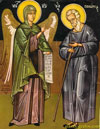 St. Pachomius can justifiably be called the founder of cenobitic monasticism (monks who live in community). Even though St. Anthony of Egypt was the first to go into the desert to pursue Christian perfection, he lived a primarily solitary life.
Pachomius first started out as a desert hermit, like many other men and women in the third and fourth centuries who sought the most radical expression of Christian life. There he developed a strong bond of friendship with the hermit Palemon. One day during prayer, he had a vision calling him to build a monastery. He was told in the vision that many people who were eager to live an ascetic life in the desert, but were not inclined to the solitary life of a hermit, would come and join him. Palemon helped him to build the monastery along the Nile River. Pachomius insisted that his cenobites were to aspire to the austerity of the hermits, but he knew that his idea was a radical one, because most of the men who came to live in his monastery had only ever conceived of the solitary lifestyle. His great accomplishment was to reconcile this desire for austere perfection with an openness to taking care of the mundane, day-to-day needs of community life as an expression of Christian love and service.
To aid the brothers in adjusting to a monastic life in community, he drew up a "rule" that was said to have been dictated to him by an angel. It is this rule that both St. Benedict in the west and St. Basil in the east drew upon to develop their better known rules of monastic community life. When he died in 346, there were 11 Pachomian monasteries: nine for men and two for women.
His feast day is May 9.
ST. MAURICE
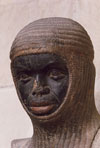 St. Maurice was a member of the Theban Legion, a Roman legion said to have been constituted by Christian soldiers from Africa, which was called to put down a revolt in Aaunum, located in modern-day Switzerland, in 287.
Two legends exist about the martyrdom of St. Maurice and his companions. According to the legends, the legion's soldiers were either ordered to take part in pagan sacrifices, or ordered to harass and kill some local Christians. In either event, the 6,600 men of Maurice's legion refused. In punishment for their disobedience, every 10th man in the legion was killed. When the remaining soldiers, fortified by St. Maurice, still refused, other legions were called in to force them to follow their orders. Persisting in their refusal, they were all massacred.
His feast day is Sept. 22.
ST. ATHANASIUS
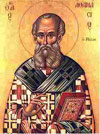 St. Athanasius, the great champion of the faith and Doctor of the Church, was born in Alexandria about the year 296, of Christian parents. Educated under the eye of Alexander, later bishop of his native city, he made great progress in learning and virtue. In 313, Alexander succeeded Achillas in the Patriarchal See, and two years later St. Athanasius went to the desert to spend some time in retreat with St. Anthony of Egypt (of whom he later wrote a biography that popularized monastic life).
In 319, he became a deacon and was called upon to oppose the rising heresy of Arianism, which was to become his life's struggle.
In 325, he assisted Bishop Alexander at the Council of Nicaea, where the Nicene Creed was formulated and the dual nature of Christ as both God and man was affirmed. Five months later Bishop Alexander died, and on his death bed he recommended St. Athanasius as his successor. Athanasius was unanimously elected patriarch in 326.
His refusal to tolerate the Arian heresy was the cause of many trials and persecutions for him. He spent 17 of the 46 years of his episcopate in exile. After a life of virtue and suffering, this intrepid champion of the Catholic faith died in peace on May 2, 373.
ST. MARY OF EGYPT
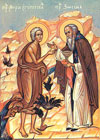 April 1 is the feast of a little-known saint whose story demonstrates the power of the Church as the home of forgiveness, redemption and mercy. St. Mary of Egypt was a prostitute for 17 years before she received the Eucharist and chose the life of a hermit.
Born in 344, she moved to Alexandria when she was 12 to work as a prostitute. With the intention of plying her trade, she joined a large group making a pilgrimage to Jerusalem for the Feast of the Exaltation of the Holy Cross. On the feast day itself, she joined the crowd as it was headed to the church to venerate the relic of the True Cross, again with the intention of luring others into sin. When she got to the door of the church, she was unable to enter. A miraculous force propelled her away from the door each time she approached. After trying to get in three or four times, she moved to a corner of the churchyard and began to cry in remorse.
Then she saw a statue of the Blessed Virgin Mary. She prayed to Mary for permission to enter the church for the purposes of venerating the relic, and she promised her that if she were allowed to enter the church, she would renounce her sinful ways.
She entered the church, venerated the relic and returned to the statue outside to pray for guidance. She heard a voice telling her to cross the Jordan River and find rest. She set out and that evening she arrived at the Jordan and received Communion in a church dedicated to St. John the Baptist.
The next day, she crossed the river and went into the desert, where she lived alone for the next 47 years. Then, while making his Lenten retreat, a priest named Zosimus found the hermitess. She asked him to return to the banks of the Jordan on Holy Thursday of the following year and to bring her Communion. The priest was true to his word and returned bearing the Eucharist. Mary told him to come back again the next year, but to the place where he had originally met her.
When Zosimus returned in a year's time, he found Mary's corpse. On the ground beside it was a written request that she be buried accompanied by a statement that she had died one year ago, in 421, on the very night she had received Communion.
ST. CYRIL OF ALEXANDRIA
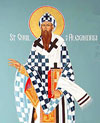 St. Cyril of Alexandria, Doctor of the Church, is best known for his role in the Council of Ephesus, where the Church confirmed that Christ is both God and man in one Person.
He was born in Alexandria between 370 and 380, the nephew of the patriarch of that city, Theophilus. He received a classical and theological education and was ordained by his uncle. He succeeded his uncle as patriarch of Alexandria in 412, but only after a riot between his supporters and the followers of a rival.
In 430 he became embroiled with Nestorius, patriarch of Constantinople, who was preaching that Mary was not the Mother of God but only the mother of Christ the man – thereby denying Christ's dual nature as both human and divine. He persuaded Pope Celestine I to convoke an ecunemical council at Rome from June 22 to July 31, 431. It was a tumultuous affair, with rival prelates from Constantinople and Alexandria and their advocates sometimes getting physically violent. But Cyril brilliantly defended the orthodox belief in Christ as a single eternally divine Person who also became incarnate as a man. The council condemned Nestorius, who was deposed as patriarch and later exiled.
During the rest of his life, Cyril wrote treatises on the Trinity and the Incarnation which helped prevent Nestorianism and other heresies from taking deep root in the Church. He was a brilliant theologian, and among his writings are commentaries on John, Luke and the Pentateuch, treatises on dogmatic theology, and letters and sermons. He died in 444 after serving as bishop for nearly 32 years. He was declared a Doctor of the Church by Pope Leo XIII in 1882.
His feast day is June 27.
ST. MONICA
Raised a Christian, St. Monica was married off to a much older and violent-tempered official in North Africa who was a pagan. His mother lived with them and was equally difficult, which proved a constant challenge to St. Monica. She had three children: Augustine, Navigius and Perpetua. Through her patience and prayers, she was able to convert her husband and mother-in-law to the Catholic faith in 370. Her husband died a year later. Perpetua and Navigius entered religious life.
St. Augustine was much more difficult, as she had to pray for him for 17 years, begging the prayers of priests who, for a while, tried to avoid her because of her persistence at this seemingly hopeless endeavor. One priest did console her by saying, "it is not possible that the son of so many tears should perish." This thought, coupled with a vision that she had received, strengthened her. St. Augustine was baptized by St. Ambrose in 387. St. Monica died later that same year, on the way back to Africa from Rome. Her feast day is Aug. 27.
ST. AUGUSTINE
St. Augustine's complete turnaround and conversion from a life of loose living and ambition has been an inspiration to many who struggle with a particular vice they long to break.
This famous son of St. Monica was born in Africa and spent many years of his life in wicked living and false beliefs. Though he was one of the most intelligent men who ever lived and though he had been brought up a Christian, his sins of impurity and his pride darkened his mind so much that he could not see or understand the Divine Truth anymore. Through the prayers of his holy mother and the powerful preaching of St. Ambrose, Augustine finally became convinced that Christianity was the one true religion. Yet he did not become a Christian then, because he thought he could never live a pure life. One day, however, he heard about two men who had suddenly been converted on reading the life of St. Anthony, and he felt ashamed.
"What are we doing?" he cried to his friend Alipius. "Unlearned people are taking Heaven by force, while we, with all our knowledge, are so cowardly that we keep rolling around in the mud of our sins!"
Full of sorrow, he flung himself out into the garden and cried out to God, "How long more, O Lord? Why does not this hour put an end to my sins?" Just then he heard a child singing, "Take up and read!" Thinking that God intended him to hear those words, he picked up the book, the Letters of St. Paul, and read the first passage he saw. It was just what Augustine needed, for in it, St. Paul says to put away all impurity and to live in imitation of Jesus. From then on, he began a new life.
He was baptized, became a priest, bishop, writer, theologian and one of the greatest saints who has ever lived. He recounted his remarkable conversion story in "The Confessions," the most intimate and well-known glimpse into a person's soul ever written. Besides seminal writings on the Trinity, Christian piety and Catholic doctrine, he also wrote "The City of God" to refute allegations that Christianity caused the decline of the Roman empire.
St. Augustine overcame strong heresies, practiced great poverty and supported the poor, preached very often and prayed with great fervor right up until his death in 430. "Too late have I loved You!" he once cried to God, but with his holy life he certainly made up for the sins he committed before his conversion.
He was one of the most significant and influential thinkers in the history of the Church, and his teachings were the foundation of Catholic doctrine for a millennium.
Forever linked to his persistent mother St. Monica, his feast day is one day after hers: Aug. 28.
ST. THECLA
According to a popular 2nd century tale, "Acts of Paul and Thecla," she was a native of Iconomium who was so impressed by the preaching of St. Paul on virginity that she broke off her engagement to marry Thamyris to live as a consecrated virgin. Paul was ordered to be scourged and banished from the city for his teaching, and Thecla was ordered burned to death. When a storm providentially extinguished the flames, she escaped with Paul and went with him to Antioch. There she was condemned to wild beasts in the arena when she violently resisted the attempt of Syriarch Alexander to kidnap her, but again escaped when the beasts did no harm to her. She rejoined Paul at Myra in Lycia, dressed as a boy, and was commissioned by him to preach the Gospel. She did for a time in Iconium and then became a recluse in a cave at Meriamlik near Seleucia. She lived as a hermitess there for the next 72 years and died there (or in Rome, where she was miraculously transported when she found that Paul had died and was later buried near his tomb). The tale had tremendous popularity in the early Church but is undoubtedly a pious fiction and was labeled apocryphal by St. Jerome.
Her feast day is Sept. 23.
ST. BENEDICT THE MOOR
St. Benedict the Moor, a lay brother, was born in Sicily in 1526. He was the son of African slave parents, but he was freed at an early age. When he was about 21 he was insulted because of his color, but his patient and dignified bearing caused a group of Franciscan hermits who witnessed the incident to invite him to join their group. He became their leader. In 1564 he joined the Franciscan friary in Palermo and worked in the kitchen until 1578, when he was chosen superior of the group. He was known for his power to read people's minds and held the nickname of the "Holy Moor." His life of austerity resembled that of St. Francis of Assisi.
His feast day is April 4.
ST. MARTIN DE PORRES
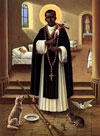 The only black saint from the Western Hemisphere so far, St. Martin de Porres was born in Lima, Peru, in 1579. His mother was a freed slave from Panama, and his father was a Spanish gentleman who did not want him. Early in his life, he demonstrated humility, charity for the poor and a love for animals, and devotion to the Blessed Virgin Mary. At the age of 11, he took a job as a servant in the Dominican friary in Lima and performed the work with such devotion that he was called "the saint of the broom."
He spent the rest of his life in the friary – as a barber, farm laborer, almoner (church worker in charge of distributing money to the poor) and infirmarian (person who nurses the sick in a monastery), among other tasks. As almoner he routinely begged more than $2,000 a week from the rich, which was turned into food, clothing and medicine for the poor of the city.
Martin had a great desire to go off to some foreign mission and thus earn martyrdom. However, because this was not possible, he made a martyr out of his body, devoting himself to ceaseless and severe penances. In turn, God endowed him with many graces and gifts, such as aerial flights and bilocation.
St. Martin's love was all-embracing, shown equally to humans and to animals, even vermin, and he maintained a shelter for stray dogs and cats.
In recognition of his devotion, his superiors dropped the stipulation that "no black person may be received to the holy habit or profession of our order" and Martin was vested in the full habit and professed solemn vows as a Dominican brother. Afterwards, he became more devout and more desirous to be of service, establishing an orphanage and a children's hospital.
A close friend of St. Rose of Lima, he died on Nov. 3, 1639, and was canonized on May 6, 1962. His feast day is Nov. 3.
ST. CHARLES LWANGA AND COMPANIONS
 The Society of Missionaries of Africa (known as the White Fathers) had been in Uganda for only six years but had built up a community of converts who were soon gaining new converts themselves. Many of these converts lived and taught at the royal court, where the violent ruler and pedophile King Mwanga routinely forced himself on the young boys and men who served him as pages and attendants. Led by the king's chief steward, 25-year-old Joseph Mkasa, the Christians among the king's court tried to protect the younger boys.
When the king killed a Protestant missionary and his companions, Mkasa confronted Mwanga. The king struck him with a spear and ordered him killed. When the executioners tried to tie his hands, he told them, "A Christian who gives his life for God is not afraid to die." He forgave Mwanga before being beheaded and then burned on Nov. 15, 1885.
After other Christians were martyred by the king, Charles Lwanga took over instructing the young Christian community – and the charge of keeping the boys and men away from the king. When the king learned that another page was being taught the faith, he thrust a spear through the young man's throat and sealed the royal compound. Knowing what was coming, Lwanga baptized four catechumens that night. The next morning Mwanga separated the Christians from the rest, saying, "Those who do not pray stand by me, those who do pray stand over there." He demanded of the 15 boys and young men (all under 25) if they were Christians and intended to remain Christians. When they answered "yes," he condemned them to death. They were marched 37 miles to Namugongo, where those who were not killed along the way were burned to death on June 3, 1886.
The White Fathers were expelled from Uganda, but when they returned after Mwanga's death, they found 500 Christians and 1,000 catchumens waiting for them.
ST. JOSEPHINE BAKHITA
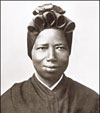 Josephine Bakhita, born in 1869, was a Sudanese-born former slave who became a Canossian nun in Italy, living and working there for 45 years.
She was known for her smile, gentleness and holiness. She even once said, "If I were to meet the slave-traders who kidnapped me and even those who tortured me, I would kneel and kiss their hands, for if that did not happen, I would not be a Christian and Religious today."
She died in 1947, and in 2000, she was became the first African woman to be canonized in modern times. She is the first person to be canonized from Sudan and is the patron saint of the country.
Her feast day is Feb. 8.
OTHER NOTABLE BLACK CATHOLICS
Father Augustus Tolton is among four African-American Catholics whose sainthood causes have been opened.
The other three are:
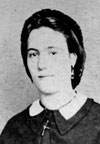 — Mother Henriette Delille, foundress of the Sisters of the Holy Family in New Orleans, who has been declared venerable
A free woman of color living in New Orleans in the 19th century, Delille wanted to be a religious but legal and social restraints 20 years before the abolition of slavery and the Civil War prevented local communities from accepting her. Therefore, she and two other free women sought to form their own. The Church gave them permission to form a pious society that took no vows and whose members were free to withdraw as they wished. They aided the poor, the sick, the elderly and helpless, the lonely, and the uninstructed who needed care.
Hundreds of more women soon followed them in consecrating themselves to God's service as Sisters of the Holy Family, and Delille was named their leader. Known as the "Servant of Slaves," Delille died in 1862.
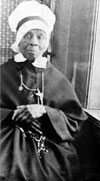 — Mother Mary Elizabeth Lange, foundress of the Oblate Sisters of Providence
Elizabeth Clarisse Lange's parents were refugees who fled to Cuba from the revolution taking place in their native Saint Dominque (present-day Haiti). Her father was a gentleman of some financial means and social standing. Her mother was a Creole. However, in the early 1800s young Elizabeth left Santiago de Cuba to seek peace and security in the United States. Providence directed her to Baltimore, where a great influx of French-speaking Catholic San Dominguios refugees was settling.
She was a courageous, loving, and deeply spiritual woman, and a strong, independent thinker and doer. Although she was a refugee, she was well educated and had her own money. It did not take long to recognize that the children of her fellow refugees needed education. She determined to respond to that need in spite of being a black woman in a slave state long before the Emancipation Proclamation. She used her own money and home to provide free education to children of color, and eventually founded the Oblate Sisters of Providence, the first Black Catholic order in the United States.
Lange practiced faith to an extraordinary degree. In fact, it was her deep faith which enabled her to persevere against all odds. To her black brothers and sisters she gave of herself and her material possessions until she was empty of all but Jesus, whom she shared generously with all by being a living witness to His teaching. She died in 1882.
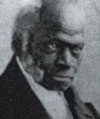 —Pierre Toussaint, who was brought to New York as a slave and later became a well-known philanthropist, also declared venerable
Coming to New York from Haiti in 1787 with his owner, Jean Bérard, Pierre Toussaint was apprenticed to a New York hairdresser. He became a friend to the city's aristocracy by dressing the hair of wealthy women, and when Bérard died penniless, Toussaint financially supported Bérard's wife and nursed her through emotional and physical ailments. She granted him his freedom in 1807.
His stable income allowed him to buy freedom for his sister and his future wife, and to be generous with many individuals and charities, including an orphanage and school for black children. He not only provided money, but manifested genuine care and concern for the afflicted. He cared for the ill when yellow fever swept the city and opened his home to homeless youth, teaching them violin and paying for their schooling. His wife shared in his philanthropic efforts, and their home became a shelter for orphans, a credit bureau, an employment agency and refuge for priests and poverty-stricken travelers.
Proud to be black, Toussaint generously supported the Oblate Sisters of Providence in Baltimore. He was also a benefactor of the First New York City Catholic school for black children.
In his later years, Toussaint still worked to help others. One of his clients advised him, "Toussaint, you are the richest man I know, why not stop working?" He replied, "Then I should not have enough to help others, madam." Two years after his wife's death, he died in 1853 aged 87.
SISTER THEA BOWMAN
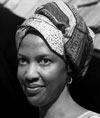 Bertha Bowman was born in a small town in Mississippi in 1937, the granddaughter of a slave. Raised a Methodist, she fell in love with Catholicism from the teachers at her school, the Franciscan Sisters of Perpetual Adoration. She converted to Catholicism and at 15, she joined the order and took the name Thea, meaning "of God."
She was sent to La Crosse, Wis., where she studied and taught until 1961, when she returned to her hometown to teach at her old school before going on to pursue doctoral studies in English at The Catholic University of America. She later taught at Catholic University and at Xavier University in New Orleans.
After 16 years as an educator at the elementary, secondary and university level, she was invited by the bishop of Jackson, Miss., to become a consultant for intercultural awareness. For the rest of her life she dedicated her life to building up the black Catholic community and sharing the Gospel message. With her Franciscan spirit, she sought to build bridges among cultures, and to share the rich cultural and spiritual heritage of the African American people through prayer, song, teaching, writing and preaching.
She was instrumental in the creation of many Catholic multicultural and African American projects such as the first edition of "Lead Me, Guide Me," an African American Catholic hymnal. She co-founded the Institute for Black Catholic Studies at Xavier University, and she helped found the National Black Sisters Conference in 1966.
In 1984, when she was only in her 40s, she was diagnosed with breast cancer. But she did not let her declining health slow her down. Confined to a wheelchair, she gave an historic address to the U.S. Conference of Catholic Bishops in 1989, and she continued to inspire others with her love and joy even in the midst of her suffering.
Her fellow sisters wrote about her: "Thea lived a full life. She fought evil, especially prejudice, suspicion, hatred and things that drive people apart. She fought for God and God's people until her death in 1990."
She was posthumously awarded an honorary doctorate in theology from Boston College, the first to any African American woman.
— Sources: Catholic News Agency, www.catholiconline.com, www.AmericanCatholic.org, www.catholic.org, EWTN, The Catholic Encyclopedia, Wikipedia
 WASHINGTON, D.C. — When Erin Bullock steps in front of the altar at the Cathedral of St. Matthew the Apostle in Washington, she is there to sing parts of the liturgy and to guide members of the congregation through song.
Her role as cantor at the church is as visible as the priest's during an October Mass and much of the music she intones with her striking soprano -- along with the choir and people in the pews -- is the unadorned resonances of Gregorian chant.
The melodic sounds are unique and often called mysterious.
When performed by the choir, the chants are typically sung in unison without rhyme, meter or musical accompaniment, with the tones rising and falling in an unstructured fashion.
The tradition of sung prayer dates back to the first millennium, with Gregorian chant becoming the proper music of the mature Roman rite, said Timothy S. McDonnell, director of the Institute of Sacred Music at The Catholic University of America in Washington.
Gregorian chant was standard in the Mass in the 1950s, but fell out of favor after the Second Vatican Council, when the traditional Latin Mass was changed to the dominant language of each country.
Though it has regained popularity in the past few decades, the chant is not the principal music in most U.S. Catholic parishes, McDonnell told Catholic News Service.
Categorically speaking, Gregorian chant is sacred music, but not all sacred music is Gregorian chant.
What distinguishes the chant is that the songs are actual prayers and text vital to the liturgy, said Elizabeth Black, assistant music director of St. John the Beloved Catholic Church in McLean, Virginia.
For instance, when the priest sings, "the Lord be with you," and the congregation responds in song, "and with your spirit," they are performing Gregorian chant, because those holy texts are an essential part of the Mass, Black told Catholic News Service during a recent interview.
Most Catholics have performed Gregorian chant, whether they know it or not, said David Lang, music director of Theological College, a national seminary at The Catholic University of America.
"If you are singing a part of the liturgy that is an essential part of the Mass, you are singing Gregorian chant," Lang said. "Even if you are singing a simple response, that's chant."
Though hymns -- often layered in rich harmonies -- may be liturgical in nature, those songs are meant to decorate the Mass with meditative spirituality and are not a crucial part of the liturgy, Black said.
It's one of the reasons the chant is traditionally sung a capella in plain, monophonic tones, McDonnell said, making the text the focal point of the music. However, there are exceptions to that unofficial chant rule, and some choirs add harmonies and occasionally insert musical accompaniment.
Singing has been a part of the liturgy since the early days of the Catholic Church, but Gregorian chant -- which began to take shape in the ninth century -- is the earliest form of liturgical music that was written and preserved for the historical record, he said.
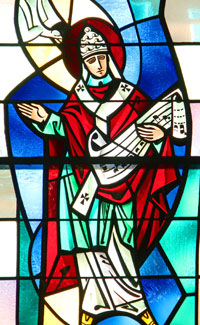
Gregorian chant is named for St. Gregory the Great, who was pope from 590 to 604.
It's unlikely that Pope Gregory I had any direct involvement in developing Gregorian chant, but he was a building pope who helped reorder the liturgy in a more practical way, creating an artistic environment necessary to establish some form of plain chant, McDonnell said.
The music we identify today as Gregorian chant really began to develop several generations after St. Gregory the Great's death, "and in fact, most historians think it's Pope Gregory II (715-731), who reigned about 100 years later, who was the Pope Gregory who actually had more of a hand in formulating this body of chants that we call Gregorian chant," he said.
"You might call it poetry in music, it's very simple in some ways," said Thomas Stehle, director of music ministries at the Cathedral of St. Matthew the Apostle, "and yet complex at times."
Throughout the centuries, the chant became a natural part of the liturgy, because of the simplicity of the sung recitation from the priest and response of chanted text by the congregation, with the choir handling the more complex music, said James Senson, music director of St. John the Beloved.
"Gregorian chant can be incredibly advanced, complicated, involved and with a high level of artistic value," McDonnell said. "At the same time, so much of its beauty resides in its simplicity and the fact that much of it can also be accessible to the congregation and by children.
"Anybody can learn to sing some amount of Gregorian chant," he said, "and the church over the years has categorized the chants according to their accessibility. So, there are many chants that are expected to be sung as part of the liturgy by the faithful and those chants really are every bit as much Gregorian chant as the more florid and elaborate ones."
The music was seen as enhancing the sacred texts with an art form.
"As St. Augustine noted, when we pray in song, it's almost as if we're praying twice," Stehle said. "In some ways, it helps carry the emotion of the chant more effectively."
Though Gregorian chant eventually became the music of the church, it's use has had periods of intense popularity throughout the centuries and eras when it receded, McDonnell said.
The causes of these waves are variable, he said.
"In many cases it simply was things like the fall of cities and the fall of Rome," McDonnell said.
"In the 15th century, when the popes came back from Avignon (a period from 1309 to 1376 during which seven popes resided in Avignon, France, rather than in Rome), the city was in absolute ruins, so the culture of Rome had to be rebuilt," he said. "Whenever you take time to invest clergy, to invest resources in the cultivation of sacred things, the art grows again. So, we saw Gregorian chant flourish again."
However, in the 16th century, after culture was put back together, Renaissance polyphony -- with its elaborate texturized harmonies -- became the dominant music in the church and eclipsed Gregorian chant for a time, McDonnell said.
The chant underwent another revival in the early 20th century with liturgical reforms in Pope Pius X's "Tra Le Sollecitudini" ("Among the Concerns") in 1903.
Then in 1947 Pope Pius XII issued his encyclical "Mediator Dei" ("On the Sacred Liturgy"), encouraging active participation by the laity in the liturgy, further reinforcing Gregorian chant, Black said.
"He has a very specific paragraph on Gregorian chant," she said, "where out of the blue he actually says Gregorian chant enables people to participate actively and that this is the people's music and they should be singing it."
While documents issued during Vatican II in the 1960s supported the use of Gregorian chant, the switch from the Latin Mass to the vernacular prompted most parishes to favor musical forms similar to popular culture, such as praise and worship and folk genres, McDonnell said.
The philosophy was, if you are celebrating Mass in the language of the culture, you should be singing in musical genres popular in local societies, he said.
Then, in the 1990s, an enormously popular album recorded by the Benedictine monks of Santo Domingo de Silos, Spain, titled "Chant" was released, once again renewing interest in the practice, he said.
Though Gregorian chant isn't the principal force in parish life that it once was, McDonnell said that if history repeats itself, it's in the recovery stage and could once again become a church music staple.
— Chaz Muth, Catholic News Service
Popularity of Gregorian chant has flourished in recent years
WASHINGTON, D.C. — James Senson grew up in the Virginia Beach, Virginia, area in the 1980s and his exposure to music in his home parish sounded remarkably similar to the tunes played on popular radio stations in the region.
"You know, there was nothing really special about the music, nor did it really say something about the church to me in it," said Senson, a Filippino-American who's had a passion for music since he was a child.
Senson had drifted away from religion by the time he was a college-age adult, but his love of music flourished.
When he discovered Gregorian chant near the turn of the century, he was inspired to reconnect with the church.
"This music was so different and mysterious to me," Senson told Catholic News Service during a recent interview. "It was telling me something. It was leading me somewhere."
It eventually led him to Catholic music ministry and the 33-year-old is now music director at St. John the Beloved Catholic Church in McLean, Virginia, a parish community where Gregorian chant is the principal sound.
This church community is unique in that the ancient sounds of Gregorian chant are deeply woven into its fabric, interlaced in every Mass, every choir and the education of the students in the parish school.
Church leaders at St. John the Beloved made the bold decision in 2005 to switch its music from the praise and worship genre to sacred music featuring Gregorian chant, decades after the practice fell out of favor following the Second Vatican Council.
It turns out that parish is part of a growing trend in American Catholic culture in which Gregorian chant is slowly being re-embraced.
That movement began following the success of a 1990s album titled "Chant," recorded by the Benedictine monks of Santo Domingo de Silos, Spain, said Timothy S. McDonnell, director of the Institute of Sacred Music at The Catholic University of America.
"People became interested in it," McDonnell told CNS. "Then you would start to hear Gregorian chant as samples in popular music. You'd start to hear it in soundtracks, things like that. So, Gregorian chant became popular with all kinds of people with all kinds of belief systems."
That was a turning point for some church officials who recognized the music had intrinsic value, he said. "That this is our proper music for our liturgy. That movement of recovery of this material I think started at that point when it was recognized more broadly as a tremendous treasure."
Though still not the core music in most American Catholic parishes, Gregorian chant continues to gain popularity among the youth, said Scott Turkington, director of sacred music at Holy Family Catholic Church and the parish school, Holy Family Academy, in St. Louis Park, Minnesota.
Young Catholics -- intrigued by the chant famous for its long melodic lines where several notes are sung on one syllable -- began asking questions about the music, its history and how it enhances the liturgy, Turkington told CNS.
Catholic Church music directors throughout the country recognized "that we should give young people what they want," he said. "They want a sense of beauty. They want a sense of mystery."
Turkington discovered that Gregorian chant was an effective tool in teaching children the importance of sacred music in the church.
"If you give Gregorian chant to kids, they love it," Turkington said.
With the help of the leaders of his parish, Turkington opened a summer camp in 2014 at the church dedicated to introducing youngsters to Gregorian chant.
Additionally, Turkington hosts a weeklong session for high schoolers, teaching them how to read chant notation and perform a concert at the end of the educational program at Holy Family.
He and other members of the Church Music Association of America continue to uphold the value of traditional music by actively teaching it to others.
Every year the association hosts a symposium that invites priests, musicians and choristers to immerse themselves in Gregorian chant.
Turkington was among the workshop leaders in St. Paul, Minnesota, last June.
The 250 conference attendees learned ways to teach Gregorian chant in their parishes. Turkington believes it is important for the those participants to "go home and improve the liturgies of their own parishes.
"Not to go home to be in an ivory tower and meditate upon these things," he said. "To go home and put them into practice and teach their own choir, teach their congregations and teach their pastors."
The growing number of conferences and camps throughout the U.S. dedicated to Gregorian chant leads McDonnell to believe there is a bright future for the music in American Catholic church communities.
Though documents from Vatican II are supportive of the use of Gregorian chant, church leaders in the 1970s faced difficulties in incorporating the music -- all written in Latin -- in a Mass that was now celebrated in the dominant language of the culture, he said.
The natural response was to adopt music in the native language, McDonnell said, much of which came in the form of genres popular in the culture.
Gregorian chant also was seen as something that was old at a time when liturgical reforms from Vatican II were transforming the Mass into something new, he said.
Senson said he understands the reasoning for implementing new musical styles in the Mass that fit that particular generation of Catholics.
However, in his view, what these parishes accomplished was generating music that sounded dated a decade later and wasn't uniquely Catholic.
"You could walk into any Protestant church and hear the same kind of music," Senson said. "When you hear Gregorian chant, you know you are hearing something connected to the ancient church and it's timeless. It's not dated, because it's the music of the Catholic Church."
Gregorian chant today isn't just limited to Latin. During the course of the past few decades, composers have scored English arrangements and compositions in other languages, McDonnell said.
"There's been a flowering of publication of English-language version of Gregorian melodies and changes that have emerged over the years," McDonnell said. "Even if you are not using the original Gregorian chant in Latin, there is some sense of the chant style and the sacred nature of chant is being recaptured."
Catholics now are used to hearing the Mass celebrated in their native tongue, Turkington said.
"Latin is not in the ears of (today's) average man and woman who go to Mass on Sunday," he said. "If you're from France, you want to hear Mass in French. If you are from Colombia, you want to probably hear Mass in Spanish."
The increased popularity of the chant in recent years has extended beyond the Catholic Church, McDonnell said. "There are people who don't really have a connection to the institutional church, but who find Gregorian chant as attractive."
The appreciation of the chant's beauty is more than just the resonances of the music, but resides in the text, which are prayers, scripture and liturgy essential to the Mass, Turkington said.
"If the music in the church is really appropriate and mysterious," he said, "the texts of the Gregorian chant … are really substantial."
— Chaz Muth and Jose Montoya, Catholic News Service