

 The music associated with the Christmas season has always maintained a special place in the Catholic Church and in the hearts of the faithful. There are many beloved sacred music works linked to this season, from G.F. Handel’s “Messiah” and Arcangelo Corelli’s “Christmas Concerto” to J.S. Bach’s “Christmas Oratorio.” One sacred Christmas Vespers text, however, seems to have captured the imagination of composers through the centuries more than any other: “O Magnum Mysterium.”
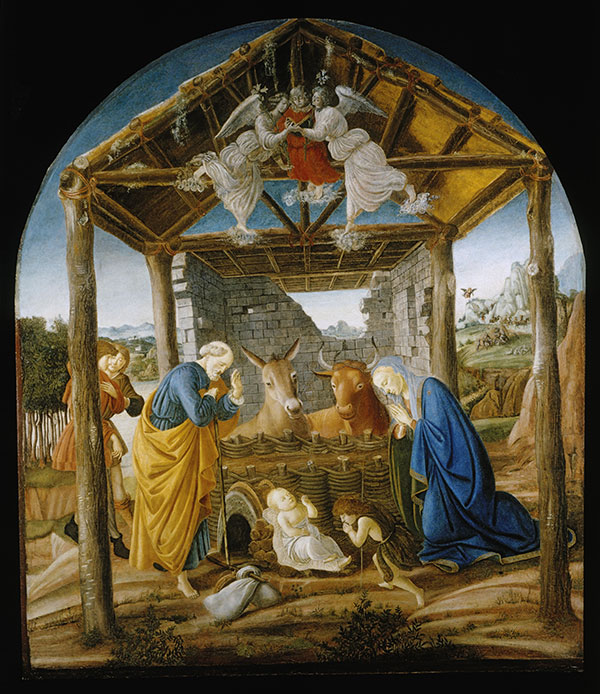
I was recently reminded of the beauty of this text prior to a Mass at St. Bartholomew Church in Sharpsville, Pa., when their phenomenal and holy priest, Father Matthew J. Strickenberger, was playing the work. As the title “O Great Mystery” suggests, the text describes the great mystery of the Nativity of Our Lord, lying in a manger with animals looking on, and closing with a reference to Our Blessed Lady whose virgin womb bore the Christ Child. While joyful, it is a reserved wonder and almost every composer – regardless of the century in which they lived – has set these words to music that illustrates the mysterious and sacred event.
The most famous is undoubtedly the motet by Tomás Luis de Victoria, a native of Ávila, Spain. His “O Magnum Mysterium,” written in 1572, dates from his employment in Rome as a Church musician. Three years later in the Eternal City, he was ordained a priest. In Victoria’s work, the listener is drawn into the significance of the role of Our Lady by the manner in which he sets “O beata Virgo” (“O blessed Virgin”). The phrase is preceded by two beats of silence immediately prior to enhance the syllabic text setting in homorhythmic texture, meaning there is one note per syllable with the voices sounding the words synchronously. These elements contribute to the textual clarity, to signify the importance of our Blessed Mother.
An example of a contemporary setting is by Pulitzer Prize-winning American composer Dr. Jennifer Higdon. As the composer explained, her setting of “O Magnum Mysterium” resulted from her desire “to create a bit of mystery, which is why wine glasses are a part of the piece.” Like Victoria’s composition, the work is scored for a chorus of soprano, alto, tenor and bass voices, but with texts in both Latin and English complemented by two flutes, chimes and two crystal glasses. The contemporary harmonies are quite different than the Renaissance counterpoint of Victoria, yet the work maintains the beauteous, mysterious nature of the text. A superior recording of the work can be found on the 2005 album “All Is Bright” by the Handel and Haydn Society Chorus.
Father Christopher Bond, pastor of St. Lucien Parish in Spruce Pine and St. Bernadette Mission in Linville, reflects on the text of “O Magnum Mysterium”:
“I find within ‘O Magnum Mysterium’ (in its various haunting arrangements) an extremely simple approach to the birth of Our Lord. So often, we get caught up in the anxieties of Christmas preparations that we fail to slow down to the point of mere marvel that God would humble Himself to enter our world, take on human flesh, and redeem the human person through the blood of the cross. If lowly animals can put their worries on hold and stop to ponder the glorious mystery of the Incarnation, why can’t we?”
As the faithful prepare to celebrate the Christmas season in a simpler way this year, the numerous settings of “O Magnum Mysterium” – in particular, the Victoria and Higdon compositions – can foster quiet devotion in pondering the stillness combined with wonder that defined the very first Christmas.
— Christina L. Reitz, Ph.D., Special to the Catholic News Herald. Christina L. Reitz, Ph.D., is professor of music at Western Carolina University in Cullowhee.
Listen to Tomás Luis de Victoria’s musical setting of “O magnum mysterium” performed by the Cambridge Singers:
‘O magnum mysterium’
O magnum mysterium,
et admirabile sacramentum,
ut animalia viderent Dominum natum,
iacentem in praesepio.
O beata Virgo, cujus viscera meruerunt
portare Dominum Iesum Christum. Alleluia.
O great mystery,
and wonderful sacrament,
that beasts should see the newborn Lord,
lying in a manger.
O Blessed Virgin, in whose unblemished womb
was carried the Lord Jesus Christ. Alleluia!
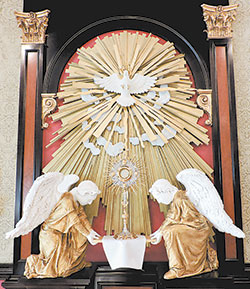 Eucharistic Adoration is the adoration of Jesus Christ present in the Holy Eucharist. In the many churches that have this adoration, the Eucharist is displayed in a special holder called a monstrance, and people come to pray and worship Jesus continually throughout the day and often the night.
Christ’s great love for us was shown when He was crucified on the cross to pay the penalty for our sins and give us eternal life. He loves us without limit, and offers Himself to us in the Holy Sacrament of the Eucharist.
The worship and custody of the Holy Eucharist, independently of Mass and Holy Communion, can be traced to post-apostolic times. St. Justin, writing in his Apology around the year 150, says that deacons were appointed to carry the Blessed Sacrament to those who were absent from the liturgy. The young St. Tarsisius was taken captive and put to death while carrying the consecrated Species on his person. St. Eudocia, martyred under Trajan, was first permitted to visit her oratory and remove a particle of the Host which she took with her to prison. What appears to be the first explicit reference to a tabernacle occurs in the Apostolic Constitutions, compiled towards the end of the fourth century, which provided that “deacons should take the remaining particles of the Sacred Species and place them in the tabernacle.”
Implicit in these and similar provisions was the Church’s constant belief in the Real Eucharistic Presence of Christ in the Blessed Sacrament. Thus, in the words of St. Augustine, “No one eats that flesh without first adoring it” (“Expositions on the Psalms,” 98:9). It was on this doctrinal basis that the cult of adoring the Eucharist was founded and gradually developed as something distinct from the Sacrifice of the Mass. At the Council of Trent, Protestants were condemned for denying that the Eucharist is at once a sacrifice and a sacrament; that it differs from other sacraments in not only producing grace “ex opere operato Christi” (deriving their power from Christ’s work), but containing in a permanent manner the Author of grace Himself.
In his 1965 encyclical “Mysterium Fidei,” Pope Paul VI wrote, “The Catholic Church has always devoutly guarded as a most precious treasure the mystery of faith, that is the ineffable gift of the Eucharist which she received from Christ her Spouse as a pledge of His immense love, and during the Second Vatican Council in a new and solemn demonstration she professed her faith and veneration for this mystery...
“No one can fail to understand that the Divine Eucharist bestows upon the Christian people an incomparable dignity. Not only while the sacrifice is offered and the sacrament is received, but as long as the Eucharist is kept in our churches and oratories, Christ is truly the Emmanuel, that is, ‘God with us.’ Day and night He is in our midst, He dwells with us, full of grace and truth. He restores morality, nourishes, virtues, consoles the afflicted, strengthens the weak. He proposes His own example to those who come to Him that all may learn to be, like Himself, meek and humble of heart and to seek not their own interests but those of God.”
Adoration means coming before the Real Presence of the Lord in the Eucharist. But what does that mean? What, or better who, is the reality of which we speak when we talk about the Real Presence?
This reality, as the Church has solemnly defined the truth for the faithful, is the “totus Christus,” the whole Christ: body and blood, soul and divinity. This is not a rhetorical expression nor a verse of poetry. It is an article of the undivided Roman Catholic faith.
There can be no doubt what the faithful are told when they are told to believe in this mystery. Once the words of consecration have been pronounced by a validly ordained priest, what used to be bread and wine are no longer bread and wine. Only the appearances or, rather, only the external physical properties of the former elements, remain. There is now on the altar Jesus Christ, true God and true man, full God and full man.
Does this mean that Jesus is present in the Eucharist? Yes. Is it Jesus in His divine nature? Yes. Is it Jesus in His human nature? Yes. But if Jesus in the Eucharist is really and truly present, is He there with all that makes Him not only man, but makes Him this man? Yes. After all, when God assumed human nature, He assumed this nature as a particular single human being. The divine Person of the Son of God did not merely in some abstract sense become human. He became a definite, historically specific human being.
Thus in the Eucharist is present the Jesus of history: the one who was conceived of His mother Mary at Nazareth; who was born in a stable at Bethlehem; who lived for 30 years in Palestine; and who walked and talked and wept and slept and ate and drank; who shed real red blood on the cross and who rose from the grave, and after His resurrection had the incredulous disciples put their fingers into His pierced side.
When, then, we speak of the Real Presence we imply that part of this reality, which is Christ, is the heart of flesh and blood that every human being has and also Christ has in the glorified body He now possesses since the resurrection.
Note what we are saying. We are affirming that the Sacred Heart of Jesus is not only a historical memory, as recorded by St. John when he tells us that the sacred side of the Savior was pierced on Calvary. Nor are we saying merely that, rising from the dead, Christ is now at the right hand of His heavenly Father in body and soul and therefore also with His human heart. Nor are we saying simply that in the Eucharist is some sort of abstract memorial of the real Christ, who is actually in heaven and no longer on earth. No; we profess on faith that Jesus is now simultaneously both in heaven and on earth; that He truly ascended into heaven and is truly still on earth; that although He left us visibly He is with us really.
This means that the heart of Christ is in our midst, because Jesus is in our midst. He is the same Jesus in heaven and on earth. So He must be present here with His Sacred Heart of flesh, living and beating in the bosom of a living human being.
He is present with His Sacred Heart, at once human and divine: human because He has a genuine human nature, like ours in all things but sin, and a truly divine nature, like that of the Father, with whom He is one God, in the unity of the Holy Spirit.
But that is not all. We know that the heart of Christ is more than just a physical organ of His human body. It is also the symbol of God’s love for the human race, and, indeed, of the eternal love (that obtains) within the Blessed Trinity.
The important aspect of this is the fact that we have in the Holy Eucharist not only the physical Christ in His human and divine natures and therefore His heart of flesh substantially united to the Word of God. We have in the Eucharist the effective means by which we can show our love for God, since it is not just our own affections when we unite them with the heart of the Eucharistic Christ. It is His affections joined with ours. His love elevates ours, and ours as a consequence is raised to a participation in the divinity.
But more than that. By our use of the Eucharist, that is, by our celebrating the Eucharistic Liturgy and by our reception of the heart of Christ in Holy Communion, we receive an increase of the supernatural virtue of charity. We are thus empowered to love God more than we would ever be able to do otherwise, especially by loving the people whom He graciously – though often painfully – places into our lives.
Whatever else the heart symbolizes, it is the world’s most expressive sign of outgoing charity.
It is precisely here that the Holy Eucharist supplies what we could never do by ourselves: loving others with total self-sacrifice. We must be animated by the light and strength that comes from the heart of Jesus Christ. If, as He said, “without me you can do nothing,” it is certainly impossible to give ourselves to others, tirelessly and patiently and continually, in a word, heartily, unless His grace gives us the power to do so.
And where does His grace come from? From the depths of His divine heart, present in the Eucharist, offered daily for us on the altar and available to us always in the sacrament of Holy Communion.
— Jesuit Father John A. Hardon
At www.therealpresence.org: Read about the history and miracles associated with Eucharistic Adoration, get resources for introducing
children to Adoration, find lots of tips on how to pray a Holy Hour, and learn more about practices such as the Forty Hours Devotion and the First Friday Devotion
Spend time with Our Lord
The Diocese of Charlotte is blessed to have Perpetual Adoration of the Blessed Sacrament offered in five locations. All of the faithful, of any age, are invited to participate! Stop by anytime or sign up for a regular Holy Hour:
BELMONT
Belmont Abbey College’s St. Joseph Perpetual Adoration Chapel, 100 Belmont-Mt. Holly Road
Margaret Fox 704-648-8947
Details: www.belmontabbeycollege.edu/about/community
CHARLOTTE
St. Gabriel Church, 3016 Providence Road
Estelle Wisneski 704-364-9568
HICKORY
St. Aloysius Church’s Immaculate Heart of Mary Perpetual Adoration Chapel, 921 2nd St. N.E.
Karen Sadlowski 828-308-5454
Details: www.staloysiushickory.org/perpetual-adoration
HIGH POINT
Pennybyrn at Maryfield Perpetual Eucharistic Adoration Chapel, 1315 Greensboro Road
Edna Corrigan 336-324-4366
Details: www.maryfieldeucharistic.org
HUNTERSVILLE
St. Mark Church’s Monsignor Bellow Perpetual Adoration Chapel (located in the Monsignor Joseph A. Kerin Family Center), 14740 Stumptown Road
Mary Sink 704-892-5107 or email This email address is being protected from spambots. You need JavaScript enabled to view it.
Details: www.stmarknc.org/adoration