


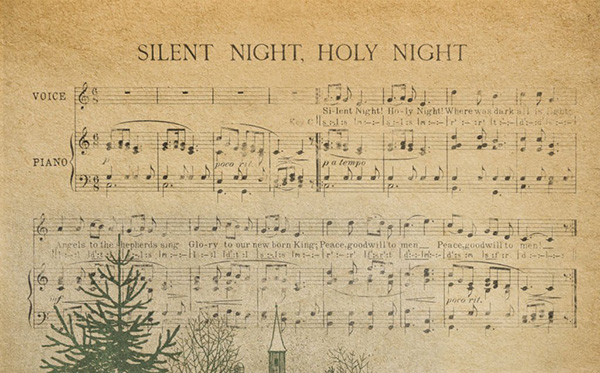
 In “The Power of Silence” by Cardinal Robert Sarah, silent music is defined as “the notes produced by the harp of our heart when it is consumed with love.” But the first Christmas night was likely not silent. References in the second chapter of Luke’s Gospel describe the praising of God by angels and shepherds, presumably in song. As such, this was likely the first Christmas music, but the magic and holiness of the season continue to inspire composers. A particular favorite of many is “Silent Night,” with words by Father Joseph Mohr and music by Franz Gruber.
Neither of these two men made a lasting impression in music beyond this collaboration. Father Mohr (1792-1848) was ordained not long before writing the six-stanza poem in 1816 that subsequently became “Silent Night.” Gruber (1787-1863), like so many with a keyboard background, worked a second gig as a church musician to supplement his income.
Their collaboration originates from 1818 in Oberndorf, Austria, when Father Mohr asked Gruber to set his poem to music. The church’s organ was unplayable for reasons that are difficult to separate fact from fiction (mice, rust, etc.). At any rate, the instrument was unusable for Christmas Eve Mass and thus the world premiere of “Silent Night (Stille Nacht)” occurred with the priest and Gruber, who accompanied on guitar, at St. Nicholas Church.
The well-known version in America varies slightly from the original melody but would be recognizable. The music is set as a “siciliana,” a slower piece in compound meter featuring dotted rhythms frequently used for a pastoral scene, appropriate for this work. The lyrics used in contemporary churches stem from a translation by the Episcopalian John F. Young and have since been translated into hundreds of languages, even Klingon!
The original St. Nicholas Church is no longer in existence, but a small chapel now stands to commemorate this beloved carol’s unassuming history. A replica of the chapel can be found in, of all places, Bonner’s Christmas Wonderland in Frankenmuth, Michigan.
Deacon Matthew Newsome, campus minister at Western Carolina University and deacon at St. Mary, Mother of God Parish in Sylva says of the hymn: “There is something in the human heart that wants to elevate our speech when we communicate with God by putting it to music. In a homily on the psalms, St. Augustine wrote that ‘it belongs to the lover to sing.’ Because of Father Mohr’s desire that his words of love for God be put to music, we have this beautiful hymn today that continues to give expression to the love of our own hearts.”
— Christina L. Reitz, Ph.D.