

Feast day: Nov. 6
 Nuno Álvares Pereira was born in the village of Bomjardin near Lisbon, Portugal, on June 24, 1360.
He was born the illegitimate son of Brother Alvaro Gonçalves Pereira, who was a professed member of the Order of Hospitalier Knights of St. John of Jerusalem. Nuno’s parents never married since his father was a professed member of a religious organization. Alvaro Gonçalves Pereira had a total of 32 illegitimate children. Nuno’s grandfather was the 97th Archbishop of Braga.
About a year after his birth, Nuno’s birth was legitimized by royal decree. This action enabled Nuno to receive a knightly education, which was the expectation for children born of nobility.
At 13 years old he became page to the queen, and he was created a knight. At the insistence of his father, Nuno, then 16, was married to a rich, young widow, Doñna Leonor de Alvim. The couple had three children, but two children died in early childhood. His daughter, Beatrice, married Alfonso, first Duke of Bragança, son of King João I (John).
Nuno, the Soldier
In 1383, the then king, Fernando, died without an heir. His brother John struggled for the throne with the King of Castile, who was married to John’s sister. Nuno supported John because he did not want Portugal to be incorporated into Castile. Several of his brothers, however, supported the King of Castile.
Throughout the war, Nuno displayed great valor. He was also acknowledged as a great military strategist. In 1384 he overcame the Castilians at the Battle of Atoleiros. As a result, at 25 years of age, he was declared constable, or supreme commander of the Portuguese army.
The constable’s courage and valor continued, when later in 1385, he won the battle of Aljubarrota and brought the war to an end. Dom Nuno Álvares Pereira became the national hero of Portugal. As a member of the nobility, and as a soldier, he gained great wealth during his first 60-plus years. Throughout his long military career, he put the interests of his nation above his own and served his people in spite of any personal risk.
Nuno, a Man of Prayer
Throughout his years as a soldier, Nuno lived a life of deep spirituality. On the field of battle, he would kneel and pray. He encouraged his soldiers to receive the sacraments as often as they could. He discouraged them from participating in immoral activities that were so common among soldiers of the day.
His life of piety included an intense devotion to the Blessed Sacrament and to the Virgin Mary. He was totally dedicated to Marian prayer, and he fasted in Mary’s honor on Wednesdays, Fridays and Saturdays.
His personal banner or standard was divided into four quadrants divided by a cross. In the quadrants was a depiction of Mary standing at the foot of the cross, Mary, Mother of God, and his two knightly role models, St. George and St. James.
Nuno also did not keep his wealth to himself. He was generous to the poor and generous to the Church. He built multiple churches dedicated to Our Lady throughout Portugal, including the Carmelite church and monastery in Lisbon.
After peace finally came to Portugal, Nuno gave away most of his wealth to war veterans.
Nuno, the Carmelite
Dom Nuno’s wife died in 1387, when he was 27 years old. He chose not to re-marry and lived a celibate lifestyle. This was a radical choice, but one built on his already acknowledged spiritual path. He dedicated himself to practices of chivalry, prayer, benevolence and living a life inspired by the Gospels. When he was 63 years old, on Aug. 15, 1423, Nuno entered the Carmel in Lisbon, a monastery that he had constructed years before.
He wanted no special treatment because of his highly respected position among the nobility of Portugal or his brilliant, victorious military career. He entered Carmel as a lay brother and took the name Brother Nuno of Saint Mary. He only wanted to serve his Lord and Mary his patroness.
In the Rule of St. Albert, the Rule followed by Carmelites, Chapter 19 speaks of spiritual armor. Nuno gave up the armor of war and took on the spiritual armor of Carmel. In his years as a Carmelite lay brother, he dedicated his life to serving the poor, and he organized a program for dispensing food to the poor and needy.
Nuno had a brilliant military career, was a member of nobility and was a friend of kings. On his deathbed he was visited by King John, who considered Brother Nuno to be his best friend. That was no wonder since it was Nuno who helped to establish John as king in the Royal House of Brançaga.
As Brother Nuno was dying, he asked that the Passion from John’s Gospel be read to him. As the reader spoke “Behold thy Mother!”, Nuno Álvares, Constable of Portugal and Carmelite Brother, died on Easter Sunday, April 1, 1431.
Nuno’s Popularity
Upon his death, Nuno was immediately considered a saint by the people who called him “O Holy Constable!” Even before his death, statues dedicated to his heroism were erected throughout Portugal.
The fame of his holiness continued to grow, as did the amount of time required to process a canonization. The process was initiated immediately by the Portuguese sovereigns and then by the Carmelite Order. Obstacles were many, but in 1894 the Postulator General for the Carmelites introduced the process again. In 1918 Dom Nuno was beatified by Pope Benedict XV. He was canonized in 2009 by Pope Benedict XVI.
— Penny Watkins, T.O.Carm. Special to the Catholic News Herald.
Sources: Vatican Archives, news notices, Carmelite informational biographies, and the Pastoral Letter from the Catholic Bishops’ Conference of Portugal.
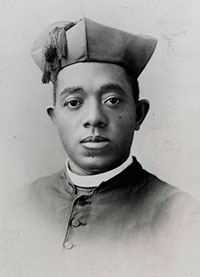 Father Augustus Tolton, a former slave, is the first recognized American diocesan priest of African descent.
The canonization cause for Father Augustus Tolton is just one step away from going to Pope Francis for the priest to be declared "venerable."
Tolton was born into slavery on April 1, 1854, at Ralls County, Brush Creek, Mo. Missouri was a slave state at the time, but its populace – a mix of settlers from both northern and southern states – was bitterly divided over the slavery question. Tolton’s mother, Martha Jane Crisley, had come to Missouri with her owners, the Elliotts, a Catholic family from Kentucky. Crisley was a personal maid to Mrs. Elliott and had been baptized in the Roman Catholic Church, as had her husband, Peter Paul Tolton, another Elliott slave. Their two sons – Augustine and his older brother Charley – were baptized in the Church and given religious instruction by Mrs. Elliott, who served as Augustine’s godmother.
When the Civil War erupted, the Tolton family, including 9-year-old Augustus, fled through the woods of northern Missouri and across the Mississippi River while being pursued by Confederate bounty hunters. The small family made their home in Quincy, Ill., a sanctuary for runaway slaves. The boy’s father had died earlier in St. Louis, after escaping slavery to serve in the Union Army.
Growing up in Quincy and serving at Mass, young Augustus felt a call to the priesthood. His parish priest, Father Peter McGirr, admitted the boy into his parish school despite racist threats. Franciscan Fathers noticed Tolton’s intelligence and purity of life and arranged for Tolton to be educated in their college in Quincy and then at the prestigious Pontifical Urban College “de Propaganda Fide” in Rome when no U.S. seminary would accept him because of his background and color.
Following six years of study he was ordained a priest with his class, Easter Vigil April 24, 1886 at St. John Lateran Basilica in Rome.
He assumed he would become a missionary priest serving in Africa. However, after ordination, he was sent back to his hometown to be a missionary to the community there, again facing rampant racism.
“It was said that I would be the only priest of my race in America and would not likely succeed,” Tolton once wrote. But Cardinal Giovanni Simeoni told him, “America has been called the most enlightened nation. We’ll see if it deserves that honor. If America has never seen a black priest, it has to see one now.”
With these prophetic words the assignment orders for Father Tolton changed from some place in Africa to Quincy, Ill.
Father Tolton served faithfully in Quincy for several years, despite enduring racial bigotry from many local Catholics and Protestants as well as jealousy from his fellow priests. He was such a good preacher that many white Catholics joined his black parishioners in the pews for his Masses. This upset white priests in the town, so Father Tolton headed north to Chicago, at the request of Archbishop Patrick Feehan, to minister to the fledgling black Catholic community there.
A year or so later, Father Tolton was given permission to start St. Monica Parish in 1891, on Chicago’s South Side, close to where many local black Catholics lived. The church seated 850 parishioners and was built with money from philanthropist Anne O’Neill and St. Katherine Drexel.
St. Monica’s Parish grew to have 600 parishioners from a base of 30 prior to the construction of the new church building. Father Tolton’s success at ministering to black Catholics quickly earned him national attention within the Church. “Good Father Gus,” as he was called by many, was known for his “eloquent sermons, his beautiful singing voice, and his talent for playing the accordion.”
A newspaper in 1893 described him: “He is a fluent and graceful talker and has a singing voice of exceptional sweetness, which shows to good advantage in the chants of the high Mass. It is no unusual thing for many white people to be seen among his congregation.”
Father Tolton worked tirelessly for his congregation in Chicago, to the point of exhaustion.
Sadly, he died before his new church building could be finished. At the age of 43, during a stifling heat wave that hit the city the week of July 9, 1897, he collapsed from heatstroke while returning from a priests’ retreat.
After a funeral that included 100 priests, Father Tolton was buried in Quincy in the priests’ lot in St. Peter’s Cemetery, which had been his expressed wish.
— Sources: Archdiocese of Chicago, Catholic News Service, the Father Tolton Guild, Wikipedia
Did you know?
On July 24, 1990, the National Black Catholic Clergy Caucus of the United States designated November as Black Catholic History Month to celebrate the history and heritage of black Catholics. November is significant because two important black saints are commemorated within the month: St. Martin de Porres’ feast day (Nov. 3) and St. Augustine’s birthday (Nov. 13). With All Saints’ Day and All Souls’ Day, we also remember the saints and souls of Africa and the African Diaspora.
Black Catholic history can be traced to the Acts of the Apostles (8:26-40) when St. Philip the Deacon converted the Ethiopian eunuch – one of the first moves the Apostles made to evangelize outside Jerusalem and thus sow the seeds for the universal Church.
Learn more
At www.nbccongress.org: Learn more about the National Black Catholic Congress and its upcoming events, download educational resources and get vocation information