

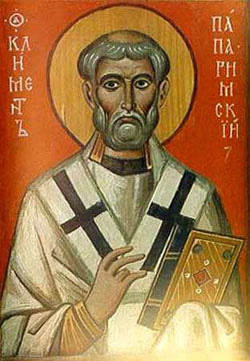
 On Nov. 23 Roman Catholics remember the fourth Pope, St. Clement I, a disciple of the Apostles who inherited the authority of St. Peter in the first century. Eastern Catholics celebrate his feast on Nov. 25.
The details of Clement's life, before his conversion and even afterward, are largely unknown. Some aspects of his writings have led scholars to believe that the fourth Pope either came from a Jewish background, or had converted to Judaism earlier in life before entering the Catholic Church.
Tradition suggests that Clement was the son of a Roman named Faustinus, and that he joined the Church in Rome during its early years through the preaching of Saint Peter or Saint Paul. He went on to share in the missionary journeys of the Apostles, and may even have assisted the first Pope in running the Church on a local level.
After the deaths of St. Peter's first two successors, the canonized Popes Linus and Cletus, Clement took up St. Peter's position of primacy in the Church around the year 90. One of his most important tasks, during nearly ten years as Pope, was to resolve serious problems in the Church of Corinth, which St. Paul had also struggled to discipline.
Clement's own letter to the Corinthians, though not part of the Biblical canon, offers an important look at the role of authority and charity in the early Church. Its introduction suggests that Pope Clement composed it while his own local church faced persecution from the Roman Emperor Domitian.
In the letter, the Pope describes how the Corinthians had once been "distinguished by humility," being "in no respect puffed up with pride" and "more willing to give than to receive." But in time, "the worthless rose up against the honored, those of no reputation against such as were renowned, the foolish against the wise, the young against those advanced in years."
"Let us give up vain and fruitless cares, and approach to the glorious and venerable rule of our holy calling," Pope Clement wrote in his call to repentance. "Let us attend to what is good, pleasing, and acceptable in the sight of him who formed us."
Order and discipline, he noted, are at least as important in the Church as they are in the rest of creation, where the powers of nature follow God's decrees. The Pope also warned the Corinthians to follow "those who cultivate peace with godliness," rather than "those who hypocritically profess to desire it."
The Church Clement headed was one that honored tradition and right order as fundamentals of its life.
"It behooves us to do all things in order, which the Lord has commanded us to perform at stated times," he told the Corinthians. God, he said, "has enjoined offerings and service to be performed ... not thoughtlessly or irregularly, but at the appointed times and hours."
"Where and by whom (God) desires these things to be done, he himself has fixed by his own supreme will, in order that all things being piously done according to his good pleasure, may be acceptable to him."
The fourth Pope's writings reveal much about the early Church, but little about his own life. According to one later account, he died in exile during the reign of the Emperor Trajan, who purportedly banished Clement to Crimea (near modern Ukraine) and had him killed in retaliation for evangelizing the local people. In 868 the Greek missionary St. Cyril claimed to have recovered St. Clement's bones.
St. Clement I probably died around the year 100. The fourth Pope is also among the saints mentioned in the Western Church's most traditional Eucharistic prayer, the Roman Canon.
— Benjamin Mann, Catholic News Agency
In honor of the Nov. 27 Marian feast, explore the history of devotion to Our Lady of the Miraculous Medal in the Gate City
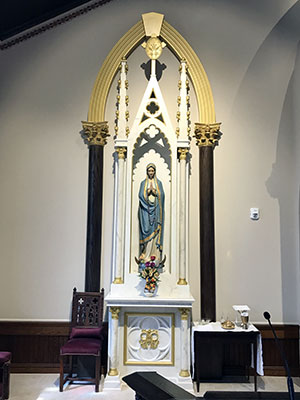 St. Benedict Catholic Church in Greensboro features a niche with a statue of Our Lady. The reverse side of the Miraculous Medal adorns the niche. Parishioners of St. Benedict have been praying the Novena to Our Lady of the Miraculous Medal for decades.A powerful and popular sacramental, the Miraculous Medal has roots in Greensboro that have grown and blossomed for well over a century, working miracles in souls and spreading the Catholic faith in the city.
For as long as anyone can remember, parishioners at St. Benedict Church in Greensboro have prayed the Perpetual Novena in Honor of Our Lady of the Miraculous Medal. However, devotion to Our Lady under this title likely began at the church before the novena was written in Philadelphia in 1930.
It may have started as early as 1899 when construction was complete for St. Benedict Church, the permanent home of the city’s first and only Catholic parish at the time. Photos show that the medal appeared above a statue of Mary in the original sanctuary and may have ties to the church’s benefactress, St. Katharine Drexel, also from Philadelphia. The popularity of the medal grew in 1906 when the Daughters of Charity of St. Vincent de Paul arrived in Greensboro from Emmitsburg, Md., to open St. Leo’s Hospital and serve at St. Benedict.
The religious order, which was dedicated to the Blessed Mother from its founding, has strong ties to the Marian apparition depicted in the medal. Our Lady appeared three times in 1830 at the order’s Paris motherhouse to Sister Catherine Labouré, a Daughter of Charity and future saint whose feast day is Nov. 28.
An Unexpected Visitor
In an apparition on Nov. 27, 1830, the Blessed Mother asked Sister Catherine to have a medal struck in the way she appeared during the vision. First the front of the medal was shown: Mary standing on a globe, with the head of a serpent beneath her feet. Rays representing graces beam from jeweled rings on her fingers. Encircling the oval shape around Our Lady is the signature, “O Mary, conceived without sin, pray for us who have recourse to thee.” On the reverse, 12 stars surrounded a large “M,” surmounted by a cross. Below the “M,” were two hearts: one circled with thorns, representing Jesus, the other pierced by a sword, symbolizing Mary.
During this dazzling vision, St. Catherine heard a voice tell her: ‘Have a medal struck after this model. All those who wear it will receive great graces; they should wear it around the neck. Graces will abound for those who wear it with confidence.’”
The medal was struck and spread far and wide in a short amount of time as its wearers reported miracle after miracle, such as dramatic healings and conversions. Devotion to Our Lady under this title has worked subtler miracles too.
“It’s been a great source of comfort, especially after the loss of my husband George in July and my daughter just three years ago,” said Roberta Van Pelt after the Nov. 19, 2023, recitation of the Miraculous Medal Novena at St. Benedict.
Van Pelt has prayed the novena since 2015 and now leads the novena recitation before the Sunday Vigil Mass each week.
“When my husband was in hospice, I prayed that I would be with him when he died,” she said. “I was there when he closed his eyes.”
Font of Religious Vocations
Devotion to Mary under this title is known to foster religious vocations and has a famous example in Alphonse Ratisbonne, an Austrian Jew, who was intensely anti-Catholic. Ater reluctantly agreeing to wear the medal and pray The Memorare, he experienced an apparition of Mary as she appears on the medal and was eventually ordained a Catholic priest.
The people of St. Benedict parish have sought the intercession of Our Lady of the Miraculous Medal for decades. Some of them must have been praying for vocations because there have been an impressive number of them from the small parish.
Monsignor Joseph Showfety, the first chancellor of the Diocese of Charlotte, was one of three examples of priestly vocations from the early days. He was ordained in 1955. Another was Father Thomas Berry, who was ordained in 1942 and had two sisters with religious vocations. In fact, eight young women at the parish went on to become religious sisters. More religious vocations sprang up, but somewhere along the way the parish lost count. There are records, however, of a boom during the 1985-1993 pastorate of Father Kimbrough. Nine men from St. Benedict went into the seminary, and three women became religious sisters.
Spreading the devotion in Greensboro
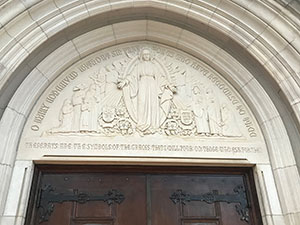 A limestone carving of Our Lady of the Miraculous Medal and related figures such as St. Catherine Labouré adorns the main entrance of Our Lady of Grace Church in Greensboro. Also on the carving are the words that appear on the medal: O Mary, conceived without sin, pray for us who have recourse to thee."
Devotion to Our Lady of the Miraculous Medal spread in 1928 to St. Mary’s, a mission of St. Benedict serving Black Catholics in Greensboro. The Emmitsburg motherhouse sent three Daughters of Charity to Greensboro to start a teaching apostolate at the mission’s Our Lady of the Miraculous Medal School with the church also bearing this title from 1948 to 1972. Around this time, devotion to Our Lady of the Miraculous Medal was skyrocketing in the United States, thanks to the work of Father Joseph Skelly, CM, who commissioned a shrine to Our Lady of the Miraculous Medal in Philadelphia. On Dec. 8, 1930, Father Skelly started the perpetual novena at the shrine, now prayed at St. Benedict and many other churches throughout the world.
In 1952, something grand happened to grow the Catholic faith and Marian devotion in Greensboro: the dedication of Our Lady of Grace Church. A memorial to St. Benedict parishioner Ethel Clay Price, the church’s patroness is the same as the one on the medal. She is seen in an array of colors in the stained-glass window behind the altar. A limestone carving of Our Lady of the Miraculous Medal graces the main entrance to the church along with key figures such as St. Catherine in her religious habit and the words the Blessed Virgin spoke to her. The devotion continues to be passed down to new generations. Leading up to the feast in 2023, children in all grades of Our Lady of Grace School learned more about the apparitions and created their own Miraculous Medals.
Today, the perpetual novena at St. Benedict is prayed before a statue of Our Lady within a niche once again adorned with the Miraculous Medal after the church's 2017 restoration. Parishioners come each week with their petitions seeking the Blessed Mother’s aid as well as her love and comfort. In the apparition, Our Lady told St. Catherine that the rings on her fingers that weren’t emitting rays of light represented unasked for graces, gentling reminding her children of what her Divine Son told us: “Ask, and it will be given you.”
— Annie Ferguson. This article includes research the author conducted for her book, “Pioneering Spirit: The History of St. Benedict Catholic Church From Inception to Restoration.”