


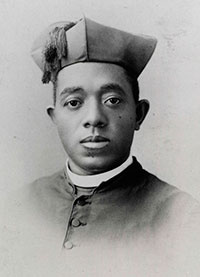
 Father Augustus Tolton, a former slave, is the first recognized American diocesan priest of African descent.
The canonization cause for Father Augustus Tolton is just one step away from going to Pope Francis for the priest to be declared "venerable."
Tolton was born into slavery on April 1, 1854, at Ralls County, Brush Creek, Mo. Missouri was a slave state at the time, but its populace – a mix of settlers from both northern and southern states – was bitterly divided over the slavery question. Tolton’s mother, Martha Jane Crisley, had come to Missouri with her owners, the Elliotts, a Catholic family from Kentucky. Crisley was a personal maid to Mrs. Elliott and had been baptized in the Roman Catholic Church, as had her husband, Peter Paul Tolton, another Elliott slave. Their two sons – Augustine and his older brother Charley – were baptized in the Church and given religious instruction by Mrs. Elliott, who served as Augustine’s godmother.
When the Civil War erupted, the Tolton family, including 9-year-old Augustus, fled through the woods of northern Missouri and across the Mississippi River while being pursued by Confederate bounty hunters. The small family made their home in Quincy, Ill., a sanctuary for runaway slaves. The boy’s father had died earlier in St. Louis, after escaping slavery to serve in the Union Army.
Growing up in Quincy and serving at Mass, young Augustus felt a call to the priesthood. His parish priest, Father Peter McGirr, admitted the boy into his parish school despite racist threats. Franciscan Fathers noticed Tolton’s intelligence and purity of life and arranged for Tolton to be educated in their college in Quincy and then at the prestigious Pontifical Urban College “de Propaganda Fide” in Rome when no U.S. seminary would accept him because of his background and color.
Following six years of study he was ordained a priest with his class, Easter Vigil April 24, 1886 at St. John Lateran Basilica in Rome.
He assumed he would become a missionary priest serving in Africa. However, after ordination, he was sent back to his hometown to be a missionary to the community there, again facing rampant racism.
“It was said that I would be the only priest of my race in America and would not likely succeed,” Tolton once wrote. But Cardinal Giovanni Simeoni told him, “America has been called the most enlightened nation. We’ll see if it deserves that honor. If America has never seen a black priest, it has to see one now.”
With these prophetic words the assignment orders for Father Tolton changed from some place in Africa to Quincy, Ill.
Father Tolton served faithfully in Quincy for several years, despite enduring racial bigotry from many local Catholics and Protestants as well as jealousy from his fellow priests. He was such a good preacher that many white Catholics joined his black parishioners in the pews for his Masses. This upset white priests in the town, so Father Tolton headed north to Chicago, at the request of Archbishop Patrick Feehan, to minister to the fledgling black Catholic community there.
A year or so later, Father Tolton was given permission to start St. Monica Parish in 1891, on Chicago’s South Side, close to where many local black Catholics lived. The church seated 850 parishioners and was built with money from philanthropist Anne O’Neill and St. Katherine Drexel.
St. Monica’s Parish grew to have 600 parishioners from a base of 30 prior to the construction of the new church building. Father Tolton’s success at ministering to black Catholics quickly earned him national attention within the Church. “Good Father Gus,” as he was called by many, was known for his “eloquent sermons, his beautiful singing voice, and his talent for playing the accordion.”
A newspaper in 1893 described him: “He is a fluent and graceful talker and has a singing voice of exceptional sweetness, which shows to good advantage in the chants of the high Mass. It is no unusual thing for many white people to be seen among his congregation.”
Father Tolton worked tirelessly for his congregation in Chicago, to the point of exhaustion.
Sadly, he died before his new church building could be finished. At the age of 43, during a stifling heat wave that hit the city the week of July 9, 1897, he collapsed from heatstroke while returning from a priests’ retreat.
After a funeral that included 100 priests, Father Tolton was buried in Quincy in the priests’ lot in St. Peter’s Cemetery, which had been his expressed wish.
— Sources: Archdiocese of Chicago, Catholic News Service, the Father Tolton Guild, Wikipedia
Did you know?
On July 24, 1990, the National Black Catholic Clergy Caucus of the United States designated November as Black Catholic History Month to celebrate the history and heritage of black Catholics. November is significant because two important black saints are commemorated within the month: St. Martin de Porres’ feast day (Nov. 3) and St. Augustine’s birthday (Nov. 13). With All Saints’ Day and All Souls’ Day, we also remember the saints and souls of Africa and the African Diaspora.
Black Catholic history can be traced to the Acts of the Apostles (8:26-40) when St. Philip the Deacon converted the Ethiopian eunuch – one of the first moves the Apostles made to evangelize outside Jerusalem and thus sow the seeds for the universal Church.
Learn more
At www.nbccongress.org: Learn more about the National Black Catholic Congress and its upcoming events, download educational resources and get vocation information