

On Aug. 28 the Church honors St. Augustine of Hippo. Augustine was born at the town of Tagaste (now Souk-Ahras, in modern day Algeria) on Nov. 13, 354, and grew to become one the most significant and influential thinkers in the history of the Church. His teachings were the foundation of Christian doctrine for a millennium.
The story of his life, up until his conversion, is written in the autobiographical "Confessions," the most intimate and well-known glimpse into an individual's soul ever written, as well as a fascinating philosophical, theological, mystical, poetic and literary work.
Augustine, though being brought up in early childhood as a Christian, lived a dissolute life of revelry and sin, and soon drifted away from the Church – thinking that he wasn't necessarily leaving Christ, of whose name he acknowledges "I kept it in the recesses of my heart; and all that presented itself to me without that Divine name, though it might be elegant, well written, and even replete with truth, did not altogether carry me away" ("Confessions," I, iv).
He went to study in Carthage and became well-known in the city for his brilliant mind and rhetorical skills and sought a career as an orator or lawyer. But he also discovered and fell in love with philosophy at the age of 19, a love he pursued with great vehemence.
He was attracted to Manichaeanism at this time, after its devotees had promised him that they had scientific answers to the mystery of nature, could disprove the Scriptures, and could explain the problem of evil. Augustine became a follower for nine years, learning all there was to learn in it before rejecting it as incoherent and fraudulent.
He went to Rome and then Milan in 386 where he met St. Ambrose, the bishop and Doctor of the Church, whose sermons inspired him to look for the truth he had always sought in the faith he had rejected. He received baptism and soon after, his mother, St. Monica, died with the knowledge that all she had hoped for in this world had been fulfilled.
st-augustine-2He returned to Africa, to his hometown of Tagaste, "having now cast off from himself the cares of the world, he lived for God with those who accompanied him, in fasting, prayers, and good works, meditating on the law of the Lord by day and by night."
On a visit to Hippo he was proclaimed priest and then bishop against his will. He later accepted it as the will of God and spent the rest of his life as the pastor of the North African town, from where he spent much time refuting the writings of heretics.
Augustine also wrote "The City of God," a response against the pagans who charged that the fall of the Roman empire, which was taking place at the hands of the Vandals.
On Aug. 28, 430, as Hippo was under siege by the Vandals, Augustine died at the age of 76. His legacy continues to deeply shape the face of the Church to this day.
The city of St. Augustine, Fla., is named for the great saint, and this year it is marking its 450th anniversary. St. Augustine's connection to the city and the parish began Aug. 28 – his feast day – in 1565, when Spanish explorer Don Pedro Menendez de Aviles sighted land off Florida's coast. He founded the new colony, St. Augustine, on Sept. 8, the same day the parish was founded.
The Diocese of St. Augustine and its cathedral, the Cathedral Basilica of St. Augustine, recently welcomed a first-class relic of the saint, on loan from the Vatican Treasury for the 450th anniversary celebration of the city and cathedral parish.
The relic is a knucklebone of a finger encased in a reliquary that is the shape of a silver and jeweled crucifix, with the inscription "Pope Pius X, 1904."
It is the first time the relic has been in the United States, and it will be on display for veneration in the Diocese of St. Augustine through Sept. 30.
— CNA/EWTN News, Catholic News Service
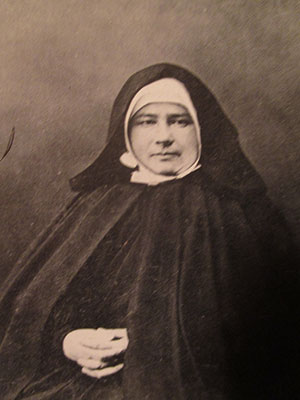 On Aug. 30, the Church celebrates St. Jeanne Jugan, also known as Sister Mary of the Cross. During the 19th century, she founded the Little Sisters of the Poor with the goal of imitating Christ’s humility through service to elderly people in need.
In his homily for her canonization in October 2009, Pope Benedict XVI praised St. Jeanne as “a beacon to guide our societies” toward a renewed love for those in old age. The pope recalled how she “lived the mystery of love” in a way that remains “ever timely while so many elderly people are suffering from numerous forms of poverty and solitude and are sometimes also abandoned by their families.”
Born on Oct. 25, 1792, in a port city of the French region of Brittany, Jeanne Jugan grew up during the political and religious upheavals of the French Revolution. Four years after she was born, her father was lost at sea. Her mother struggled to provide for Jeanne and her three siblings, while also providing them secretly with religious instruction amid the anti-Catholic persecutions of the day.
Jeanne worked as a shepherdess, and later as a domestic servant. At age 18, and again six years later, she declined two marriage proposals from the same man. She told her mother that God had other plans, and was calling her to “a work which is not yet founded.”
At age 25, the young woman joined the Third Order of St. John Eudes, a religious association for laypersons founded during the 17th century. Jeanne worked as a nurse in the town of Saint-Servan for six years, but had to leave her position due to health troubles. Afterward she worked for 12 years as the servant of a fellow member of the third order, until the woman’s death in 1835.
During 1839, a year of economic hardship in Saint-Servan, Jeanne was sharing an apartment with an older woman and an orphaned young lady. It was during the winter of this year that Jeanne encountered Anne Chauvin, an elderly woman who was blind, partially paralyzed, and had no one to care for her.
Jeanne carried Anne home to her apartment and took her in from that day forward, letting the woman have her bed while Jeanne slept in the attic. She soon took in two more old women in need of help, and by 1841 she had rented a room to provide housing for a dozen elderly people. The following year, she acquired an unused convent building that could house 40 of them.
During the 1840s, many other young women joined Jeanne in her mission of service to the elderly poor. By begging in the streets, the foundress was able to establish four more homes for their beneficiaries by the end of the decade. By 1850, over 100 women had joined the congregation that had become known as the Little Sisters of the Poor.
However, Jeanne Jugan – known in religious life as Sister Mary of the Cross – had been forced out of her leadership role by Father Auguste Le Pailleur, the priest who had been appointed superior general of the congregation. In an apparent effort to suppress her true role as foundress, the superior general ordered her into retirement and a life of obscurity for 27 years.
During these years, she served the order through her prayers and by accepting the trial permitted by God. At the time of her death on Aug. 29, 1879, she was not known to have founded the order, which by then had 2,400 members serving internationally. Father Le Pailleur, however, was eventually investigated and disciplined, and St. Jeanne Jugan came to be acknowledged as their foundress.
— Catholic News Agency