

St. Rose, whose feast we celebrate on Aug. 23, is the first saint of the New World. She was born in Lima, Peru, on April 20, 1586, the daughter of a Puerto Rican father and a Peruvian mother.
Her given name was Isabel (Elizabeth), but she was such a beautiful baby that she was nicknamed Rose, and that name remained. In 1597 she formally took the name Rose when she was confirmed by the Archbishop of Lima, Turibius de Mongrovejo, who was also to be declared a saint.
As she grew older, Rose became more and more beautiful. One day her mother put a wreath of flowers on her head to show off her loveliness to friends. But Rose had no desire to be admired, for she had already decided to consecrate her life to God. So she put a long pin into the wreath, and it pierced her so deeply that she had a hard time getting the wreath off afterward. Another time, she cut off her hair when someone admired it. She also became afraid that her beauty might be a temptation to someone, since people could not take their eyes off her, so she rubbed her face with pepper until it was all red and blistered.
Despite the censure of her parents, she spent many hours contemplating the Blessed Sacrament, which she received daily. She was determined to take a vow of virginity, in opposition to her parents, who wished her to marry. Finally, out of frustration, her father gave her a room to herself in the family home.
She practiced very intense prayer and penance daily, sometimes depriving herself of food and sleep, in emulation of St. Catherine of Siena. She began to fast three times a week and performed severe penances in secret. Her days were filled with acts of charity and industry. Otherwise, she lived as a recluse, leaving her room only to go to church.
Rose worked hard to support her poor parents and she humbly obeyed them, except when they tried to get her to marry.
The fame of her holiness became so widespread among the people of Lima that she attracted the attention of the friars of the Dominican Order. She wanted to become a nun, but her father refused. Out of obedience to him, Rose entered the Third Order of St. Dominic instead, remaining in her parents' home. At 20 she donned the habit of tertiary and took the vow of perpetual virginity.
Rose had many temptations from the devil, and there were also many times when she had to suffer a feeling of terrible loneliness and sadness, for God seemed far away. Yet she cheerfully offered all these troubles to Him. In fact, in her last long, painful sickness, this heroic young woman use to pray: "Lord, increase my sufferings, and with them increase Your love in my heart."
She was ill for the last three years of her life, and was cared for by a government official and his wife. She died, aged 31, on Aug. 24, 1617. Her funeral was held in the cathedral in Lima, attended by all the public authorities of the city, and the archbishop himself gave her eulogy.
Many miracles followed her death. She was beatified by Clement IX in 1667 and canonized in 1671 by Clement X – the first American to be so honored.
Her shrine, alongside those of her friends, St. Martin de Porres and St. John Macias, is located inside the convent of St. Dominic in Lima.
St. Rose is the patroness of Latin America and Philippines. She is also the patroness of native Indian people of the Americas and their beneficence, of gardeners, of florists, of Lima, of Peru, of the New World, and of Sittard, the Netherlands, of India, of people misunderstood for their piety and of the resolution of family quarrels.
She is represented wearing a crown of roses.
— Sources: www.catholic.com, Catholic News Agency, Wikipedia
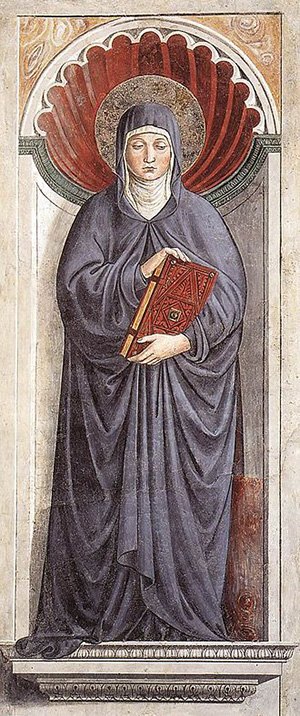 On Aug. 27, one day before the feast of her son St. Augustine, the Church honors St. Monica, whose holy example and fervent intercession led to one of the most dramatic conversions in Church history.
Monica was born into a Catholic family in 332, in the North African city of Tagaste (located in present-day Algeria). She was raised by a maidservant who taught her the virtues of obedience and temperance. While still relatively young, she married Patricius, a Roman civil servant with a bad temper and a disdain for his wife's religion.
Monica dealt patiently with his distressing behavior, which included infidelity to their marriage vows. But she experienced a greater grief when he would not allow their three children – Augustine, Nagivius and Perpetua – to be baptized. When Augustine, the oldest, became sick and was in danger of death, Patricius gave consent for his baptism, but withdrew it when he recovered.
Monica's long-suffering patience and prayers eventually helped Patricius to see the error of his ways, and he was baptized into the Church one year before his death in 371. Her oldest son, however, soon embraced a way of life that brought her further grief, as he fathered a child out of wedlock in 372. One year later, he began to practice the occult religion of Manichaeism.
In her distress and grief, Monica initially shunned her oldest son. However, she experienced a mysterious dream that strengthened her hope for Augustine's soul, in which a messenger assured her: "Your son is with you." After this experience, which took place around 377, she allowed him back into her home and continued to beg God for his conversion.
But that would not take place for another nine years. In the meantime, Monica sought the advice of local clergy, wondering what they might do to persuade her son away from the Manichean heresy. One bishop, who had once belonged to that sect himself, assured Monica that it was "impossible that the son of such tears should perish."
These tears and prayers intensified when Augustine, at 29, abandoned Monica without warning as she passed the night praying in a chapel. Without saying goodbye to his mother, Augustine boarded a ship bound for Rome. Yet even this painful event would serve God's greater purpose, as Augustine left to become a teacher in the place where he was destined to become a Catholic.
Under the influence of the bishop St. Ambrose of Milan, Augustine renounced the teaching of the Manichees around 384. Monica followed her son to Milan and drew encouragement from her son's growing interest in the saintly bishop's preaching. After three years of struggle against his own desires and perplexities, Augustine succumbed to God's grace and was baptized in 387.
Shortly before her death, Monica shared a profound mystical experience of God with Augustine, who chronicled the event in his "Confessions." Finally, she told him: "Son, for myself I have no longer any pleasure in anything in this life. Now that my hopes in this world are satisfied, I do not know what more I want here or why I am here."
"The only thing I ask of you both," she told Augustine and his brother Nagivius, "is that you make remembrance of me at the altar of the Lord wherever you are."
St. Monica died at age 56, in the year 387.
Augustine recounted her in his Confessions: "I will not speak of her gifts, but of Thy gift in her; for she neither made herself nor trained herself. Thou didst create her, and neither her father nor mother knew what kind of being was to come forth from them. And it was the rod of Thy Christ, the discipline of Thy only Son, that trained her in Thy fear, in the house of one of Thy faithful ones who was a sound member of Thy Church."
St. Monica is the patroness of abuse victims, alcoholics, difficult marriages, disappointing children, homemakers, married women, mothers, victims of adultery, victims of verbal abuse, widows and wives. She has also become the inspiration for the St. Monica Sodality, which encourages prayer and penance among Catholics whose children have left the faith.
Learn more
The St. Monica Sodality began at St. John Cantius Church of Chicago in 1995. The Sodality's purpose is to pray for a return to Catholic unity and provide prayerful support for those who have experienced the loss of faith of a loved one. For more, go online to www.cantius.org/go/organizations/category/st_monica_sodality.
–Benjamin Mann, Catholic News Agency