

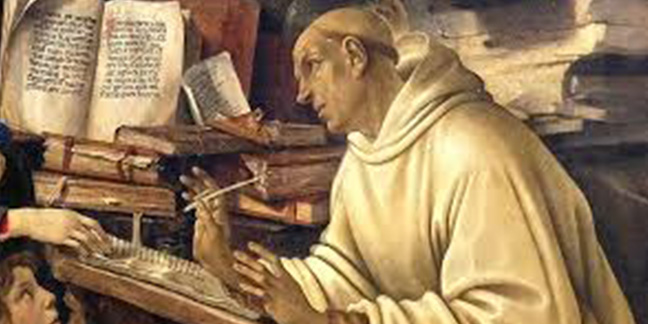
 On Aug. 20 the Catholic Church will honor St. Bernard of Clairvaux, the 12th-century monk who helped to build up the Cistercian order – some of whom are known today as the Trappists. Bernard is considered the last of the Church Fathers in the Western tradition.
Bernard was born during the year 1090, near the French town of Dijon. His father Tescelin and his mother Aleth belonged to the highest class of nobility in the region and had six other children. Bernard, their third child, received an especially good education in response to a local man's prophecy that he was destined for great achievements.
After his mother's death, Bernard began to consider a life of solitude and prayer. At Citeaux, near Dijon, a group of monks had gathered in 1098 with the intention of returning to St. Benedict's original rule of monasticism from the sixth century. Bernard, together with 30 other noblemen of Dijon, sought to join this monastery around the year 1113.
Three years into his life as a monk of Citeaux, Bernard received a commission from his abbot to become the head of a new monastery, practicing the same rule of life. Bernard himself dubbed the new monastery's location "Clairvaux," or "Clear Valley."
In his zeal to set an example for the Cistercian monastic reform, Bernard lived a life of such severe penance that his health suffered, and his superiors in the order had to persuade him to be more moderate. Meanwhile, the monastery thrived and attracted large number of men, including Bernard's five brothers and his widowed father.
In 1119, Bernard played an important role in the first General Chapter of the Cistercian Order, which drew up its constitutions and rules. The following year, he composed a treatise on the vice of pride and the virtue of humility, as well as a series of homilies in praise of the Blessed Virgin Mary. He also defended the Cistercians against charges from other monks, who claimed that their rule was too severe.
At the local Council of Troyes, in 1128, Bernard assisted the Cardinal Bishop of Albano in resolving internal disputes within the Church of Paris. At this same council, Bernard outlined the rule of life for the Knights Templars, the Catholic military order charged with the defense of the Holy Land. Bernard developed the ideals of Christian knighthood in his writings addressed to the Templars.
These were not the Abbot of Clairvaux's last forays into civil and religious controversies. He also defended the Church's freedom against the intrusions of temporal rulers and he admonished bishops who had abandoned their sees. In 1130, he had the responsibility of determining which of two rival clerics, both claiming to have been elected pope, would ultimately occupy the Chair of Peter.
Bernard became a close adviser to Pope Innocent II, who prevailed in the controversy. Further threats to the Church's peace and unity occupied him for much of the 1130s, although he continued to produce important writings, including his commentary on the Biblical "Song of Songs." He also sent monks to established new Cistercian monasteries throughout Western Europe.
One of Bernard's own Cistercian monks became Pope Eugene III in 1145, prompting Bernard to write him a letter of instructions that subsequent popes have also found valuable. When Eugene declared a crusade for the protection of Christians in Antioch and Jerusalem during 1146, he appointed Bernard to strengthen the faith of the crusaders with his preaching.
The "Second Crusade," however, failed in its attempt to take the Syrian city of Damascus. This was a heavy blow to Bernard's cause, and he received undue blame for a defeat more likely due to political intrigue and military misconduct. Bernard sent a letter to the pope, stating that the crusade failed because of the moral failings of its participants.
Pope Eugene III, Bernard's onetime disciple and close friend, died in 1153 and was eventually beatified. Bernard died the same year, at the age of 63, having spent 40 years as a monk. He personally founded 163 Cistercian monasteries, a number which had more than doubled by the time of his death.
Pope Alexander III canonized St. Bernard of Clairvaux in 1174. During the 19th century, Pope Pius VIII declared him to be a Doctor of the Church.
— CNA/EWTN News
 On Aug. 22, we celebrate the feast of the Queenship of Mary. In this feast, particularly cherished by the popes of modern times, we celebrate Mary as the Queen of Heaven and Earth.
In his papal encyclical “Ad Coeli Reginam,” Pope Pius XII proposed the traditional doctrine on the Queenship of Mary and established this feast for the universal Church.
Pope Pius IX said of Mary’s queenship: “Turning her maternal heart toward us and dealing with the affair of our salvation, she is concerned with the whole human race.
Constituted by the Lord Queen of heaven and earth, and exalted above all choirs of angels and the ranks of saints in heaven, standing at the right hand of Her only-begotten Son, Our Lord Jesus Christ, she petitions most powerfully with Her maternal prayers, and she obtains what she seeks.”
And Pope Pius XII added the following: “We commend that on the festival there be renewed the consecration of the human race to the Immaculate Heart of the Blessed
Virgin Mary. Upon this there is founded a great hope that there will rejoice in the triumph of religion and in Christian peace...
“Therefore, let all approach with greater confidence now than before, to the throne of mercy and grace of our Queen and Mother to beg help in difficultly, light in darkness and solace in trouble and sorrow...
“Whoever, therefore, honors the lady ruler of the Angels and of men – and let no one think themselves exempt from the payment of that tribute of a grateful and loving soul – let them call upon her as most truly Queen and as the Queen who brings the blessings of peace, that she may show us all, after this exile, Jesus, who will be our enduring peace and joy.”
— Catholic News Agency. “Coronation of the Virgin” by Diego Velázquez (1635-1636) on display at the Prado Museum in Madrid