

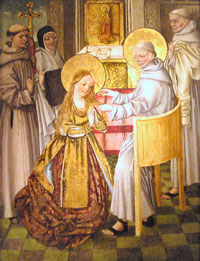
 St. Clare was born in 1193 in Assisi to a noble family. Before her birth, her mother received a sign that her daughter would be a bright light of God in the world. As a child she was already very strongly drawn to the things of God, praying fervently, devoutly visiting the Blessed Sacrament, and manifesting a tender love towards the poor.
When she was 18, she heard St. Francis of Assisi preaching in the town square during Lent and she knew at once that God wanted her to consecrate herself to Him. The next evening, Clare left her house at night, ran to meet St. Francis and his companions at the church they were staying in, and shared her desire to follow him in his way of life. He received her, gave her his tunic, cut off her golden locks, and sent her to a Benedictine convent because she could not stay with the brothers. Her younger sister Agnes soon joined her and the two had to resist much pressure from their family to return home.
When Clare was 22, St. Francis placed her in a small house beside the convent and made her superior, a post she would serve for the next 42 years until her death.
The “Poor Clares,” as they came to be known, lived an unusually austere life for women of the time, walking barefoot around the town begging for alms, wearing sackcloth, and living without any possessions, completely dependent for their food on what was given to them. But the emphasis of their lives was, and still is, contemplation.
Many young noble women left all they had to take on the poor habit of Clare and the order grew rapidly, with houses being founded all over Italy, all of whom took St. Clare as their model and inspiration.
Clare’s reputation for holiness was such that the pope himself came to her deathbed in 1253 to give her absolution. He wanted to canonize her immediately on her death, but was advised by his cardinals to wait.
Claire died in absolute tranquility, saying to one of the brothers at her side, “Dear brother, ever since through His servant Francis I have known the grace of our Lord Jesus Christ, I have never in my whole life found any pain or sickness that could trouble me.”
She was canonized in 1255, two years after her death.
— Catholic News Agency
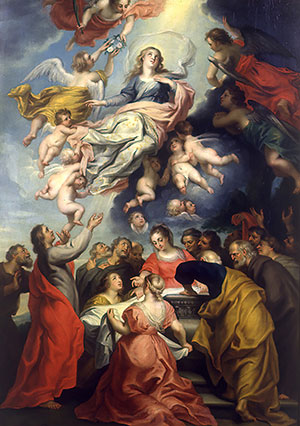 On Aug, 15 Catholics and many other Christians celebrate the feast of the Assumption of the Blessed Virgin Mary. This significant feast day recalls the spiritual and physical departure of the mother of Jesus Christ from the earth, when both her soul and her body were taken into the presence of God.
Venerable Pope Pius XII confirmed this belief about the Virgin Mary as the perennial teaching of the Church when he defined it formally as a dogma of Catholic faith in 1950, invoking papal infallibility to proclaim, “that the Immaculate Mother of God, the ever-Virgin Mary, having completed the course of her earthly life, was assumed body and soul into heavenly glory.”
His apostolic constitution “Munificentissimus Deus” (“Most Bountiful God”), which affirmed the dogma, contained the pontiff’s accounts of many longstanding traditions by which the Church has celebrated the Assumption throughout its history.
The constitution also cited testimonies from the early Church fathers on the subject, and described the history of theological reflection on many Biblical passages which are seen as indicating that Mary was assumed into heaven following her death.
Although the bodily assumption of Mary is not explicitly recorded in Scripture, Catholic tradition identifies her with the “woman clothed with the sun” who is described in the 12th chapter of the Book of Revelation.
The passage calls that woman’s appearance “a great sign” which “appeared in heaven,” indicating that she is the mother of the Jewish Messiah and has “the moon under her feet, and on her head a crown of twelve stars.” Accordingly, Catholic iconography of the Western tradition often depicts the Virgin Mary’s assumption into heaven in this manner.
Eastern Christians have also traditionally held Mary’s assumption into heaven as an essential component of their faith. Pius XII cited several early Byzantine liturgical texts, as well as St. John of Damascus, the eighth-century Christian theologian, monk and Doctor of the Church, in his own authoritative definition of her Assumption.
“It was fitting,” St. John of Damascus wrote in a sermon on the Assumption, “that she, who had kept her virginity intact in childbirth, should keep her own body free from all corruption even after death,” and “that she, who had carried the creator as a child at her breast, should dwell in the divine tabernacles.”
In Eastern Christian tradition, the same feast is celebrated on the same calendar date, although typically known as the Dormition (“falling asleep”) of Mary. Eastern Catholic celebration of the Dormition is preceded by a two-week period of fasting similar to Lent. Pius XII, in “Munificentissimus Deus,” mentioned this same fasting period as belonging to the traditional patrimony of Western Christians as well.
— Catholic News Agency