

Feast day: May 22
On May 22, the Church celebrates the feast day of St. Rita of Cascia, who the late Pope St. John Paul II called "a disciple of the Crucified One" and an "expert in suffering."
Known in Spain as "La Santa de los impossibiles" ("the saint of the impossible"), St. Rita has become immensely popular throughout the centuries. She is invoked by people in all situations and stations of life, since she had embraced suffering with charity and wrongs with forgiveness in the many trials she experienced in her life: as a wife, widow, a mother surviving the death of her children, and a nun.
Born in 1386 in Roccaparena, Umbria, St. Rita was married at the age of 12 to a violent and ill-tempered husband. He was murdered 18 years later and she forgave his murderers, praying that her twin sons, who had sworn to avenge their father's death, would also forgive. She was granted this grace, and her sons, who died young, died reconciled to God.
The saint heard the call to become a nun in the Augustinian convent at Cascia, but she was refused entry at first. She asked the intercession of Sts. Augustine, Mary Magdalene and John the Baptist and was finally allowed to enter the convent. There she lived the last 40 years of her life in prayer, mortification and service to the people of Cascia.
For the final 15 years of her life, she received a stigmata-like thorn wound in answer to her prayers to be more profoundly conformed to the Passion of Jesus. Rita was bedridden for the last four years of her life, consuming almost nothing except for the Eucharist. She died of tuberculosis at the age of 70 on May 22, 1456.
St. Rita was canonized in 1900 by Pope Leo XIII. On the 100th anniversary of her canonization in 2000, Pope St. John Paul II noted her remarkable qualities as a Christian woman: "Rita interpreted well the 'feminine genius' by living it intensely in both physical and spiritual motherhood."
She is the patron saint of impossible causes, sterility, abuse victims, loneliness, marriage difficulties, parenthood, widows, the sick, bodily ills and wounds.
— Catholic News Agency
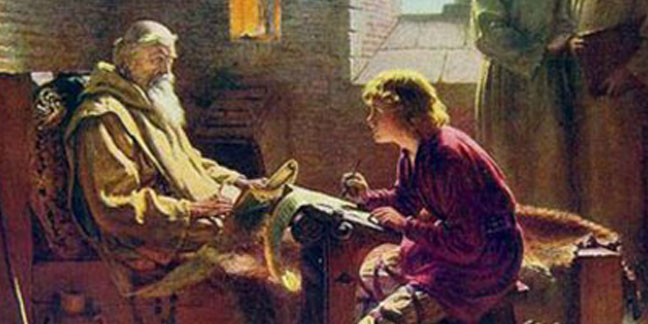 The Church will celebrate the feast of St. Bede May 25. The English priest, monk and scholar is sometimes known as "the Venerable Bede" for his combination of personal holiness and intellectual brilliance.
Bede was born during 673 near the English town of Jarrow. His parents sent him at the age of 7 to study at a monastery founded by a Benedictine abbot who would later be canonized in his own right as St. Benedict Biscop. The abbot's extensive library may have sparked an early curiosity in the boy, who would grow up to be a voracious reader and prolific writer.
Later, Bede returned to Jarrow and continued his studies with an abbot named Ceolfrid, who was a companion of St. Benedict Biscop. The abbot and a group of other monks instructed Bede not only in Scripture and theology, but also in in sacred music, poetry and Greek.
Bede's tutors could see that his life demonstrated a remarkable devotion to prayer and study, and Ceolfrid made the decision to have him ordained a deacon when Bede was just 19. Another Benedictine monk and future saint, the bishop John of Beverley, ordained Bede in 691.
Bede studied for 11 more years before entering the priesthood at 30, around the beginning of the eighth century. Afterward, Bede took on the responsibility of celebrating daily Mass for the members of his Benedictine community, while also working on farming, baking and other works of the monastery.
As a monk, Bede gave absolute priority to prayer, fasting and charitable hospitality. He regarded all other works as valueless without the love of God and one's neighbor. However, Bede also possessed astounding intellectual gifts, which he used to survey and master a wide range of subjects according to an all-encompassing vision of Christian scholarship.
Bede declined a request to become abbot of his monastery. Instead, he concentrated on writing, producing more than 45 books – primarily about theology and the Bible, but also on science, literature and history. He taught hundreds of students at the monastery and its school, which became renowned throughout Britain.
His extensive scholarly contributions include championing the use of B.C. ("Before Christ") and A.D. ("Anno Domini," "the year of Our Lord") in dates, and contributing scientific calculations in the long-standing debate of the era over how to set the date for Easter, using the phases of the moon. With his renowned work "The Ecclesiastical History of the English People," Bede is also called the father of English history, credited with creating a sense of English national identity among the people of Britain that was founded on a common Christian faith.
During Bede's own lifetime, his spiritual and intellectual gifts garnered wide recognition. His writings on Scripture were considered so authoritative that a Church council ordered them to be publicly read in England's churches. Some of the most illustrious members of English society made pilgrimages to his monastery to seek his guidance, and he was personally invited to Rome by Pope Sergius.
Bede, however, was unaffected by these honors. Perhaps inspired by the Benedictine monastic ethos, which emphasizes one's absolute commitment to the monastic community, he chose not to visit Rome, or even to travel much beyond the Monastery of Sts. Peter and Paul in Jarrow throughout his entire adult life.
Instead, the world came to him – through the visitors he received, according to the Benedictine tradition of hospitality, and through his voluminous reading. And Bede, in turn, reached the world without leaving his monastery, writing books that were copied with reverence for centuries and still read today. He is one of the last western Christian writers to be numbered among the Church Fathers.
But Bede understood that love, rather than learning, was his life's purpose.
"It is better," he famously said, "to be a stupid and uneducated brother who, working at the good things he knows, merits life in heaven, than to be one who – though being distinguished for his learning in the Scriptures, or even holding the place of a teacher – lacks the bread of love."
Bede died on the vigil of the feast of the Ascension of Christ in 735, shortly after finishing an Anglo-Saxon translation of the Gospel of John. Pope Leo XIII declared him a Doctor of the Church in 1899.
-- Benjamin Mann, Catholic News Agency
The image above is from "The Venerable Bede Translates John" by James Doyle Penrose, 1902.