

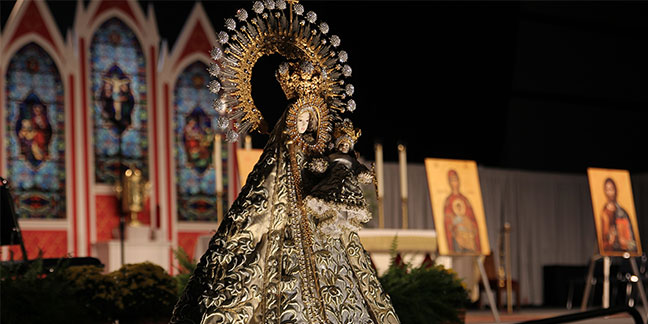
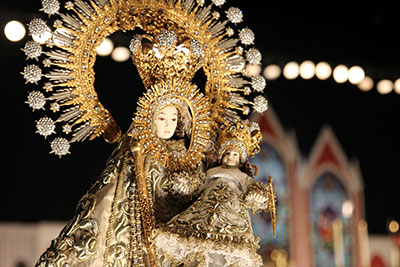
 Our Lady of Manaoag is a title of the Blessed Virgin Mary venerated in Manaoag, a town in Pangasinan, the Philippines. Under this title, she is invoked as patroness of the sick, helpless and needy.
The devotion to Our Lady of Manaoag includes two feast days: the first in the summer, on the third Wednesday after Easter, and then again on the first Sunday in October. The summer feast commemorates the papal coronation of the image of Our Lady of Manaoag in 1926, and the October feast is connected to Mary’s title as Our Lady of the Rosary.
Our Lady of Manaoag is depicted in a 17th-century ivory and silver image of the Virgin Mary with the Child Jesus. Brought to the Philippines from Spain in the early 17th century by Father Juan de San Jacinto, the statue is now enshrined at the high altar of the Minor Basilica of Our Lady of the Most Holy Rosary of Manaoag.
The church was built on the site of a Marian apparition in Manaoag. Documents dating back to 1610 attest that a middle-aged farmer walking home heard a mysterious female voice. He looked around and saw on a cloud-veiled treetop an apparition of the Virgin Mary, holding a rosary in her right hand and the Child Jesus in her left arm, all amid a heavenly glow. Mary told the farmer where she wanted her church to be built, and a chapel was built on the hilltop site of the apparition, forming the nucleus of the present town.
Today, thousands of pilgrims flock to the shrine and basilica in Manaoag.
A replica of the statue is at St. Matthew Church in Charlotte, a gift from parishioner Joe Calicdan and his wife Cristy. Joe, who was born in Pangasinan, and his family have a deep devotion to Our Lady of Manaoag.
The statue features in the Eucharistic Procession for the annual Diocese of Charlotte Eucharistic Congress each year.
— Wikipedia, Catholic News Herald. Photos by SueAnn Howell, Catholic News Herald
 Pray the Novena to Our Lady of Manaoag:
 Pray the Novena to Our Lady of Manaoag:
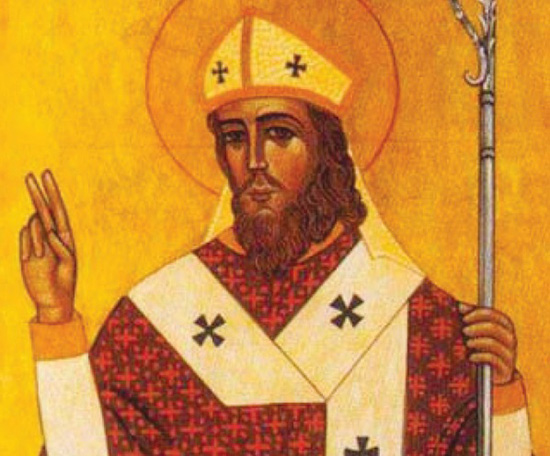 On May 5, Catholics celebrate St. Hilary of Arles, a fifth-century bishop who gave up wealth and privilege in favor of austerity and sacrifice for the sake of the Church.
Hilary was born during the year 401, most likely in the present-day French region of Loraine. He came from a wealthy background and received a traditional aristocratic education in philosophy and rhetoric, which he expected to put to use in a secular career.
One of Hilary's relatives, Honoratus, had founded a monastery in Lerins and given his life to the service of the Church. Honoratus was deeply concerned for Hilary's salvation, and urged him with tears to abandon worldly pursuits for the sake of following Christ.
"On one side," Hilary later recalled, "I saw the Lord calling me; on the other the world offering me its seducing charms and pleasures. How often did I embrace and reject, will and not will the same thing!"
"But in the end Jesus Christ triumphed in me. And three days after Honoratus had left me, the mercy of God, solicited by his prayers, subdued my rebellious soul."
Hilary returned to his relative, humbling himself as Honoratus' disciple and embracing his life of prayer, asceticism and Scripture study. He sold his property, gave the proceeds to the poor, and wholeheartedly embraced the monastic life of the community in Lerins.
In 426, Honoratus became the Archbishop of Arles. Hilary initially followed him, but soon returned to the monastery at Lerins. Honoratus, however, insisted on having the assistance of his relative and disciple, and traveled to Lerins himself to retrieve him.
When Honoratus died in 429, Hilary again attempted to leave Arles and return to his monastery. But the faithful of the city sent out a search party and had him brought back, so that he could be consecrated as Honoratus' successor.
Though he was not yet 30 years old, the new archbishop was well-prepared by his years in religious life and the time spent assisting his predecessor. As archbishop, he maintained the simplicity of a monk. He owned few possessions, put the poor ahead of himself, and continued to do manual labor.
Known for his kindness and charity, the archbishop was also remembered for publicly rebuking a government official who brought shame on the Church. He also warned lukewarm believers that they would "not so easily get out of hell, if you are once unhappily fallen into its dungeons."
Hilary helped to establish monasteries in his diocese, and strengthened the discipline and orthodoxy of the local Church through a series of councils. He sold Church property in order to pay the ransoms of those who had been kidnapped, and is said to have worked miracles during his lifetime.
St. Hilary of Arles died on May 5, 449. Although his short life was marked by some canonical disputes with Pope St. Leo I, the pope himself praised the late Archbishop of Arles in a letter to his successor, honoring him as "Hilary of holy memory."
-- Benjamin Mann, Catholic News Agency