

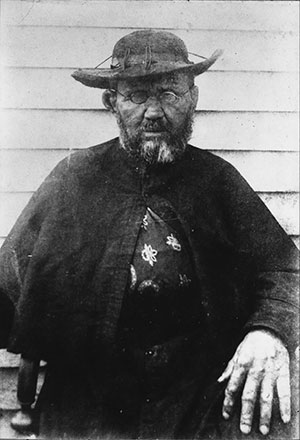
 The Church will remember St. Damien of Molokai May 10. The Belgian priest sacrificed his life and health to become a spiritual father to the victims of leprosy quarantined on a Hawaiian island.
Joseph de Veuser, who later took the name Damien in religious life, was born into a farming family in the Belgian town of Tremlo in 1840. During his youth he felt a calling to become a Catholic missionary, an urge that prompted him to join the Congregation of the Sacred Hearts of Jesus and Mary.
Damien's final vows to the congregation involved a dramatic ceremony in which his superiors draped him in the cloth that would be used to cover his coffin after death. The custom was meant to symbolize the young man's solemn commitment, and his identification with Christ's own death. For Damien, the event would become more significant, as he would go on to lay down his life for the lepers of Molokai.
His superiors intended to send Damien's brother, a member of the same congregation, to Hawaii. But he became sick, so Damien arranged to take his place. Damien arrived in Honolulu in 1864, less than a century after Europeans had begun to establish a presence in Hawaii. He was ordained a priest the same year.
When he had been a priest for nine years, Father Damien responded to his bishop's call for priests to serve on the leper colony of Molokai.
Their lack of previous exposure to leprosy, which had no treatment at the time, made the Hawaiian natives especially susceptible to the infection. Molokai became a quarantine center for the victims, who became disfigured and debilitated as the disease progressed. The island had become a wasteland in human terms, despite its natural beauty. The leprosy victims faced hopeless conditions and extreme deprivation, sometimes lacking not only basic palliative care but even the means of survival.
Inwardly, Damien was terrified by the prospect of contracting leprosy himself. However, he knew that he would have to set aside this fear if he were to convey God's love to the lepers. Other missionaries had kept the lepers at arms' length, but Damien chose to immerse himself in their lives and leave the outcome to God.
The leprosy victims saw the difference in the new priest's approach and embraced his efforts to improve their living conditions. A strong man, accustomed to physical labor, Damien performed the Church's traditional works of mercy – feeding the hungry, sheltering the homeless, and giving proper burial to the dead – in the face of suffering that others could hardly even bear to see.
His work helped to raise up the lepers from their physical sufferings, while also making them aware of their worth as beloved children of God. Although he could not take away the constant presence of death in the leper colony, Damien could change its meaning and inspire hope.
The priest's devotion to his people, and his activism on their behalf, sometimes alienated him from officials of the Hawaiian kingdom and from his religious superiors in Europe. His mission was not only fateful, but also lonely. He drew strength from Eucharistic adoration and the celebration of the Mass, but longed for another priest to arrive so that he could receive the sacrament of confession regularly.
In December of 1884, Damien discovered that he had lost all feeling in his feet. It was an early but unmistakable sign that he had contracted leprosy. The priest knew that his time was short, so he began to finish whatever work he could on behalf of the leprosy colony before the diseased robbed him of his eyesight, speech and mobility.
Damien suffered humiliations and personal trials during his final years. An American Protestant minister accused him of scandalous behavior, based on a mistaken belief of the time that leprosy was a sexually transmitted disease.
In the end, priests of his congregation arrived to administer the last sacraments to the dying priest. In the spring of 1889, Damien told his friends that he believed it was God's will for him to spend the upcoming Easter not on Molokai, but in heaven. He died of leprosy during Holy Week, on April 15, 1889.
He was beatified in 1995 and Pope Benedict XVI canonized him in 2009.
-- Benjamin Mann, Catholic News Agency
Prayer to St. Damien
St. Damien, brother on the journey,
Happy and generous missionary,
who loved the Gospel more than your life,
who for love of Jesus left your family,
your homeland, your security, your dreams,
Teach us to give our lives
with a joy like yours,
to be in solidarity with the outcasts of the world,
to celebrate and contemplate the Eucharist
as the source of our commitment.
Help us to love to the very end
and, in the strength of the Spirit,
to persevere in compassion
for the poor and forgotten
so that we might be
good disciples of Jesus and Mary.
Amen.
— Diocese of Honolulu
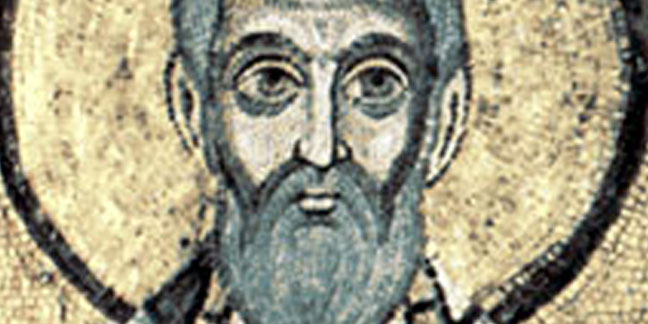 On May 12 the Church honors St. Epiphanius of Salamis, an early monk, bishop and Church Father known for his extensive learning and defense of Catholic teachings in the fourth century.
During a 2007 visit with the Orthodox Archbishop of Cyprus, Pope Benedict XVI praised Epiphanius as "a good pastor" who "pointed out to the flock entrusted to him by Christ, the truth in which to believe, the way to take and the pitfalls to avoid."
"At the beginning of this third millennium," the pope reflected during the visit, "the Church finds herself facing challenges and problems not at all unlike those which Bishop Epiphanius had to tackle."
Epiphanius was born in Palestine around 310 or 315, the son of Greek-speaking Jewish parents. He is said to have been drawn to the Church after seeing a monk give away his clothing to a person in need. Not long after his conversion, he became a monk himself, spending time in the Egyptian deserts.
Around 333 he returned to the Holy Land and built a monastery near his birthplace in Judea. Epiphanius showed great dedication to the rigors of monasticism, which some of his contemporaries considered excessive, although he insisted he was only seeking to work faithfully for God's kingdom.
The devoted monk was also a man of extraordinary learning, versed in the Hebrew, Egyptian, Syrian, Greek and Latin languages and literature. For more than two decades, until 356, Epiphanius was a disciple and close companion of St. Hilarion the Great, a monk known for his wisdom and miracles.
The spiritual bond between them remained unbroken after Hilarion left Palestine around 356. Hilarion's influence within the Church of Salamis, in present-day Cyprus, led to its choice of Epiphanius as bishop in 367.
During his years in Palestine, Epiphanius had frequently offered guidance and help in the Church's struggle against Arianism, the heresy which denied Jesus' eternal existence as God. As a bishop, he went on to write several works arguing for orthodox teaching on subjects like the Trinity and the Resurrection. He became known as the "Oracle of Palestine."
Determined to protect the Church from error, Epiphanius became involved in various controversies and was known as a strong voice for orthodoxy. In some instances, however, his zeal was misguided or uninformed, as when he inadvertently became involved in a plot against St. John Chrysostom.
Likewise, some of Epiphanius' apologetic works are regarded today as inaccurate or flawed on certain points. Nonetheless, he is revered among the early Church Fathers, and his writings – which contain important formulations of orthodox belief – are cited in the Catechism of the Catholic Church.
St. Epiphanius of Salamis died in 403, while returning from Constantinople after distancing himself from the attempt to depose St. John Chrysostom. Sensing the approach of death, he gave his disciples two final pieces of advice: to keep God's commandments, and guard their thoughts against temptation.
He was buried on May 12, after his ship's return to Salamis. The Seventh Ecumenical Council, in 787, confirmed his reputation as a Church Father worthy of veneration.
— Benjamin Mann, Catholic News Agency