

Feast day: Feb. 18
On Feb. 18, the Roman Catholic Church remembers Patriarch St. Flavian of Constantinople, who is honored on the same date by Eastern Catholics of the Byzantine tradition and by Eastern Orthodox Christians.
Known to Eastern Christians as “St. Flavian the Confessor,” the patriarch endured condemnation and severe beatings during a fifth-century dispute about the humanity and divinity of Jesus Christ. Though he died from his injuries, his stand against heresy was later vindicated at the Church’s fourth ecumenical council in 451.
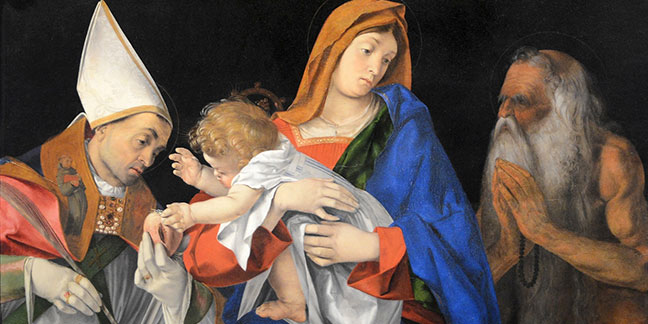
Pictured: “Madonna with Child between Saints Flavian and Onuphrius” by Lorenzo Lotto, on display at the Borghese Gallery in Rome
St. Flavian is closely associated with Pope St. Leo the Great, who also upheld the truth about Christ’s divine and human natures during the controversy. The pope’s best-known contribution to the fourth council – a letter known as the “Tome of Leo” – was originally addressed to St. Flavian, though it did not reach the patriarch during his lifetime.
Flavian’s date of birth is unknown, as are most of his biographical details. He was highly-regarded as a priest during the reign of the Eastern Roman Emperor Theodosius II (which lasted from 408 to 450), and he became Archbishop of Constantinople following the death of Patriarch St. Proclus in approximately 447.
Early in his patriarchate, Flavian angered a state official named Chrysaphius by refusing to offer a bribe to the emperor. The ruler’s wife Eudocia joined the resulting conspiracy which Chrysaphius hatched against Flavian, a plot that would come to fruition in an illegitimate Church council and the patriarch’s death.
As head of the Church in Constantinople, Flavian had inherited a theological controversy about the relationship between deity and humanity in the person of Jesus Christ. In an occurrence that was not uncommon for the time, the doctrinal issue became entangled with personal and political rivalries. Flavian’s stand for orthodoxy gave his high-ranking court opponents a chance to act against him by encouraging the proponents of doctrinal error and manipulating the emperor in their favor.
The theological issue had arisen after the Council of Ephesus, which in 431 had confirmed the personal unity of Christ and condemned the error (known as Nestorianism) that said he was a composite being made up of a divine person and a human person. But questions persisted: Were Jesus’ eternal divinity, and His assumed humanity, two distinct and complete natures fully united in one person? Or did the person of Christ have only one hybrid nature, made up in some manner of both humanity and divinity?
The Church would eventually confirm that the Lord’s Incarnation involved both a divine and a human nature at all times. When God took on a human nature at the incarnation, in the words of Pope St. Leo the Great, “the proper character of both natures was maintained and came together in a single person,” and “each nature kept its proper character without loss.”
During Flavian’s patriarchate, however, the doctrine of Christ’s two natures had not been fully and explicitly defined. Thus, controversy came up regarding the doctrine of a monk named Eutyches, who insisted that Christ had only “one nature.” Flavian understood the “monophysite” doctrine as contrary to faith in Christ’s full humanity, and he condemned it at a local council in November 448. He excommunicated Eutyches, and sent his decision to Pope Leo, who gave his approval in May 449.
Chrysaphius, who knew Eutyches personally, proceeded to use the monk as his instrument against the patriarch who had angered him. He convinced the emperor that a Church council should be convened to consider Eutyches’ doctrine again. The resulting council, held in August 449 and led by Dioscorus of Alexandria, was completely illegitimate, and later formally condemned. But it pronounced against Flavian and declared him deposed from the patriarchate.
During this same illicit gathering, known to history as the “Robber Council,” a mob of monks beat St. Flavian so aggressively that he died from his injuries three days later. Chrysaphius seemed, for the moment, to have triumphed over the patriarch.
But the state official’s ambitions soon collapsed. Chrysaphius fell out of favor with Theodosius II shortly before the emperor’s death in July 450, and he was executed early in the reign of his successor Marcian.
St. Flavian, meanwhile, was canonized by the Fourth Ecumenical Council in 451. Its participants gave strong acclamation to the “Tome of Leo” – in which the pope confirmed St. Flavian’s condemnation of Eutyches and affirmed the truth about Christ’s two natures, both divine and human.
— Catholic News Agency
Did you know?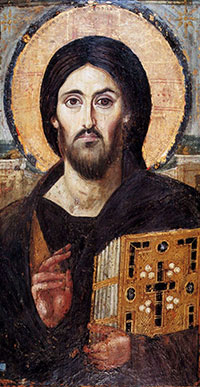 The oldest known surviving icon of Christ Pantocrator, written sometime in the sixth or seventh century and preserved at St. Catherine’s Monastery at the foot of Mount Sinai. The image of Christ Pantocrator, which translates from the Greek as “Christ Ruler of All,” was one of the first depictions of Jesus in the early Church.The Church describes Christ’s dual nature – that is, He is both perfectly divine and perfectly human – as “hypostatic union” or “hypostasis.” Because it is impossible for us to fully comprehend this mystery, the term “mystical union” is also commonly used.
You may also have heard the terms “homoousios” and “homoiousios” used to describe this Christian doctrine. The First Council of Nicaea in 325 debated the terms “homoousios” and “homoiousios.” The word “homoousios” means “same substance,” whereas the word “homoiousios” means “similar substance.” The council affirmed that the Father, Son and Holy Spirit (the Holy Trinity) are of the “homoousious” (same substance) – reflected in the Creed when we say Jesus was “begotten, not made, consubstantial with the Father.” This ancient debate became the source of the English idiom “differ not by one iota.”
Note that the words “homoousios” and “homoiousios” differ only by one “i” (the Greek letter iota). Thus, to say two things differ not one iota is to say that they are the same substance.
For more about Christ’s nature as both “true God and true man,” read the Catechism of the Catholic Church 464-469.
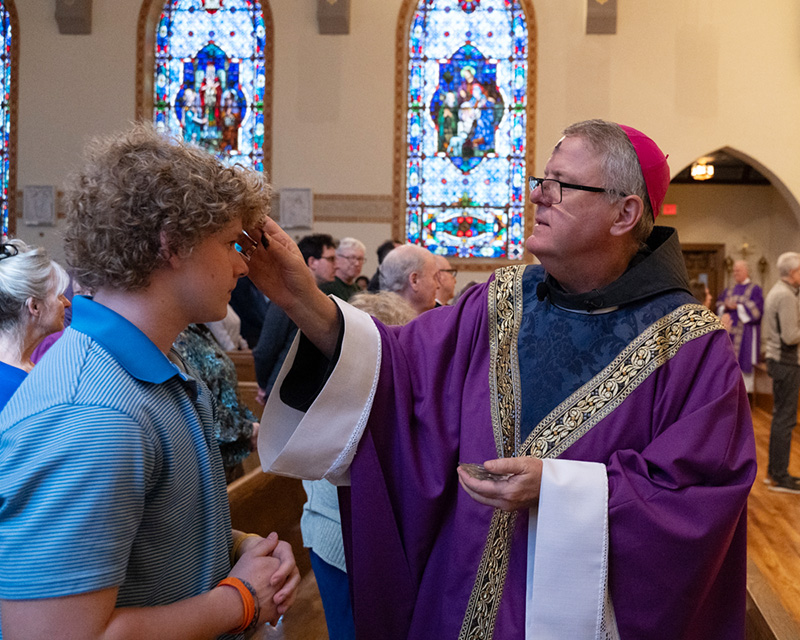 Ash Wednesday marks the start of Lent. It is a day of fast and abstinence, though it is not a holy day of obligation. During the Ash Wednesday Mass, ashes are marked on the foreheads of the faithful with the Sign of the Cross.
The ashes are a symbol of penance and remind us that we are creatures of the earth and mortal beings: “For dust you are and to dust you shall return” (Gen. 3:19).
Today, the priest marks the foreheads of the faithful with the ashes while saying, “Remember, man, you are dust and to dust you will return,” or “Turn away from sin and be faithful to the Gospel.”
During earlier observances of Lent, the season began on Quadragesima Sunday, the sixth Sunday before Easter. But because no fast was kept on Sundays, the penitential season consisted of only 36 days of fasting. So that the faithful may imitate Jesus’ 40 days of fasting in the desert, four days were added. To add these four days, Pope St. Gregory the Great moved the start of Lent to the Wednesday before Quadragesima Sunday.
The ashes, which help us to develop a spirit of humility and sacrifice, are made from the blessed palms used in the Palm Sunday celebration of the previous year. The ashes are blessed with holy water. While the ashes symbolize penance and contrition, “they are also a reminder that God is gracious and merciful to those who call on Him with repentant hearts,” states Catholic.org.
The customary use of ashes as a sign of repentance is seen in the Books of Jeremiah, Daniel and Jonah of the Old Testament. In the Book of Judith, acts of repentance involved ashes being put on people’s heads: “All the Israelites in Jerusalem, including women and children, lay prostrate in front of the Temple, and with ashes on their heads stretched out their hands before the Lord” (Judith 4:1).
The practice within the Church originated from a custom involving those who had committed serious sins. In the ancient Church, penitents expressed their humiliation by appearing in sackcloth and ashes. On Ash Wednesday they were presented to the bishop, clothed in sackcloth and barefooted.
After the seven penitential psalms were sung, the bishop laid his hands on them, sprinkled them with holy water, and poured ashes upon their heads, declaring “that as Adam was cast out of paradise, so they, for their sins, were cast out of the Church. Then the inferior ministers expelled them out of the doors of the church. In the end of Lent, on the Thursday before Easter, they were presented for reconciliation,” according to the “Cyclopaedia of Biblical, theological, and ecclesiastical literature” by John McClintock.
— Sources: “Cyclopaedia of Biblical, theological, and ecclesiastical literature,” by John McClintock, and www.catholic.org