

 WASHINGTON, D.C. — Ash Wednesday is Feb. 18 this year. Here are some things to know about Ash Wednesday and the kickoff to Lent:
In the Table of Liturgical Days, which ranks the different liturgical celebrations and seasons, Ash Wednesday ties for second in ranking – along with Christmas, Epiphany, Ascension, Pentecost, Sundays of Advent, Lent and Easter, and a few others. But Ash Wednesday is not a holy day of obligation, though it is a day of prayer, abstinence, fasting and repentance.
Top ranked in the table are the Paschal Triduum – the Holy Thursday Mass of the Lord’s Supper, Good Friday and the Easter Vigil – along with Easter Sunday. Good Friday isn’t a holy day of obligation either, but Catholics are encouraged to attend church for a liturgy commemorating Christ’s crucifixion and death.
Ash Wednesday begins the liturgical season of Lent. There are hymns that speak to the length of the season – one of them is “Lord, Who Throughout These Forty Days” – but Lent spans more than 40 days. So what gives?
“It might be more accurate to say that there is the ‘40-day fast within Lent,’” said Father Randy Stice, associate director of the U.S. Conference of Catholic Bishops’ Secretariat of Divine Worship.
“Historically, Lent has varied from a week to three weeks to the present configuration of 46 days,” Father Stice said. “The 40-day fast, however, has been more stable. The Sundays of Lent are certainly part of the time of Lent, but they are not prescribed days of fast and abstinence.” There are six Sundays in Lent, including Passion Sunday.
Ashes
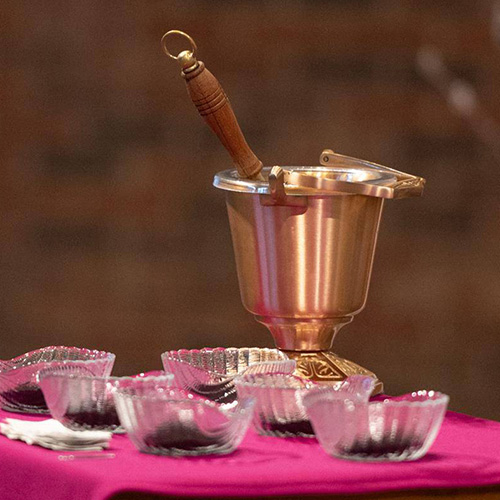
The ashes used for Ash Wednesday are made from the burned and blessed palms of the previous year’s Palm Sunday.
“The palms are burned in a metal vessel and then broken down into a powder. I believe ashes can also be purchased from Catholic supply companies,” Father Stice said.
“As far as I know, palms from the previous year are always dry enough,” he added. “Parishes normally ask parishioners to bring their palms shortly before Ash Wednesday, so there is no need to store them. People usually like to keep the blessed palm as long as possible.”
Almost half of adult Catholics, 45 percent, typically receive ashes at Ash Wednesday services, according to the Center for Applied Research in the Apostolate at Georgetown University.
During Ash Wednesday services, ashes are marked on the foreheads of the faithful with the Sign of the Cross. The ashes are a symbol of penance and remind us that we are creatures of the earth and mortal beings: “For dust you are and to dust you shall return” (Gen. 3:19).
Alleluia
You might not have noticed, but the use of the word “Alleluia” is verboten during Lent. What is known as the “Alleluia verse” preceding the Gospel becomes known during Lent as “the verse before the Gospel,” with a variety of possible phrases to be used – none of which include an alleluia.
“The Alleluia was known for its melodic richness and in the early Church was considered to ornament the liturgy in a special way,” Father Stice said, adding it was banned from Lenten Masses in the fifth or sixth century.
Fasting
Ash Wednesday also is a day of abstinence and fasting; Good Friday is another. Abstinence means refraining from eating meat; fish is OK. Fasting means reducing one’s intake of food, like eating two small meals that together would not equal one full meal.
“Fasting during Lent followed the example of Jesus’ 40-day fast in the wilderness. It also recalled the 40 days that Moses fasted on Sinai and the 40 days that Elijah fasted on his journey to Mount Horeb,” Father Stice said.
“In the second century, Christians prepared for the feast of Easter with a two-day fast. This was extended to all of Holy Week in the third century. In 325 the Council of Nicea spoke of a 40-day period of preparation for Easter as something already obvious and familiar to all.”
— Mark Pattison, Catholic News Service
More online: Read more about the customs of Ash Wednesday
Lent starts with Ash Wednesday, Feb. 18
 Ash Wednesday is one of the most popular and important holy days in the liturgical calendar. Ash Wednesday opens Lent, a season of penitential prayer and fasting.
Ash Wednesday takes place 46 days before Easter Sunday and is chiefly observed by Catholics, although many other Christians observe it, too.
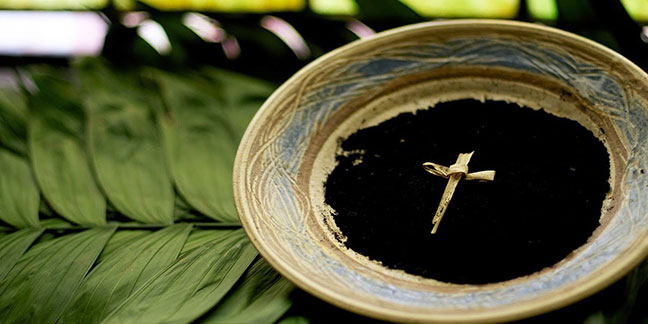
Ash Wednesday comes from the ancient Jewish tradition of penance and fasting. The practice includes the wearing of ashes on the head. The ashes symbolize the dust from which God made us. As the priest applies the ashes to a person’s forehead, he speaks the words: “Remember that you are dust, and to dust you shall return.”
Alternatively, the priest may speak the words, “Repent and believe in the Gospel.”
Ashes also symbolize grief, in this case, grief that we have sinned and caused division from God. Writings from the second-century Church refer to the wearing of ashes as a sign of penance.
The Ashes
The ashes are made from blessed palm branches, taken from the previous year’s Palm Sunday Mass. They are christened with holy water and scented by exposure to incense.
While the ashes symbolize penance and contrition, they are also a reminder that God is gracious and merciful to those who call on Him with repentant hearts. His Divine Mercy is of utmost importance during the season of Lent, and the Church calls on us to seek that mercy during the entire Lenten season with reflection, prayer and penance.
Receiving ashes
While not a holy day of obligation, Ash Wednesday is a day of penitential prayer and fasting.
Priests administer ashes during Mass on Ash Wednesday and everyone – even non-Catholics and non-Christians – is invited to accept the ashes as a visible symbol of penance.
It is generally inappropriate to dine out, shop or go about in public after receiving the ashes.
Feasting is highly inappropriate. Small children, the elderly and the sick are exempt from this observance.
It is not required that a person wear the ashes for the rest of the day, and they may be washed off after Mass. However, many people keep the ashes as a reminder until the evening.
Recently, movements have developed that involve pastors distributing ashes to passersby in public places. This isn’t considered taboo, but Catholics should know this practice is distinctly Protestant. Catholics should still receive ashes within the context of Mass.
In some cases, ashes may be delivered by a priest or a family member to those who are sick or shut-in.
Why we receive ashes
Following the example of the Ninevites, who did penance in sackcloth and ashes, our foreheads are marked with ashes to humble our hearts and remind us that life passes away.
The distribution of ashes comes from a ceremony of ages past. Christians who had committed grave faults performed public penance. On Ash Wednesday, the bishop blessed the hair shirts they were to wear during their 40 days of penance, and sprinkled over them ashes made from the previous year’s palms. Then, while the faithful recited the Seven Penitential Psalms, the penitents were turned out of the church because of their sins – just as Adam, the first man, was turned out of
Paradise because of his disobedience. The penitents did not enter the church again until Maundy Thursday after having won reconciliation by the toil of 40 days’ penance and sacramental absolution.
— Catholic Online
Inspiring words for your Lenten journey
St. Augustine: “Fasting cleanses the soul, raises the mind, subjects one’s flesh to the spirit, renders the heart contrite and humble, scatters the clouds of concupiscence, quenches the fire of lust, kindles the true light of chastity.”
Flannery O’Connor: “I do not know you, God, because I am in the way. Please help me to push myself aside.”
Dorothy Day: “How shall we have the means to help our brother who is in need? We can do without those unnecessary things which become habits, cigarettes, liquor, coffee, tea, candy, sodas, soft drinks and those foods at meals which only titillate the palate. We all have these habits, the youngest and the oldest. And we have to die to ourselves in order to live, we have to put off the old man and put on Christ. That it is so hard, that it arouses so much opposition, serves to show what an accumulation there is in all of us of unnecessary desires.”
Archbishop Fulton Sheen: “Never forget that there are only two philosophies to rule your life: the one of the cross, which starts with the fast and ends with the feast. The other of Satan, which starts with the feast and ends with the headache.”
St. John Chrysostom: “Fasting of the body is food for the soul.”
St. Catherine of Siena: “Nothing great is ever achieved without much enduring.”