

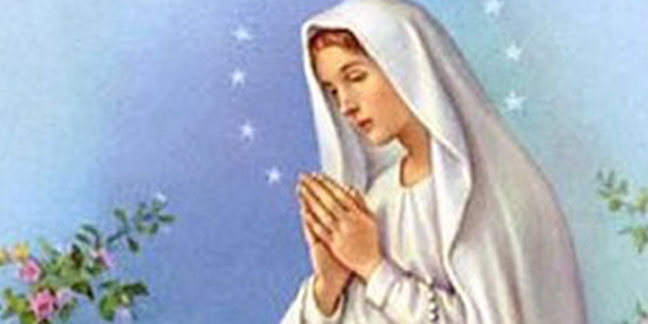
 In 1858, in the grotto of Massabielle, near Lourdes in southern France, Our Lady appeared 18 times to Bernadette Soubirous, a young peasant girl.
She revealed herself as the Immaculate Conception, asked that a chapel be built on the site of the vision, and told the girl to drink from a fountain in the grotto.
No fountain was to be seen, but when Bernadette dug at a spot designated by the apparition, a spring began to flow. The water from this still flowing spring has shown remarkable healing power, though it contains no curative property that science can identify.
The Virgin appeared 18 times to the little peasant who would latter become St. Bernadette, but the most important apparition was the 16th: On the evening on March 24th, Bernadette told her parents of the feeling she had that she was being called to the Grotto once more by an interior impulse – she intended to return there in the morning. It had been more than two weeks since the Lady had visited her. How long that night was – try as she might, the child was unable to sleep. As soon as the first light dawned, she rose and quickly dressed.
Bernadette arrived at the grotto at 5 a.m. with a blessed candle in her hand. Her parents were with her. Even before she reached the rock, she could see the wondrous light filling the niche, in which stood her beautiful Lady.
Bernadette herself describes the conversation and events which followed this moment: "Whilst I was praying, the thought of asking her name came to my mind with such persistence that I could think of nothing else. I feared to be presumptuous in repeating a question She had always refused to answer and yet something compelled me to speak. At last, under an irresistible impulsion, the words fell from my mouth and I begged the Lady to tell me who she was.
"The Lady did as she had always done before; she bowed her head and smiled, but she did not reply.
"I cannot say why, but I felt myself bolder and asked her again to graciously tell me her name; however, she only smiled and bowed as before, still remaining silent.
"Then once more, for the third time, clasping my hands and confessing myself to be unworthy of the great favor I was asking of her, I again made my request.
"The Lady was standing above the rose bush, in a position very similar to that shown on the Miraculous Medal. At my third request, her face became very serious and she seemed to bow down in an attitude of humility. Then she joined her hands and raised them to her breast. She looked up to Heaven.
"Then slowly opening her hands and leaning towards me, she said to me in a voice vibrating with emotion, 'I am The Immaculate Conception.'
"She smiled again, spoke no more, and disappeared smiling."
In 1862 Church authorities confirmed the authenticity of the apparitions and authorized the devotion of Our Lady of Lourdes. The Feast of Our Lady of Lourdes became worldwide in 1907.
— Catholic News Agency
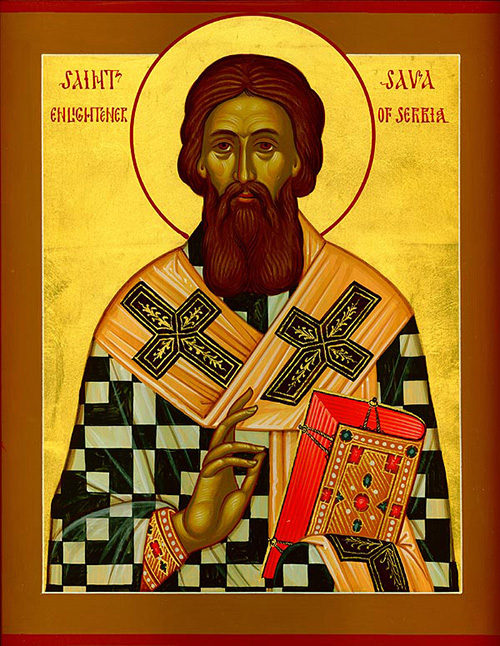 Born Prince Rastko Nemanjic (son of the Serbian ruler and founder of the Serbian medieval state, Stefan Nemanja), St. Sava was the first patriarch of Serbia (1219-1233) and is an important saint in the Catholic and Serbian Orthodox churches.
About age 17 (around 1192), Rastko escaped from home to join the monastic colony on Mount Athos (the holy mountain in Greece) and was given the name Sava. He first traveled to a Russian monastery, then moved to a Greek monastery. At the end of 1197 his father abdicated as Serbian ruler and joined St. Sava in the ascetic life. In 1198 together they moved to and restored the abandoned monastery Hilandar, and it became the center of Christian monastic life in Serbia.
St. Sava's father took monastic vows under the name Simeon, and he died in Hilandar on Feb. 13, 1200. He was canonized as St. Simeon.
After his father's death, St. Sava retreated to an ascetic monastery in Kareya, which he built himself in 1199. He wrote the "Kareya Typicon," a set of instructions for the services and ceremonies at the monastery. It still exists today, inscribed into a marble board at the monastery. He wrote two other typicons, as well as a set of church laws that later became the basis for a constitution in the young country of Serbia.
St. Sava stayed on Mount Athos until 1207. The next year, he returned to Serbia to reconcile his two brothers, who had dragged the country into civil war fighting over their father's throne. It is said that he showed his brothers the uncorrupt remains of their saintly father, which he had brought with him to establish a monastery at Studenitsa, and they were instantly reunited. From his new monastery, he and his monks worked to educate the people and teach them the faith, because during the war education and religion had greatly deteriorated.
He was named metropolitan of a new Serbian hierarchy by Emperor Theodore II Laskaris at Nicaea; was consecrated, though for political reasons unwillingly, by the Orthodox patriarch in 1219, to create the independent Serbian Church; returned home bringing more monks from Mount Athos; and in 1222 crowned his brother Stefan II king of Serbia. Through his efforts, he finished the uniting of his people begun by his father, translated important religious works into Serbian, and gave his people a native clergy and hierarchy.
After stepping down as head of the Serbian Church, he died in Trnovo, Bulgaria, while on his way back from a second pilgrimage to the Holy Land to found a hospice for pilgrims in Jerusalem. After participating in the blessing of the waters ("agiasmo"), performed during the Divine Liturgy on the Feast of Jesus' baptism ("Theophany"), he developed a cough that progressed into pneumonia. He died from pneumonia two days later on Jan. 14, 1235. He was buried at the Cathedral of the Holy Forty Martyrs in Trnovo.
In 1237 St. Sava's remains were moved to the monastery of Mileseva in southern Serbia. (When the monastery at Mileseva was conquered in 1448, its conquerer proclaimed himself "Herzog of St. Sava" – and the area he ruled became called Herzegovina.) More than 300 years later, the Ottoman Turks unearthed his bones and burned them on the main square in Belgrade. St. Sava Cathedral, one of the largest churches in the world, was recently built on that spot.
St. Sava is celebrated as founder of the independent Serbian Orthodox Church and patron saint of education and medicine among Serbs.
— Sources: www.CatholicNewsAgency.com, www.Wikipedia.com, www.CatholicOnline.com