

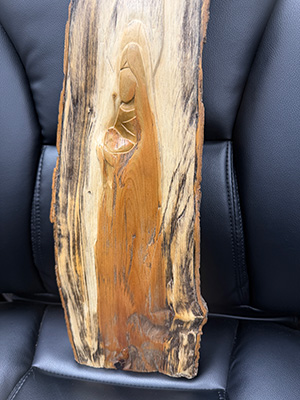
 A poplar tree branch that fell in Tropical Storm Helene revealed a unique image that has since been enhanced. Photos providedMORGANTON — St. Charles Borromeo Church is known for its eclectic art, with Stations of the Cross crafted by a mountain woodsman and icons purchased from passing craftsmen. It recently displayed a piece of ecumenical art called “The Branch” that had its roots in Tropical Storm Helene.
As its title suggests, the piece is a branch of a poplar tree that was knocked down during Helene, but what is unique is its image of the Blessed Mother holding the Christ Child.
During the storm, Alex Kneen and her husband watched as the little creek in their yard overflowed and the winds uprooted a poplar tree.
“We hopelessly watched as the water rose and the ground became supersaturated. A tree fell,” Kneen recalled. “It demolished a swing we had and then hit this particular branch to the ground. And then it knocked out another tree.”
While parts of Burke County were completely wiped out, the Kneen residence was spared. When they started piling up branches, Kneen stopped in her tracks.
“When I saw the broken branch, immediately I saw Mary holding the Baby. I just thought it was beautiful. It captured my heart and my imagination,” she said.
Kneen could not bring herself to put it in the woodpile, so she put it in her shed for safekeeping.
“The revealing of the beauty, even in the midst of what was difficult for so many, amazed me,” she said. “There is so much God can say if we just pay attention and look.”
As an Anglican who graduated with a theology degree from Nashotah House Theological Seminary, Kneen did not believe the resemblance was a coincidence. When she showed the branch to family and friends, they saw it, too.
After she took an iconography carving class, she knew exactly what to do. She returned “with all these woodworking tools and immediately sat down and started sanding the branch, and I kind of traced around the colors in the wood and the contours where I saw her picture,” Kneen said.
The project took about two weeks of sanding to accentuate the image.
“The whole process of carving for me was filled with prayer and meditation,” Kneen said. “Of course, the reason I name it ‘The Branch’ is because of the Biblical idea of Christ being the branch from the stump of Jesse. A righteous branch that would spring from Mary, that would be fully God and fully man. And, Mary was a part of that. And, of course, the fact that it was an actual branch.”
It was then that Gail Watson, faith formation director of St. Charles Borromeo, learned about the branch from her daughter, a friend of Kneen’s, and wanted to see it for herself.
“I was awestruck,” Watson said. “I could not believe that a branch from a tree broke with such a clear image of the Virgin Mary holding Baby Jesus.”
She then brought it to St. Charles Borromeo Parish for all to see.
While it was on display at the church, parishioners paused in front of the image to reflect on the simple beauty of God’s creation revealed in nature while praying for Mary’s intercession.
After its visit to the church, “The Branch” was mounted by a local artisan and is proudly displayed on a table in Kneen’s house – although it may not stay there.
“I am not sure if I want to part with it, but I am also not sure if I want to keep it to myself,” Kneen said. “When God does something beautiful, He doesn’t want to hide it.”
Kneen has since taken the time to walk very intentionally through forests, looking for images that God puts in her path.
As Kneen said,“I can’t help but think that is the Christian life. In us, God is bringing out those things that are good and true and beautiful and forming us and shaping us, highlighting His own work.”
— Lisa Geraci
CHARLOTTE — Daniel Torres has been hired as the new director of Youth and Young Adult Ministry for the Diocese of Charlotte. Torres, currently campus coordinator at Christ the King High School in Huntersville, will begin his new role in early February.
“His passion for evangelization and proven ability to walk with youth and young adults on their faith journey will be an incredible blessing to our diocesan community,” said Christopher Beal, director of the diocese’s Office of Catechetical Formation. “Daniel brings experience, energy and a deep commitment to forming young disciples.”
Torres will continue assisting Christ the King through April.
Along with the six years of experience Torres gained from Christ the King, he brings a wealth of knowledge and expertise to his new position.
Torres graduated with a theology degree from Belmont Abbey College. He went on to serve as a Campus Missionary in Houston, Texas, for FOCUS, a well-known Catholic campus ministry dedicated to discipleship. Torres also coordinated the youth ministry at St. Matthew Parish in Charlotte, where he led programs such as Life Teen, Edge and confirmation preparation.
— Catholic News Herald