

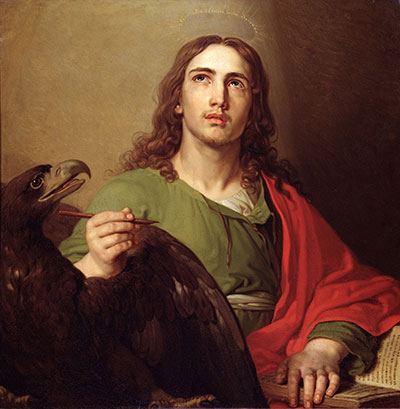
 The feast day of St. John the Evangelist, one of the authors of the Gospels, is celebrated Dec. 27. Also known as St. John the Divine, the day honors John, the son of Zebedee and brother of St. James the Great, was called to be an Apostle by our Lord in the first year of His public ministry.
He became the “beloved disciple” and the only one of the Twelve who did not forsake the Savior in the hour of His Passion. He stood faithfully at the cross when Christ made him the guardian of His Mother.
His later life was passed chiefly in Jerusalem and at Ephesus. He founded many churches in Asia Minor and he wrote many important works, including the fourth Gospel and three Epistles (although many scholars believe that the final editing of the Gospel was done by others shortly after his death). The Book of Revelation is also attributed to him.
Brought to Rome, tradition relates that he was cast into a cauldron of boiling oil on the orders of Emperor Domitian but came forth unhurt, and then was banished to the Greek island of Patmos for a year.
He lived to an extreme old age, surviving all his fellow apostles, and died in Ephesus about the year 100.
St. John is called the Apostle of Charity, a virtue he had learned from his Divine Master, and which he constantly inculcated by word and example. A stately church was later erected over his tomb in Ephesus.
It was afterwards converted into a mosque.
— Catholic News Agency
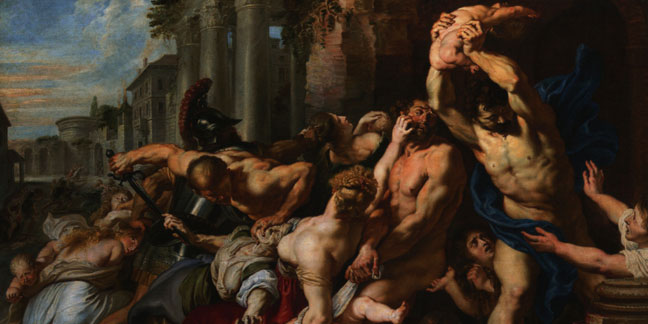 The Holy Innocents are the children mentioned in the gospel of Matthew, chapter 2:16-18:
“When Herod realized that he had been deceived by the magi, he became furious. He ordered the massacre of all the boys in Bethlehem and its vicinity two years old and under, in accordance with the time he had ascertained from the magi. Then was fulfilled what had been said through Jeremiah the prophet: ‘A voice was heard in Ramah, sobbing and loud lamentation; Rachel weeping for her children, and she would not be consoled, since they were no more.’”
The Greek Liturgy asserts that Herod killed 14,000 boys, the Syrians speak of 64,000, and many medieval authors speak of 144,000, according to Revelation 14:3. Modern writers reduce the number considerably, since Bethlehem was a rather small town. Some estimate the actual number around 15 to 20, 10 or 12, or even only 6.
This cruel deed of Herod is not mentioned by the Jewish historian Flavius Josephus, although he relates quite a number of atrocities committed by the king during the last years of his reign. The number of these children was so small that this crime appeared insignificant amongst the other misdeeds of Herod. Macrobius relates that when Augustus heard that among the boys of 2 years and younger Herod’s own son also had been massacred, he said: “It is better to be Herod’s hog, than his son,” alluding to the Jewish law of not eating, and consequently not killing, swine. The Middle Ages gave faith to this story, and French theologian and philosopher Peter Abelard inserted it in his hymn for the feast of Holy Innocents. But the “infant” mentioned by Macrobius is Antipater, the adult son of Herod, who, by command of the dying king, was decapitated for having conspired against the life of his father.
It is impossible to determine the day or the year of the death of the Holy Innocents, since the chronology of the birth of Christ and the subsequent Biblical events is uncertain. All we know is that the infants were slaughtered within two years after the apparition of the star to the wise men.
Some have disputed that they should be called martyrs since they did not submit freely for the sake of Christ but were “merely victims” of Herod. Nevertheless, the Church has long numbered them in her ranks of martyrs. St. Augustine says of them: “And while (Herod) thus persecutes Christ, he furnished an army (or martyrs) clothed in white robes of the same age as the Lord…. O blessed infants! He only will doubt of your crown in this your passion for Christ, who doubts that the baptism of Christ has a benefit for infants.
He who at His birth had Angels to proclaim Him, the heavens to testify, and Magi to worship Him, could surely have prevented that these should not have died for Him, had He not known that they died not in that death, but rather lived in higher bliss. Far be the thought, that Christ who came to set men free, did nothing to reward those who died in His behalf, when hanging on the cross He prayed for those who put Him to death. (Sermon 373, 3, quoted in the Catena Aurea).
The Latin Church instituted the feast of the Holy Innocents at a date now unknown, not before the end of the fourth, and not later than the end of the fifth century.
While the details are in dispute, the feast day remains an important one for the Church. Through our honoring of their sacrifice, and worship of God, we seek to atone for the many sins against human life, beginning with abortion, and including other forms of murder, and euthanasia, disregard for the safety and dignity of others, mistreatment and indifference to the plight of others, and all other sins against life.
— Catholic Encyclopedia, EWTN, Monsignor Charles Pope