

 Dec. 14 is the liturgical memorial of Saint John of the Cross, a 16th century Carmelite priest best known for reforming his order together with St. Teresa of Avila, and for writing the classic spiritual treatise “The Dark Night of the Soul.”
Honored as a Doctor of the Church since 1926, he is sometimes called the “Mystical Doctor,” as a tribute to the depth of his teaching on the soul's union with God.
The youngest child of parents in the silk-weaving trade, John de Yepes was born during 1542 in Fontiveros near the Spanish city of Avila. His father Gonzalo died at a relatively young age, and his mother Catalina struggled to provide for the family. John found academic success from his early years, but failed in his effort to learn a trade as an apprentice. Instead he spent several years working in a hospital for the poor, and continuing his studies at a Jesuit college in the town of Medina del Campo.
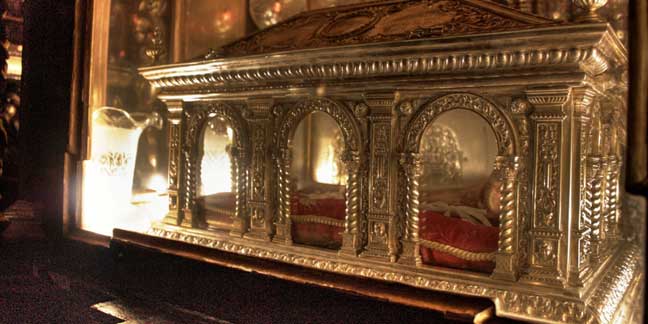
Pictured: Reliquary of St. John of the Cross in Úbeda, Spain
After discerning a calling to monastic life, John entered the Carmelite order in 1563. He had been practicing severe physical asceticism even before joining the Carmelites, and got permission to live according to their original rule of life – which stressed solitude, silence, poverty, work and contemplative prayer. John received ordination as a priest in 1567 after studying in Salamanca, but considered transferring to the more austere Carthusian order rather than remaining with the Carmelites.
Before he could take such a step, however, he met the Carmelite nun later canonized as St. Teresa of Avila. Born in 1515, Teresa had joined the order in 1535, regarding consecrated religious life as the most secure road to salvation. Since that time she had made remarkable spiritual progress, and during the 1560s she began a movement to return the Carmelites to the strict observance of their original way of life. She convinced John not to leave the order, but to work for its reform.
Changing his religious name from “John of St. Matthias” to “John of the Cross,” the priest began this work in November of 1568, accompanied by two other men of the order with whom he shared a small and austere house. For a time, John was in charge of the new recruits to the “Discalced Carmelites” – the name adopted by the reformed group, since they wore sandals rather than ordinary shoes as sign of poverty. He also spent five years as the confessor at a monastery in Avila led by St. Teresa.
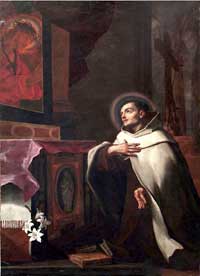 "Saint John of the Cross," attributed to Cesare Gennari (17th century)Their reforming movement grew quickly, but also met with severe opposition that jeopardized its future during the 1570s. Early in December 1577, during a dispute over John's assignment within the order, opponents of the strict observance seized and imprisoned him in a tiny cell. His ordeal lasted nine months and included regular public floggings along with other harsh punishments. Yet it was during this very period that he composed the poetry that would serve as the basis for his spiritual writings.
After nine months, John escaped his prison cell in August 1578 by unscrewing the lock on his door and creeping past the guard. Taking only the mystical poetry he had written in his cell, he climbed out a window using a rope made of strips of blankets. With no idea where he was, he followed a dog to civilization. He hid from pursuers in a convent infirmary where he read his poetry to the nuns.
Thereafter he resumed the work of founding and directing Discalced Carmelite communities. Over the course of a decade he set out his spiritual teachings in works such as “The Ascent of Mount Carmel,” “The Spiritual Canticle” and “The Living Flame of Love” as well as “The Dark Night of the Soul.” But intrigue within the order eventually cost him his leadership position, and his last years were marked by illness along with further mistreatment.
St. John of the Cross died in the early hours of Dec. 14, 1591, nine years after St. Teresa of Avila's death in October 1582. Suspicion, mistreatment and humiliation had characterized much of his time in religious life, but these trials are understood as having brought him closer to God by breaking his dependence on the things of this world. Accordingly, his writings stress the need to love God above all things – being held back by nothing, and likewise holding nothing back.
Only near the end of his life had St. John's monastic superior recognized his wisdom and holiness. Though his reputation had suffered unjustly for years, this situation reversed soon after his death. He was beatified in 1675, canonized in 1726, and named a Doctor of the Church in the 20th century by Pope Pius XI. In a letter marking the 400th anniversary of St. John's death, Pope John Paul II – who had written a doctoral thesis on the saint's writings – recommended the study of the Spanish mystic, whom he called a “master in the faith and witness to the living God.”
— Catholic News Agency
What is a Doctor of the Church? Read more at: http://www.catholicnewsherald.com/faith/101-news/faith/496-the-doctors-of-the-church
On Dec. 26, the universal Church commemorates the death of St. Stephen in 34 A.D., the first man to give his life in witness to the faith. He is sometimes referred to as the "protomartyr."
St. Stephen was a Greek Jew who had converted to Christianity and who was ordained by St. Peter as one of the first deacons in the early Church. The sixth chapter of the Acts of the Apostles states that Stephen was "a man filled with faith and with the Holy Spirit ... filled with grace and fortitude." The Bible also notes that Stephen was a gifted orator and that his logic was sound. The conversions of many people are attributed to him.
However, his outspokenness provoked the ire of some of his listeners, particularly the Sanhedrin, and he was accused of blaspheming against Moses and against God. He was brought before the high priest in Jerusalem, and many false witnesses testified against him.
Acts recounts that, in his defense, he gave an eloquent analysis of salvation history and the love and mercy of God. He also recounted Israel's repeated ungratefulness towards their God. However, it didn't sway his accusers, who proceeded to take him outside the city and stone him. One of those who participated in the stoning was Saul of Tarsus, who would later be converted and become the Apostle Paul.
As he was about to die, Stephen looked up to heaven and said, "Behold, I see the heavens opened, and the Son of man standing at the right hand of God." Then, as he was being stoned, he cried out, "Lord Jesus, receive my spirit."
His last words, as the stoning had brought him to his knees, were "Lord, do not hold this sin against them."
In most Catholic art, Stephen is invested with a crown of martyrdom, holding three stones and a martyrs' palm branch. In Eastern Christian iconography, he is shown as a young beardless man with a tonsure, wearing a deacon's vestments, and often holding a miniature church building and a censer.
— Catholic News Agency
Take a closer look
Illustration: "The Martyrdom of St. Stephen," a fresco painted in 1324 by Bernardo Daddi, at Santa Croce in Florence, Italy
This famous Italian fresco (above) depicts the story of St. Stephen's martyrdom in two panels.
In the left panel, St. Stephen appears before the Sanhedrin judges, where they accuse him of blasphemy against Moses and against God. He is a young man, dressed in deacon's vestments and wearing a tonsure. As he defends the faith, he points heavenward and describes seeing "the heavens opened, and the Son of man standing on the right hand of God" (Acts 7:55).
In the right panel, Stephen is being stoned outside the gates of Jerusalem. But it's not an act of mob violence; it's a death sentence ordered by law when someone had been convicted of blasphemy. Stephen has been thrown down to his knees, while the men who had testified falsely against him cast the first stones. They have thrown off their outer cloaks, to make throwing the rocks easier.
The character who holds one man's coat and cheers on the sidelines is Saul – the future Apostle Paul, but at this point he is still a severe persecutor of Christians.
Typically the bodies of those stoned to death would be left to be eaten by animals. But Acts recounts that "devout men," most likely including Gamaliel (a wealthy Christian who would become the teacher of St. Paul and St. Barnabas), secretly came and took St. Stephen's remains to be entombed at his estate about 20 miles outside Jerusalem. His tomb was forgotten to history until rediscovered in 415 A.D., when Gamaliel appeared in visions to a priest named Father Lucien.
— Source: "The Catholic Encyclopedia" (1912), online at www.newadvent.org