

Feast day: Sept. 28
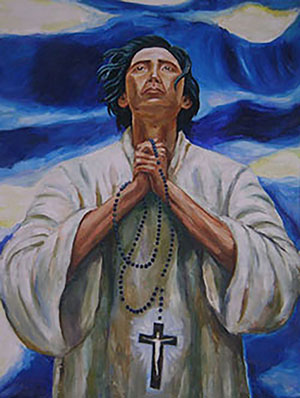 St. Lorenzo Ruiz was born around the year 1600 in Binondo, Manila, in the Philippines. He was the son of a Chinese father and a Filipino mother. Both were Christians and took care to raise Lorenzo as a Catholic. He served happily in his parish church as an altar boy and calligrapher.
As a young man, Lorenzo joined the Dominican Confraternity of the Most Holy Rosary. Later, he married a woman named Rosario and the happy couple had three children, two sons and one daughter. By all accounts, the family was ordinary and happy.
In 1636, Lorenzo was accused of murder, allegedly having killed a Spaniard. However, to protect his safety at the time, he fled home and found refuge on board a ship with three Dominican priests and a leper. There are no details of this alleged crime other than a journal entry by two Dominican priests, that he joined their group to escape possible arrest. The ship departed the Philippines on June 10, 1636, bound for Okinawa.
A shock awaited the passengers when they arrived in Japan. At the time of their arrival, the rulers of Japan, the Tokugawa Shogunate, were persecuting Christians. Prior to this persecution, the Christian population of Japan was thought to number 50,000 souls.
Lorenzo was arrested by Japanese officials for the crime of being a Christian and ordered to recant his faith. When he refused, he was imprisoned for two years. On Sept. 27, 1637, Lorenzo and his companions were taken to Nagasaki to be tortured and killed if they would not recant their faith.
Lorenzo and his companions were tortured by water, which was forced into their mouths and down their throats and out their noses and ears. Despite the painful torture, the men refused to do so.
Following this, Lorenzo was hanged upside down, with a rope around his ankles. This method of torture was known as tsurushi, or “gallows and pit.” The torture forces a person to be hanged upside down with a gash cut in their forehead to prevent too much blood from gathering in the head. The gash also causes the victim to bleed to death over an extended period of time.
Those who have survived the torture have said it is unbearable. One hand is left free so the victim can offer an agreed symbol that will represent their desire to recant their faith. Those few who recant are spared and allowed to live. But few people ever recanted – choosing instead to die for their faith.
Lorenzo refused to recant. According to the record of his death, his last words were, “I am a Catholic and wholeheartedly do accept death for God. Had I a thousand lives, all these to Him I shall offer. Do with me as you please.”
His traveling companions were also all killed, steadfast until the end.
Lorenzo was beatified by Pope John Paul II on Feb. 18, 1981. The beatification ceremony was held in the Philippines – the first beatification ceremony ever held outside the Vatican.
A miracle attributed to his intercession occurred in 1983. A 2-year-old girl, Alegria Policarpio who had suffered from hydrocephaly since birth, was miraculously cured.
His canonization took place at the Vatican on Oct.18, 1987.
St. Lorenzo Ruiz is the patron saint of Filipino youth, the Philippines, people working overseas, and altar servers.
— Source: www.catholic.org
Feast day: Sept. 29
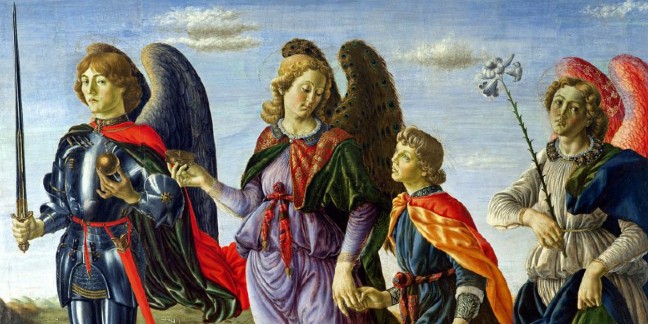 “Three Archangels with Tobias” by Francesco Botticini, 1470.Each year as the warm days of summer turn to the coolness and bright colors of autumn, the Church celebrates the work and ministry of angels. We begin this celebration on Sept. 29, with the feast of the archangels – Raphael, Michael and Gabriel. The Scriptures speak of how angels are sent to assist in God’s plan of salvation. They are the only angels named in Sacred Scripture, and all three have important roles in the history of salvation. They bring messages and accompany the faithful along the path of daily life.
In celebrating the archangels on Sept. 29, the Church reminds us of three special messengers who were sent to accomplish very specific tasks. The Book of Tobit, one of the classics of the seven apocryphal texts of the Hebrew Bible, tells the story of Raphael, who was sent by God to accompany Tobias in his quest to find medicine to cure the blindness of his father, Tobit. Raphael’s task is to lead, guide and protect his young companion in his quest. Along the way Tobias experiences many adventures, finds love and marriage and, in the end, secures the medicine his father needs. Thus he achieves many goals, receives numerous blessings and completes his mission. This is made possible because of the archangel’s guidance. Raphael has served his purpose well; he has carried out the mission God gave him to accompany, guide and protect Tobias from harm and fight the battles of God.
St. Michael is the “Prince of the Heavenly Host,” the leader of all the angels. His name is Hebrew for “Who is like God?” which was the battle cry of the good angels against Lucifer and his followers when they rebelled against God. He is mentioned four times in the Bible, in Daniel 10 and 12, in the letter of Jude, and in Revelation.
Michael was sent to fight God’s battles. The short letter of St. Jude describes Michael in an argument with Satan over the body of Moses. While Michael does not make any pronouncement against the devil, he does say, “May the Lord rebuke you” (Jude 1:9), indicating the false nature of Satan’s argument. In the apocalyptic Book of Daniel, Michael’s role is much more proactive. He is described as “the great prince, guardian of your people” (12:1). In his vision, Daniel describes the classic confrontation between good and evil at the end of time. Michael is the great champion of the people; he stands ready to greet those who rise from the dead and experience God’s great victory over evil.
The New Testament continues to reveal Michael’s role as a champion for God.
Michael, whose forces cast down Lucifer and the evil spirits into Hell, is invoked for protection against Satan and all evil. In 1899 Pope Leo XIII, having had a prophetic vision of the evil that would be inflicted upon the Church and the world in the 20th century, instituted a prayer asking for Saint Michael’s protection to be said at the end of every Mass.
Christian tradition recognizes four offices of Saint Michael: 1) to fight against Satan, 2) to rescue the souls of the faithful from the power of the enemy, especially at the hour of death, 3) to be the champion of God’s people, and 4) to call away souls from earth and bring them to judgment.
Perhaps the most prominent and best-known of the archangels is Gabriel, the one who delivers special messages to those favored by God. We first hear of Gabriel through St. Luke’s depiction of the Annunciation:
“In the sixth month, the angel Gabriel was sent from God to a town of Galilee called Nazareth, to a virgin betrothed to a man named Joseph, of the house of David, and the virgin’s name was Mary. And coming to her, he said, ‘Hail, favored one! The Lord is with you’” (Luke 1:26-28). Gabriel continued: “Do not be afraid, Mary, for you have found favor with God. Behold, you will conceive in your womb and bear a son and you shall name him Jesus. He will be great and will be called Son of the Most High and the Lord God will give him the throne of David his father, and he will rule over the house of Jacob forever and of his kingdom there will be no end” (Luke 1:30-33).
Christian tradition suggests that it is he who appeared to St. Joseph and to the shepherds, and also that it was he who “strengthened” Jesus during his agony in the garden of Gethsemane.
St. Raphael’s name means “God has healed” because of his healing of Tobias’ blindness in the Book of Tobit. Tobit is the only book in which he is mentioned, where he speaks: “I am the angel Raphael, one of the seven, who stand before the Lord” (Tob 12:15).
His office is generally accepted by tradition to be that of healing and acts of mercy. Raphael is also identified with the angel in John 5:1-4 who descended upon the pond and bestowed healing powers upon it so that the first to enter it after it moved would be healed of whatever infirmity he was suffering.
— Catholic News Herald Teachingcatholickids.com and catholicnewsagency.com contributed.