

Make time to get away to see North Carolina’s kaleidoscope of color this fall and consider visiting our scenic churches as you take in the natural beauty of our diocese. From our newest parish, St. Jude near Gorges State Park in Sapphire, to St. Lawrence Basilica in Asheville, the Diocese of Charlotte includes more than a dozen churches along leaf viewing routes throughout western North Carolina.
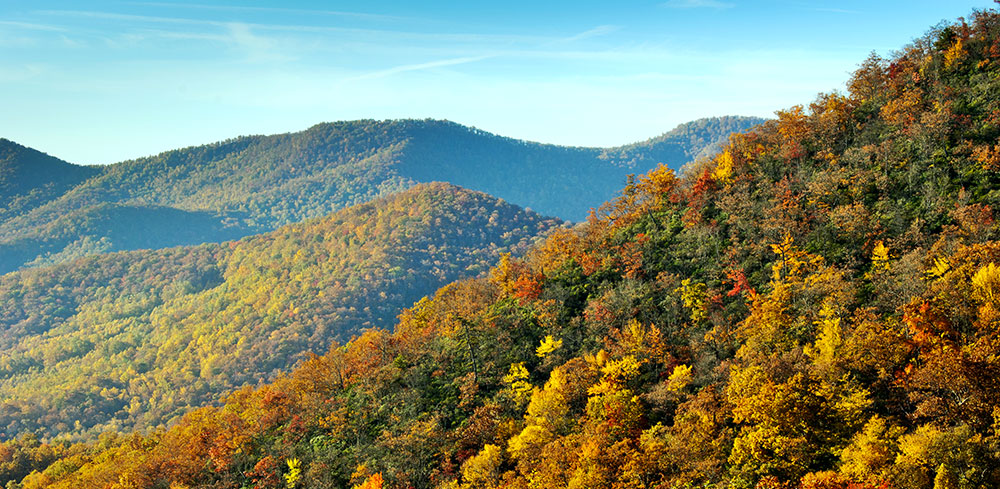
Many offer historical and architectural significance, as well as a range of Mass times, within close proximity of natural treasures such as Grandfather Mountain, Linville Gorge and Sliding Rock. Peak color is expected from early October through early November, depending on elevation. God’s beauty awaits!
— SueAnn Howell
Click on each leaf above to discover parish information and find directions.
Dedicated in 1909 and listed on the National Register of Historic Places, St. Lawrence Basilica is capped by a spectacular tiled dome – one of the largest free-standing elliptical domes in North America.
97 Haywood St., Asheville, N.C. 28801
www.saintlawrencebasilica.org
This church features a beautiful hand-carved white oak crucifix suspended above the altar and set against a backdrop of stacked stone.
208 Seventh Ave., Hendersonville, N.C. 28791
www.immaculateconceptionchurch.com
Conveniently located near Pisgah National Forest in Brevard, a walkable town noted as a tourism, retirement and cultural destination.
150 Brian Berg Lane, Brevard, N.C. 28712
www.sacredheartbrevard.org
Just 20 minutes north of Asheville, Mars Hill is a small college town near a host of outdoor activities.
149 Brook St., Mars Hill, N.C. 28754
www.standrew-sacredheart.org
Enjoy panoramic views of Grandfather Mountain. An outdoor St. Anthony of Padua Chapel and a Lourdes grotto are open for prayer.
2085 N.C. Hwy. 105, Linville, N.C. 28646
www.stlucienbernadette.org
Boone is located near hiking trails, zipline courses, ski resort chairlifts and waterfall trails that
provide perfect leaf viewing opportunities.
259 Pilgrim’s Way, Boone N.C. 28607
www.saintecc.org
Sparta is situated in the heart of the Blue Ridge Parkway not far from the second oldest river in the world, the New River.
29 Highland Dr., Sparta N.C. 28675
www.stfrancesofrome-sparta.org
Located hillside in a town within the Nantahala National Forest, visitors can pray at an outdoor
St. Joseph Shrine.
299 Maple St., Franklin, N.C. 28734
www.stfrancisassisifranklin.org
Come see the 33 beautiful windows designed by Statesville Stained Glass Co. and venerate a first-class relic of St. Francis in the nave of this “mountain Gothic” style church.
167 St. Francis Pl., Jefferson, N.C. 28640
www.stfrancisofassisi-jefferson.org
Nestled between the Great Smoky Mountains National Park and Nantahala National Forest, this area is an outdoor enthusiast’s dream.
316 Main St., Bryson City, N.C. 28713
www.stjosephbryson.org
Perched above Maggie Valley, this is the perfect spot for leaf looking near the Blue Ridge Parkway.
37 Murphy Dr., Maggie Valley, N.C. 28751
www.stmargaretofscotlandmv.org
Filmmakers have captured the beauty of this small town located near the Cherokee Indian Reservation and Great Smoky Mountains National Park.
22 Bartlett St., Sylva, N.C. 28779
www.stmarymotherofgod.com
Formerly a mission of Sacred Heart Parish in Brevard, this picturesque octagonal church was elevated to a parish in July, making it the newest church in the Diocese of Charlotte.
3011 Hwy. 64 East, Sapphire Valley, N.C. 28774
www.stjudeofsapphirevalley.org
Mayberry fame aside, Mount Airy is known for its white granite and Holy Angels Church is made from it. Also check out the historic altar, stained glass and statues inside.
1208 North Main St., Mt. Airy, N.C. 27030
www.mountairycatholicsha.com
This wooden church built in the Gothic style, with large exposed rafters, just celebrated its 85th anniversary last year.
102 Andrews Place, Swannanoa, N.C. 28778
www.saintmmc.com
This westernmost church in the diocese is in a quaint town flanked by the Hiwassee and Valley Rivers.
765 Andrews Road, Murphy, N.C. 28906
www.st-william.net
In an area surrounded by national forest and graced by the North Toe River, the town boasts a lively arts scene and great parks.
695 Summit St., Spruce Pine, N.C. 28777
www.stlucienbernadette.org
Home to Mt. Mitchell, the highest peak east of the Mississippi River, this mountain town offers endless outdoor adventures.
20 Summit St., Burnsville, N.C. 28714
www.standrew-sacredheart.org
From farms and wineries to galleries and ski slopes, this part of western North Carolina does not disappoint.
163 Galax Lane, Blowing Rock, N.C. 28605
www.saintecc.org/church-of-the-epiphany/
In the heart of the Great Smoky Mountains, visitors enjoy all that mountain vistas of Cataloochee Valley and the Blue Ridge Parkway.
234 Church St., Waynesville, N.C. 28786
www.stjohnrcc.com
Throughout 2024, Franciscans around the world commemorate the 800th anniversary of St. Francis of Assisi receiving the stigmata on Sept. 17, 1224, the appearance of the bodily wounds of Christ's crucifixion.
At an April 5 audience with members of the Franciscan communities of La Verna, Italy, where St. Francis was staying when he received the wounds of Christ, Pope Francis commemorated the eighth centenary and said the stigmata serves as a reminder of "the pain suffered by Jesus in His own flesh for our love and salvation."
"The image of Christ in the crucifix that appears to him in La Verna, marking his body, is the same as the one that had impressed itself upon his heart at the beginning of his 'conversion,' and which had indicated to him the mission of 'repairing his house,'" the pope said.
While there have been several notable figures in the church who experienced the stigmata, St. Francis' experience was the first recorded occurrence of the phenomenon. Yet, such recognition of a quite miraculous, and excruciatingly painful, phenomenon was something the poor man of Assisi did his utmost to avoid.
On Sept. 14, 1224, the feast of the Exaltation of the Cross, just two years before his death, St. Francis was at the hermitage of La Verna, nestled in the Tuscan Apennine Mountains, for a time of prayer and reflection.
Franciscan Brother Thomas of Celano, who was commissioned by Pope Gregory IX to write about St. Francis' life in 1229, recounted how he received the stigmata.
According to Brother Thomas, St. Francis was praying when he saw a vision "a man like a seraph having six wings, standing over him with hands outstretched and feet joined together, fixed to a cross."
After seeing the vision and trying to understand its meaning, "marks of nails began to appear in his hands and feet."
Furthermore, the Franciscan biographer wrote that "certain small pieces of flesh were seen like the ends of nails bent and driven back" and "his right side, as it had been pierced by a lance, was overlaid with a scar, and often shed forth blood, so that his tunic and drawers were many times sprinkled with the sacred blood."
However, Brother Tommaso also dedicated a chapter to recount the lengths St. Francis went to hide the wounds he had received.
St. Francis, he wrote, "concealed the stigmata most diligently from strangers, and from those about him he hid them so carefully that even the brethren at his side and his most devoted followers were for a long time unaware of them."
Yet, despite his best efforts, St. Francis couldn't hide the wounds nor the pain it caused from his fellow brothers.
"Once when one of his companions saw the stigmata in his feet, he cried, 'What is this, good brother?'" Brother Tommaso wrote.
"'Mind your own business,'" the saint replied.
While only a few knew about the phenomenon and the stories of St. Francis' stigmata were only whispered among a few brothers, it wasn't until the saint's death in 1226 when it was confirmed as his body was prepared for burial.
Mourning the death of their founder, Brother Thomas said their "grief was converted into singing and weeping into jubilation" upon seeing the wounds of Christ on St. Francis' hands, feet and side, "for never had they heard or read in Scriptures of a thing which was now displayed before their eyes."
Polish Franciscan Father Emil Kumka, an expert on early and medieval church history, as well as Franciscan history and hagiography, at Rome's Pontifical Theology Faculty of St. Bonaventure, also known as the Seraphicum, said that bearing the marks of the crucifixion served as "a sign and proof" of the possibility of belonging "intimately to Christ."
"The exemplary value of the saint of Assisi is universal, also due to his behavior after encountering the winged seraph with the figure of the crucified Savior. His reaction -- discretion, humility and gratitude for such an extraordinary gift -- exemplifies a truly evangelical following of Christ," Father Kumka told OSV News Sept. 13.
However, the Franciscan priest said "it is difficult to answer definitely" why God chose this form of manifestation "because it enters into the mystery of God."
"Yes, it is a painful gift, but the mystics who received the stigmata did not see it merely as a sacrifice but as the joy of participating in the supreme love God offers to the world," Father Kumka explained. "The love of the Lord, which passes through suffering, gives meaning to this pain. For this reason, human sacrifice in stigmatics was an added dimension, not the determining one."
There have been several revered saints in the Catholic Church who reportedly received the stigmata, including Sts. Padre Pio, Faustina Kowalska and Rita of Cascia.
Like St. Francis, those who authentically experienced the phenomenon "were reluctant to reveal this special grace," Father Kumka told OSV News.
"The stigmata are a free gift from the Lord and only demonstrate his holiness and goodness. Of course, those who receive them are viewed as 'saints' by others, but stigmatics themselves often felt unworthy of such immense trust from God."
Catholics, he said, should view the stigmata not simply as proof of one's holiness, but instead as "a comfort and sign" of God's closeness.
The faithful, Father Kumka said, should "be inspired to follow the humble, poor, and crucified Son of God, as St. Francis did" and "remain aware that the call to holiness is universal and leads to total conformity with Christ, offering themselves to him with trust and willingness."
In Poland, for the grand anniversary of St. Francis' stigmata, Archbishop Marek Jedraszewski of Kraków Sept. 15 elevated the Church of the Stigmata of St. Francis of Assisi into the Sanctuary of Sorrowful Jesus Ecce Homo.
The church is located some 18 miles west from Kraków, in Alwernia -- a town that got its name from the Tuscan La Verna. Polish nobleman Krzysztof Korycinski, devoted to St. Francis of Assisi, visited La Verna in 1616, was mesmerized by the place, saw the similarity of land and initiated the construction of Polish La Verna in 1625 on a hill that he owned.
During his homily, Archbishop Jedraszewski said St. Clare of Assisi sewed special shoes for St. Francis to "ease his pain" caused by stigmata and that "many people describing Francis wrote: Whoever saw Francis saw Christ," the archbishop said.
Alwernia's church is also home to Ecce Homo painting of Christ before his crucifixion that "was already famous for its graces in the 15th century and was venerated in the Imperial Chapel of Constantine XI."
— Junno Arocho Esteves, OSV News