

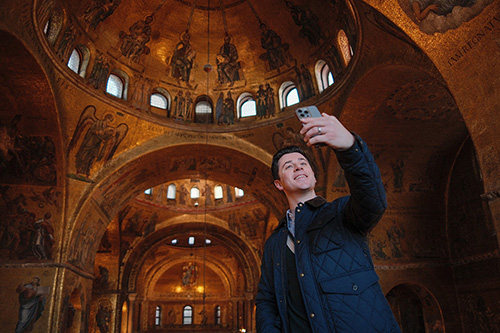
 David Henrie is crediting beauty for his return to the Catholic faith after creating a new docuseries with EWTN Studios called “Seeking Beauty.”
“Beauty was a part of it, because the place that I had my conversion was St. Michael’s Abbey in Orange County, which is probably one of the most beautiful monasteries in the United States,” the 36-year-old actor, who rose to fame starring in TV shows such as Disney’s “Wizards of Waverly Place” and the CBS sitcom “How I Met Your Mother,” said of the community of Norbertine priests in Silverado, California. “That’s where I went and did my first general confession.”
Henrie spoke with OSV News ahead of the premiere of his adventure documentary series, “Seeking Beauty with David Henrie,” on Jan. 19.
As the show’s host, he invites viewers to travel with him across Italy to Vatican City, Rome, Florence, Milan, Subiaco and Venice in a quest for beauty. In six 45-minute long episodes, he channels the viewer’s wonder and curiosity as he explores the art, music, food, history and culture of those regions.
The show will debut on EWTN’s streaming platform, EWTN+, which is available free on RokuTV and recently launched on EWTN.com, AppleTV, AmazonFireTV and GoogleTV.
“Beauty is a fingerprint of the divine,” Henrie told OSV News. “I have come to see how, if you invite it into your life, it can help you know, see and love God.”
In his search for beauty, Henrie examines masterpieces and monasteries up close. Along the way, he invites viewers into his own life and introduces his wife Maria and their three children. In one episode, Henrie speaks about his faith journey.
“By the time I was a teenager and in my 20s, I had gained all this – all this success and money – and traveled the world,” he said. “But I was brought to a real low point.” At the time, he felt depressed and struggled with a lot in his life, he says.
“I felt I should be happy, I have all the things that I should have to be happy,” he adds. “But then once God reached out and gave me that clear sign that there is a path and that my life isn’t a big mistake.”
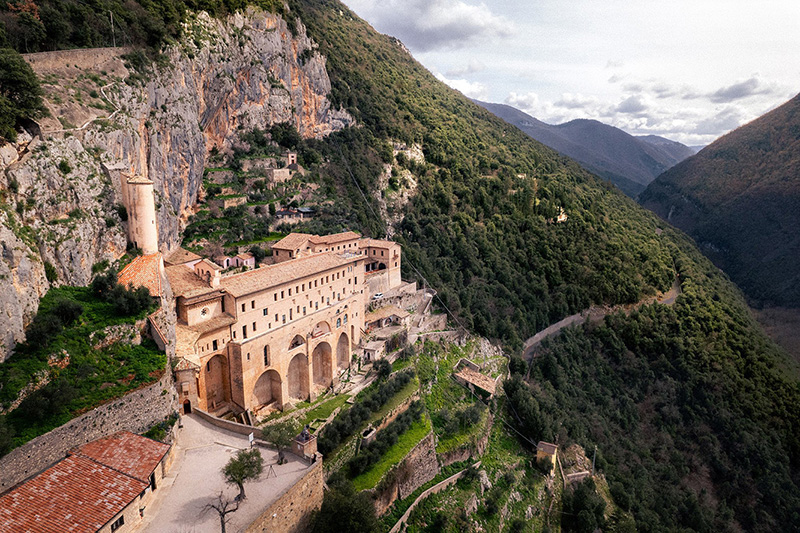 Places of beauty such as the Monastery of St. Benedict, known as the Sanctuary of the Sacred Cave, near Subiaco, Italy, can bring us closer to God, a new TV series says. (EWTN Studios | OSV News)
Henrie was 22 when he visited St. Michael’s Abbey for confession on Jan. 1, 2012.
“I didn’t just go anywhere for my conversion, and I wasn’t even directly seeking it,” Henrie said of the abbey. “It was at the most beautiful place, a place that you can really feel God … beauty was right there, knocking on my door.”
Henrie expressed excitement about exploring beauty with others in “Seeking Beauty,” which has already filmed a second season in Spain. “I’ve always struggled with just purely producing secular works and working in secular Hollywood and being vocal about my faith,” he said. “It’s been a joy to just be able to be myself and talk about something that I love and care about.”
Beauty, Henrie said, is God’s language. He encouraged viewers to explore whether beauty is subjective or objective.
“If it’s something that’s outside of you that has a universal effect, where you have people from all different faiths, all different ages, standing there, looking at a thing, contemplating it, being brought to tears,” he said. “Maybe there’s an objective truth to it.”
“If that’s the case, who’s the author of that? That’s where you start the conversation about God and contemplation,” he said.
He hopes the show inspires viewers to embrace beauty.
— Katie Yoder, OSV News
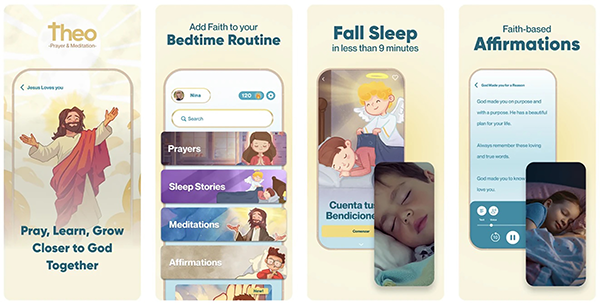 Theo, a free Catholic prayer and meditation app for children and their parents, plans to host the largest Advent celebration for children to help them discover the true meaning of the season.
Now through Dec. 24, more than 1 million children are expected to take part in a 25-day journey filled with stories, songs, activities and reflections.
The Advent campaign will be led by Theodore, a cheerful animated donkey who is described as a direct descendant of the donkey that carried the Blessed Virgin Mary to Bethlehem. It will also feature several special guests, including Catholic actor David Henrie and Father Ambrose Criste, among others.
Participants will read through the first two chapters of Luke, which will be accompanied by some meditations and reflection questions for children to do with their parents as well as hearing the stories of several saints, listening to songs, and explaining activities that parents and children can do together.
Francisco Cornejo, CEO of Theo, told CNA in an interview that this campaign will help children “hear the word of God” and “prepare their hearts for the birth of Jesus.”
“We prepared these four weeks in a way that is engaging; it’s fun, but it’s also educational,” he added.
While Theo can be used for children of all ages, Cornejo pointed out that the Advent campaign is best suited for children between the ages of 4 and 12.
“The content tends to be on the more mature side of things, I would say, meaning 6 to 8 and older, but again this is the beauty of creating an app that is for the parent and the child – if the theme or the topic is a little hard to grasp or we want to go deeper in the learning, you have your parent by your side,” Cornejo said. “So you can discuss that and we’ll provide those discussion points and all the guidance there.”
Theo launched seven months ago and already has over 2 million users. Cornejo attributes the app’s success first and foremost to God but also to the need among Catholics families for a tool like this.
“We’ve seen over the last few years how families and how parents specifically wanted to have something like Theo because it’s not enough to take kids to Mass every Sunday or to get them through holy Communion preparation or confirmation preparation,” he said. “What happens every other day of the year or of their lives? So we really wanted to create a tool that makes faith accessible and teachings accessible for everyday kids and families regardless of where they are in their faith journey.”
He added: “It’s not meant to replace all the good things that we parents have to do, but it’s meant to help make faith an everyday thing. Something that kids want to hear more because it’s packed in a way that it’s accessible for them.”
The content on Theo includes daily Scripture readings, prayers, bedtime stories, faith-based affirmations, meditations, novenas, stories of the saints, the rosary, and much more.
Cornejo also highlighted the importance of having both child and parent involved in using the app, because “education needs to be done together.”
“You need to exemplify what you want to try to teach, and you have to do it with your kids – that’s the domestic Church. That’s what we are meant to do as parents,” he added.
As for what he hopes children and their parents will take away from participating in the Advent campaign, Cornejo said: “I think the main thing is remembering and living the actual meaning of Advent – the waiting for Jesus’ birth, preparing our hearts as the manger to welcome Jesus into our hearts” and that participants “forget about the fluff and the gifts and the ‘me, me, me’ and start thinking about what this actually represents.”
— Francesca Pollio Fenton, Catholic News Agency