

Pilgrimage of life
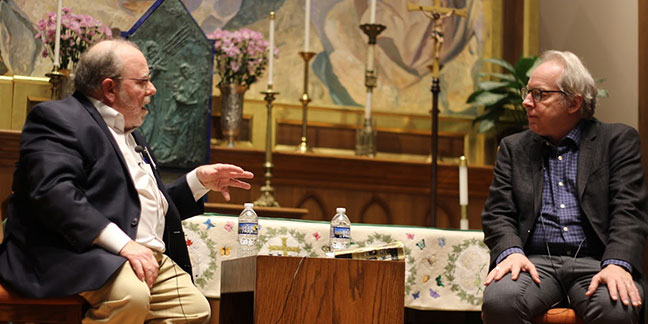 Best-selling author and journalist, Paul Elie was the guest lecturer for the 2024 Kennedy Lecture at St. Peter Church. Elie spoke about his books and career, then participated in a question-and-answer session with Tim Funk, a former religion and politics writer for The Charlotte Observer and one of the event’s organizers. (Christina Knauss | Catholic News Herald)CHARLOTTE — Paul Elie has come to think about life as a pilgrimage, traveled in the company of others yet ultimately up to each individual to interpret its significance.
The best-selling author and journalist was the featured speaker at the 24th annual Kennedy Lecture at St. Peter Church in Uptown Charlotte on Saturday, Jan. 27. The event drew about 300 people for the series’ first in-person lecture since the pandemic began.
Elie covers the Catholic Church and Pope Francis for “The New Yorker” and wrote the best-selling book “The Life You Save May Be Your Own”— a biography of Catholic authors Dorothy Day, Thomas Merton, Flannery O’Connor and Walker Percy. He also is a senior fellow at Georgetown University’s Berkely Center for Religion, Peace and World Affairs.
Elie said studying the lives and faith journeys of the four authors he profiled helped him develop a sense of Catholic life as a modern pilgrimage, and to think of the faithful as “people of God on a pilgrimage in time.”
“A pilgrimage is a journey to a place with a story that precedes us,” Elie said. “Our challenge is figuring out where we fit into that story.”
Each of the iconic Catholic authors he wrote about embarked on their own pilgrimage of sorts, he noted, leading Dorothy Day to become a writer, activist and co-founder of The Catholic Worker social justice movement. Walker Percy’s journey took him through serious illness and a challenging family life to explore philosophy in novels such as “The Moviegoer,” which chronicles man’s search for faith. Thomas Merton’s spiritual longing led him to become a Trappist monk in Kentucky, and Flannery O’Connor’s faith led her to look at her home in the rural South through a Biblical lens as she produced her iconic short stories and novels, which included “Wise Blood.”
The four writers are still inspiring people today, Elie said, because of the sincerity and integrity of their searches for faith and truth, and because they wrote so well about them.
“The word pilgrimage has great resonance in this country not only to Catholics, but to Protestants and in Judaism as well,” he said. “The word has not been degraded by overuse.
We can look at a pilgrimage as a journey where something significant is going to happen, and learning about others’ pilgrimages can help us understand the narrative we belong to as Catholics.”
The format of this year’s lecture differed from prior years, with Elie talking about his work and then participating a question-and-answer session with Tim Funk, a former religion and politics writer for The Charlotte Observer and one of the event’s organizers.
The conversation featured questions submitted to the lecture’s organizing committee in advance and explored Elie’s perspectives on a variety of topics.
On Pope Francis
Asked about his experience covering Pope Francis, Elie compared our current pontiff with our two previous popes he wrote about, Saint Pope John Paul II and Pope Benedict XVI, describing each pope’s personality and way of interacting with the world.
“Pope John Paul II had a background in acting and his style was very much the dramatist, while Benedict was a scholar,” Elie said. “I see Pope Francis as a conversationalist. He is present for each person he meets. He looks you right in the eye when he talks to you and gives you his attention. He also doesn’t seem to be drawn from a playbook but is more spontaneous. He is a pope who looks the whole world in the eye.”
Elie said Pope Francis makes a point of “being present” in meetings with the faithful and is more interested in “listening than wagging his finger.”
He also called Pope Francis a “transformational” leader who has taken landmark positions on world affairs, including his condemnations of war.
“Pope Francis when asked about the conflicts in Gaza and in Ukraine openly denounces war in general – that is a minority position in the world,” he said. “It’s easy for us to forget how radical that is even within the Church.”
On Jesuits
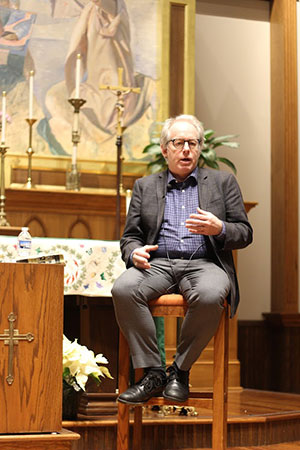 St. Peter is the only Jesuit parish in the Diocese of Charlotte, and Elie talked about the order’s role in the world today, especially since he was educated by Jesuit teachers and works at Georgetown University, a Jesuit institution.
“Those of us who have been formed by the Jesuits can’t help but embody their charism in our lives,” he said. “St. Ignatius, their founder, is regarded by many as the first ‘modern man’ because he brought religious life down from the walls (of the Church) and put it into the head. He created an approach to religion that is personal, imaginative, intense and mobile.”
On the sex abuse crisis
Elie said the Church in the U.S. has “dealt with the problem with resolve,” but must continue its work to earn trust by supporting and providing opportunities for abuse victims to openly tell their stories.
“One of the best ways to show the desire to be honest about the abuse crisis would be to truly encourage people to say what happened to them and let them tell their stories…,” said Elie, who described himself as a victim of clerical misconduct. “If you can’t say what happened, there’s a loss of honesty that leaves a lot out.”
On the rise of “Nones”
Recent polls in the U.S. indicate the rising number of so-called “nones,” people who claim affiliation with no specific religious tradition.
“One reason this may be happening is that God and religion are not being presented as much in today’s culture,” he said. “When something is not presented, it doesn’t become an option for people’s lives in the same way that it used to. The Church assumes that religion is natural to human nature, is deeply wound into our nature and that we are oriented toward the divine and the good. Once you remove that perspective from people’s lives, the discussion is not the same.”
Elie talked briefly about politics, social issues and the role of women in the Church. As a new dad, he also noted his deepening interest in Catholic parenthood, as well as his evolving exploration of – and inspiration from – various Saints at different times in his life.
People in the pews at St. Peter applauded his observations and waited in long lines for him to sign copies of his book.
“I think it is fantastic how he projects so many facets of Catholic charisms and offers more than just a one-dimensional view of the church,” said Cristobal Villapando, a parishioner at St. Peter. “He has synthesized the gift of Catholic genius.”
— Christina Lee Knauss