

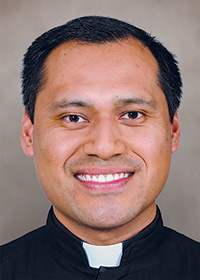
 HENDERSONVILLE — For some, serving the kingdom of God as a priest is an intimidating calling, but Juan González Hernández knew from the age of six that God had plans for him.
Hernández’ devout Catholic upbringing in Mexico City led him to encounter his vocation in one of the most moving ways possible: witnessing his brother’s ordination to the priesthood and receiving his first communion from him during his first Mass.
Born on October 1, 1990, in Tapalapa, Chiapas, Hernández grew up in a faith-filled family where service to the Church was a natural part of life, with siblings who went on to become priests, religious sisters and educators. His early calling led him to formation in Spain in 2007, followed by ministry in Peru and advanced theological studies in Rome, where he completed master’s degrees in philosophy and moral theology in 2021.
Drawn to serve the Hispanic Catholic community, Hernández is assigned to Immaculate Conception in Hendersonville and lives at St. Joseph College Seminary. Choosing Deacon Bryan Ilagor to vest him at his diaconate ordination, Hernández continues to prepare for priesthood while enjoying music, literature, and hiking as he deepens his commitment to a life of service in Christ.
CNH: When did you first feel a calling to the priesthood?
Hernández: It was the day that my brother was ordained a priest in 1997 when I was just about to turn 7 years old. On that day, the lightbulb in me lit up and I asked myself, “what if I myself become a priest one day, like my brother?”
CNH: What experience led you to attend seminary?
Hernández: At 12 years of age, I had a vocational experience that was sort of like a pre-seminary experience. There I was for about two years with other boys who had the same feeling of a call that I did, then before college I did another vocational retreat in Mexico City. Then I received a formal invitation to the seminary, and after talking with my father he had no opposition, and I decided I had to join.
CNH: What was it like to continue your studies by leaving for Spain?
Hernández: My brother, a priest, and two of my sisters, who were cloistered nuns, lived there. My brother studied in Spain while in seminary and my sisters were also a part of the institute “Obra de Amor” which brought them to Spain.
Having them there was helpful, because even though it was a new experience for me, I could be close to my family and learn from them.
CNH: What does it mean to you to be able to serve the Hispanic community in this diocese?
Hernández: I have lived in many different places with a variety of cultures. I feel as though I mold well to both communities, the Anglo and Hispanic communities. So the idea that my mentor at Immaculate Conception in Hendersonville, Father Andrés Gutierrez, has mentioned is [to] create a singular and strong community out of both of those cultures. That way, people do not show divisions but rather the church becomes a place where everyone feels like one community.
CNH: What will it mean for you to become a deacon?
Hernández: It is a radical change in my life, because after this moment I will be a representative of not only the Church, but of Jesus Christ. Of course, the responsibility is much bigger, but I am also conscious that God’s grace, the prayers of the faithful and a spiritual life, help to take charge of that weight.
CNH: What stands out when you think about the day you will become a priest?
Hernández: I think about when my father told me before I left my family to the seminary, ‘If the Lord is calling you, you must follow his instruction. The Lord can choose whoever He wants whenever He wants, we must be ready to follow.’ For me it is accepting a gift. I feel secure in this decision because this is my vocation and God has control.
CNH: What does it mean to become a leader and represent the Church?
Hernández: To represent the Church is to represent Christ. If He was not real or He didn’t rise from the dead, my life would not have any meaning.
I want to represent Him by showing the unconditional love that Christ had for everyone with the goal of bringing them into the Church and conversion. For those that don’t, that they might at least have a more meaningful relationship with the Lord.
— Brian Segovia
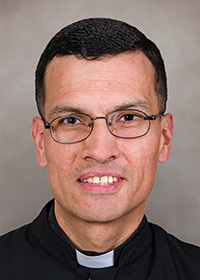 HENDERSONVILLE — Daniel Chaves Peña thought he had his life all worked out. A track star living in New Jersey, he was close to achieving his dreams as an athlete, but suddenly his life changed. God had different plans for him. Plans to which, he eventually would say yes.
Originally from Bogotá, Colombia, Chaves moved to New Jersey in 1993 at a young age. As he matured, so did the quiet call God was placing in his heart.
He entered seminary and completed his philosophical studies in Spain in 2010. His journey of formation led him to serve in missions in Peru from 2016 to 2018, and eventually to Rome, where he earned his Baccalaureate in Sacred Theology in 2021.
In 2023, Chaves joined the Diocese of Charlotte’s seminary program and is serving the community of Immaculate Conception Parish in Hendersonville as he awaits the grace of receiving Holy Orders.
CNH: When did you first feel a calling to the priesthood?
Chavez Peña: When I got to what was going to be my last year of high school, I ran cross-country and I was doing pretty well. I had many scholarship offers from universities here in the United States, and in the final race of the state championship in New Jersey, I collapsed just before reaching the finish line...
They rushed me to the ER, and they told me it was my sugar levels – they were extremely low. That began a crisis not only health-wise, but spiritually. And
I wasn’t getting better, I had relapses, so the decision was made for me to return to Colombia with my mom.
It was during that crisis when I had to face reality. Because everyone thought my future was so bright, and suddenly I realized life ends and things aren’t just fun or passing time. You face reality and the question arises. And as I said, it wasn’t just “change your life,” but “give yourself to Me.” But that was a vague first call that I didn’t fully understand until much later.
CNH: What was life like in Colombia? How did it lead to you choosing this life?
Chavez Peña: When I went to Colombia, I reconnected with the Church through my paternal grandparents, especially through the Charismatic Renewal at the Minuto de Dios, a very strong movement in Colombia. Even though I’ve never felt particularly drawn to the Charismatic Renewal, it was like the door that opened for me to search for what I was looking for. And eventually that same grandmother took me to a silent weekend retreat—an Ignatian retreat in Bogotá—where I clearly found the call to the priesthood.
At that retreat I remember thinking, yes, maybe this is it, but we’re always reluctant to face what God asks of us because we know God asks for a lot. So there was that fear: if I say yes, everything else is over. …But the thought kept returning, resonating, until I said, I can’t live with myself if I say no. It was so clear – God was calling me.
CNH: Reflecting on that health crisis you had in high school, how did God use it to transform you?
Chavez Peña: I’d say it was the beginning of a transformation—one I dare say continues even today, and probably will until my death. But yes, it was the push. A moment where I said, “I could die here.” And everything changes—it's a new reality. And even though I wasn’t practicing, that’s the beauty of planting faith in children: even if they stray, the seed remains. And I realized—if I die now, I must give an account to God. There is something after life. And it may be heaven, or it may not be. It’s serious, facing that. That was the shake that began the process of thinking differently.
CNH: What are some of your interests?
Chavez Peña: I like reading a lot—especially lives of saints and writings of saints. History as well, but spending time with writings of saints is what I dedicate the most time to, especially during prayer. And classical music.
CNH: How has your family relationship been with your decision to pursue the priesthood?
Chavez Peña: My dad always supported me and told me, “If that’s what you believe God is asking, go ahead.” My mom had a harder time because moms are moms, and I’m her only child, her only son. That bond is special, and it isn’t easy—I understand that. She didn’t oppose it directly, but you could tell she didn’t share that ideal at first. But beautifully, as time has gone by, she’s now a model Catholic. I couldn’t ask for more.
CNH: You mentioned reading saints. Is there any who particularly inspires you?
Chavez Peña: First, St. Thérèse of the Child Jesus, Thérèse of Lisieux. Not only her life and teachings, but the spiritual closeness I’ve felt with her in critical moments of my vocation. Her “spiritual childhood” – giving everything to God but with a sense of personal weakness. Recognizing that God provides what He asks of us. That intimate trust in God. That even when things are dark, you move forward knowing He’s there. She has been a great support.
The second influence, giving everything a Marian flavor, is St. Maximilian Kolbe. His spirituality deepened my understanding of Mary…She has been decisive in my journey.
— Brian M. Segovia