


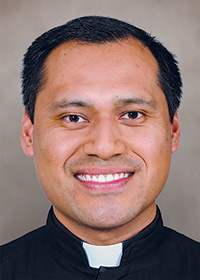
 HENDERSONVILLE — For some, serving the kingdom of God as a priest is an intimidating calling, but Juan González Hernández knew from the age of six that God had plans for him.
Hernández’ devout Catholic upbringing in Mexico City led him to encounter his vocation in one of the most moving ways possible: witnessing his brother’s ordination to the priesthood and receiving his first communion from him during his first Mass.
Born on October 1, 1990, in Tapalapa, Chiapas, Hernández grew up in a faith-filled family where service to the Church was a natural part of life, with siblings who went on to become priests, religious sisters and educators. His early calling led him to formation in Spain in 2007, followed by ministry in Peru and advanced theological studies in Rome, where he completed master’s degrees in philosophy and moral theology in 2021.
Drawn to serve the Hispanic Catholic community, Hernández is assigned to Immaculate Conception in Hendersonville and lives at St. Joseph College Seminary. Choosing Deacon Bryan Ilagor to vest him at his diaconate ordination, Hernández continues to prepare for priesthood while enjoying music, literature, and hiking as he deepens his commitment to a life of service in Christ.
CNH: When did you first feel a calling to the priesthood?
Hernández: It was the day that my brother was ordained a priest in 1997 when I was just about to turn 7 years old. On that day, the lightbulb in me lit up and I asked myself, “what if I myself become a priest one day, like my brother?”
CNH: What experience led you to attend seminary?
Hernández: At 12 years of age, I had a vocational experience that was sort of like a pre-seminary experience. There I was for about two years with other boys who had the same feeling of a call that I did, then before college I did another vocational retreat in Mexico City. Then I received a formal invitation to the seminary, and after talking with my father he had no opposition, and I decided I had to join.
CNH: What was it like to continue your studies by leaving for Spain?
Hernández: My brother, a priest, and two of my sisters, who were cloistered nuns, lived there. My brother studied in Spain while in seminary and my sisters were also a part of the institute “Obra de Amor” which brought them to Spain.
Having them there was helpful, because even though it was a new experience for me, I could be close to my family and learn from them.
CNH: What does it mean to you to be able to serve the Hispanic community in this diocese?
Hernández: I have lived in many different places with a variety of cultures. I feel as though I mold well to both communities, the Anglo and Hispanic communities. So the idea that my mentor at Immaculate Conception in Hendersonville, Father Andrés Gutierrez, has mentioned is [to] create a singular and strong community out of both of those cultures. That way, people do not show divisions but rather the church becomes a place where everyone feels like one community.
CNH: What will it mean for you to become a deacon?
Hernández: It is a radical change in my life, because after this moment I will be a representative of not only the Church, but of Jesus Christ. Of course, the responsibility is much bigger, but I am also conscious that God’s grace, the prayers of the faithful and a spiritual life, help to take charge of that weight.
CNH: What stands out when you think about the day you will become a priest?
Hernández: I think about when my father told me before I left my family to the seminary, ‘If the Lord is calling you, you must follow his instruction. The Lord can choose whoever He wants whenever He wants, we must be ready to follow.’ For me it is accepting a gift. I feel secure in this decision because this is my vocation and God has control.
CNH: What does it mean to become a leader and represent the Church?
Hernández: To represent the Church is to represent Christ. If He was not real or He didn’t rise from the dead, my life would not have any meaning.
I want to represent Him by showing the unconditional love that Christ had for everyone with the goal of bringing them into the Church and conversion. For those that don’t, that they might at least have a more meaningful relationship with the Lord.
— Brian Segovia