

‘God’s doorkeeper’
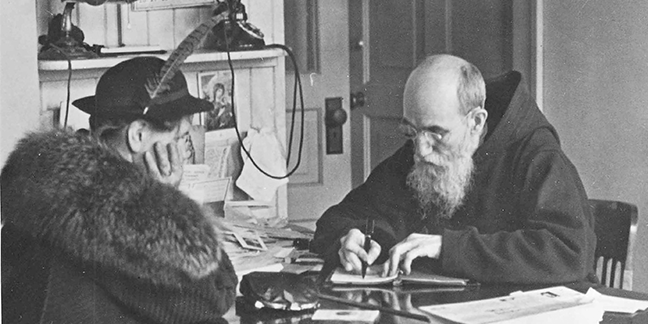 Blessed Solanus Casey takes a note from a woman who is visiting him at St. Bonaventure Monastery in Detroit in 1941. The Capuchin Franciscan friar kept dozens of notebooks filled with prayer requests and favors from the thousands who visited him each year. (OSV News photo | Archdiocese of Detroit) Though Blessed Solanus Casey died many decades ago, Detroit has never forgotten the Capuchin Franciscan priest, whose feast day is July 30. Authentic and approachable, Father Solanus (1870-1957) was a soft-spoken friar and son of Irish immigrants. He loved hot dogs with onions, shooting pool, family reunions and practical jokes. He was devoted to the Detroit Tigers.
Most of all, he loved God and helping others. In 1929, four days after the stock market crash, Father Solanus helped start a soup kitchen. As automobile factories closed, it was feeding between 1,500 and 3,000 people a day. Even with this great legacy, in the eyes of many it was undoubtedly his ministry of prayer and healing that made him a saint.
However, it requires more than a legacy and life devoted to prayer and healing to be officially recognized by the Church as a blessed or saint. On May 4, 2017, speaking to an excited and joyous crowd at the Solanus Casey Center in St. Bonaventure Monastery in Detroit, Archbishop Allen H. Vigneron explained that the miracle needed for the beatification of Solanus Casey had been approved in September 2016 by the Holy See’s Congregation for the Causes of Saints.
The miracle involved a woman with an incurable, congenital skin disease. She was visiting friends in Detroit and asked to go to the Solanus Center to pray at the tomb of Father Solanus. She wanted to pray for others who needed healing. While praying, she heard a voice within saying, “Pray for yourself.” She did, and was instantly cured.
From farm to calling
Bernard Francis Casey Jr. was born Nov. 25, 1870, in Oak Grove, Wisconsin. “Barney” was the sixth child of Ellen and Bernard Casey Sr., and, after three boys, the couple decided to give this son his father’s name. More Casey children followed, and eventually there were 16 children in the close-knit Casey clan. They farmed on the Midwestern frontier, and every young Casey child helped to support the family.
There was a spiritual depth in Barney that stood out, even in his large, busy family. He was deeply committed to prayer. At the same time, he was witty, handsome, athletic and strong. He was a fearless catcher for family baseball games.
At 18, he fell in love with Rebecca Tobin. After he proposed marriage, Rebecca’s mother refused to give her consent and sent Rebecca away to boarding school. Shaken and sad, Barney continued working for some years as a streetcar conductor.
After years of soul-searching, he felt that God was calling him to be a priest.
God’s doorkeeper
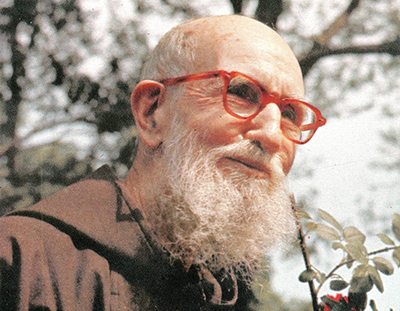 Barney entered the seminary of the Archdiocese of Milwaukee but had to leave because of academic problems. At age 26, he tried again in Detroit, joining the Order of Friars Minor Capuchin.
Since the seminary faculty spoke mostly German, Barney was at a disadvantage. His superiors were concerned with his theological knowledge and understanding. When ordination finally came in 1904, he was ordained as a simplex priest, which meant he couldn’t hear confessions or preach homilies.
What limitations these were for a 34-year-old priest who wanted to give everything to God! Though it humiliated him, Father Solanus was obedient and ready for any role. His first pastoral assignments were at Capuchin parishes in New York. Solanus was given simple jobs: acting as doorkeeper, training altar boys, serving as sacristan, moderating the Ladies Sodality.
Parishioners were soon drawn to Father Solanus – finding that the doorkeeper was compassionate, wise and patient – and sought his pastoral care. Unburdened by the usual responsibilities of a parish priest, he had time to listen. God used that. Within a year or two, the lines of visitors wanting to talk with the doorkeeper were long.
While Father Solanus was still in New York, his Capuchin superiors asked him to keep a record of prayer requests. He also took notes when a healing or an unexplainable turn of events was reported.
Notebooks of hope
- Eventually, Father Solanus filled seven notebooks with notes on more than 6,000 “cases.” On about 700, he later added amazing endings. Among them: “Papa went to confession and Holy Communion for the first time in 49 years,” Solanus penned at the end of an entry about a woman asking for prayers for her father, who had left the Church.
- “Walking out of the monastery without assistance” followed his notations on a 46-year-old man who suffered a fractured skull and broken back several weeks earlier in a car accident. The man was carried in to see Father Solanus.
- “Declared entirely cured July 2 without having any operation.” Father Solanus added that note to data about 59-year-old Bertha Smith, who had been diagnosed with stomach cancer. She had already had four operations at Detroit’s Ford Hospital.
Capuchin authorities tried to reduce demands made on him, as he rarely got more than five hours of sleep a night. To the frustration of his superiors, Father Solanus found it hard to turn away hurting people.
A terribly painful skin disease plagued Father Solanus in his last years. In the summer of 1957 he was hospitalized. On the morning of July 31, he sat up and stretched out his arms as if on the cross. “I give my soul to Jesus Christ,” he said before falling back and taking his last breath.
In 2017, Father Casey was beatified in Detroit. He is one of the currently few native-born North Americans to be beatified.
Today, people come from all over the world to see his tomb and leave prayer requests. He is a model for the value of caring and continues to teach the power of listening.
— Catherine Odell, OSV News
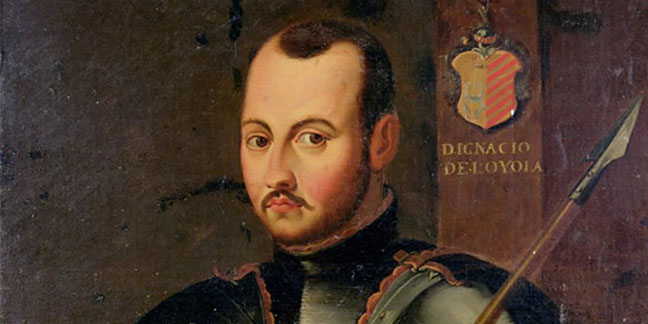 On July 31, the Universal Church marks the feast day of St. Ignatius of Loyola. The Spanish saint is known for founding the Society of Jesus, also known as the Jesuits, as well as for creating the “Spiritual Exercises” often used today for retreats and individual discernment.
St. Ignatius was born Oct. 23, 1491, into a noble family in Guipuzcoa, Spain. He served as a page in the Spanish court of King Ferdinand and Queen Isabella.
He then became a soldier in the Spanish army and wounded his leg during the siege of Pamplona in 1521. During his recuperation, he read “Lives of the Saints.” The experience led him to undergo a profound conversion, and he dedicated himself to the Catholic faith.
After making a general confession in a monastery in Montserrat, St. Ignatius proceeded to spend almost a year in solitude. He wrote his famous “Spiritual Exercises” and then made a pilgrimage to Rome and the Holy Land, where he worked to convert Muslims.
St. Ignatius returned to complete his studies in Spain and then France, where he received his theology degree. While many held him in contempt because of his holy lifestyle, his wisdom and virtue attracted some followers, and the Society of Jesus was born.
The Society was approved by Pope Paul III in 1540, and it grew rapidly. St. Ignatius remained in Rome, where he governed the Society and became friends with St. Philip Neri.
St. Ignatius died peacefully on July 31, 1556. He was canonized by Pope Gregory XV in 1622.
The Jesuits remain numerous today, particularly in several hundred universities and colleges worldwide, and Pope Francis himself is a Jesuit.
On April 22, 2006, Pope Benedict XVI presided over a Eucharistic concelebration for the Society of Jesus. He addressed the fathers and brothers of the Society present at the Vatican Basilica, calling to mind the dedication and fidelity of their founder.
“St. Ignatius of Loyola was first and foremost a man of God who in his life put God, his greatest glory and his greatest service, first,” the Pope said. “He was a profoundly prayerful man for whom the daily celebration of the Eucharist was the heart and crowning point of his day.”
“Precisely because he was a man of God, St Ignatius was a faithful servant of the Church,” Benedict continued, recalling the saint’s “special vow of obedience to the pope, which he himself describes as ‘our first and principal foundation.’”
Highlighting the need for “an intense spiritual and cultural training,” Pope Benedict called upon the Society of Jesus to follow in the footsteps of St. Ignatius and continue his work of service to the Church and obedience to the pope, so that its members “may faithfully meet the urgent needs of the Church today.”
— Catholic News Agency
More online
At www.stpeterscatholic.org: Learn more about St. Peter Church in Charlotte, staffed by the Jesuits. The parish regularly offers resources about the “Spiritual Exercises” of the Jesuits’ founder, St. Ignatius of Loyola, and Ignatian spirituality in general, including group and individual prayer and retreat experiences.
Read more about St. Ignatius of Loyola’s radical conversion and his intense devotion to the Blessed Virgin Mary in “St. Ignatius of Loyola: Madman or Militant Monk?”