

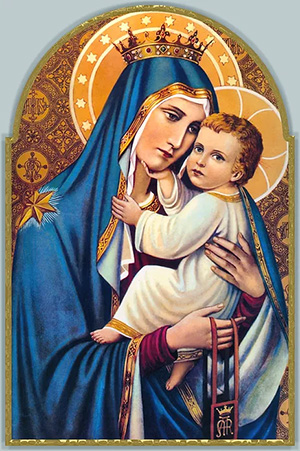
 The feast of Our Lady of Mount Carmel, celebrated on July 16, was first instituted in the late 14th century in commemoration of the approval of the rule of the Carmelite Order a hundred years earlier. According to legend, a religious community was established even before the time of Christ on Mount Carmel. This is the mountain overlooking the Mediterranean Sea on which the prophet Elijah successfully challenged the priests of Baal and won the people to the true God. The feast of Our Lady of Mount Carmel entered the Calendar of the universal Church in the early 18th century.
Although there is no historical evidence for the pre-Christian Carmelite community, references in the 12th century record a community of monks on the holy mountain. Despite continual difficulties, the community built a monastery and church dedicated to the Virgin Mary on Mount Carmel in 1263. Saint Louis, King of France, had visited Mount Carmel in 1254, and brought back six French hermits for whom he built a convent near Paris.
Mount Carmel was taken by the Muslims in 1291, and the brothers were killed and the convent burned. The spread of the Carmelites in Europe is largely attributable to the work of Saint Simon Stock (1247-1265). The Carmelite Order was formally approved in 1274 at the Council of Lyon.
The Scapular of Our Lady of Mount Carmel
The brown Scapular of Our Lady of Mount Carmel, according to the Carmelite tradition, was presented by Our Lady to St. Simon Stock, the then Father General on July 16, 1251. Our Lady gave St. Simon a scapular for the Carmelites with the following promise, saying : "Receive, My beloved son, this habit of thy order: this shall be to thee and to all Carmelites a privilege, that whosoever dies clothed in this shall never suffer eternal fire .... It shall be a sign of salvation, a protection in danger, and a pledge of peace."
Another important aspect of wearing the Scapular is the Sabbatine Privilege. This concerns a promise made by Our Lady to Pope John XXII. In a papal letter he issued, he recounted a vision that he had had. He stated that the Blessed Virgin had said to him in this vision, concerning those who wear the Brown Scapular: "I, the Mother of Grace, shall descend on the Saturday after their death and whomsoever I shall find in Purgatory, I shall free, so that I may lead them to the holy mountain of life everlasting."
Many popes and saints have strongly recommended wearing the Brown Scapular to the Catholic Faithful. Pope Pius XII said: "The Scapular is a practice of piety which by its very simplicity is suited to everyone, and has spread widely among the faithful of Christ to their spiritual profit." In our own times, Pope Paul VI said: "Let the faithful hold in high esteem the practices and devotions to the Blessed Virgin ... the Rosary and the Scapular of Carmel" and in another place referred to the Scapular as: "so highly recommended by our illustrious predecessors."
According to Church tradition, there are three conditions necessary to participate in this Privilege and share in the other spiritual benefits of the Scapular: wear the Brown Scapular, observe chastity according to your state in life, and pray the Rosary. In addition to the Sabbatine Privilege, enrollment in the Brown Scapular also makes a person part of the Carmelite family throughout the world. They therefore share in all of the prayers and good works of the Carmelite Orders.
In order to receive the spiritual blessings associated with the Scapular, it is necessary to be formally enrolled in the Brown Scapular. The enrollment is made only once by a priest or authorized person. The Scapular can be replaced afterwards by a medal, which has on one side the image of the Sacred Heart of Jesus and on the other, the image of Mary.
There a short form for giving the scapular: "Receive this Scapular, a sign of your special relationship with Mary, the Mother of Jesus, whom you pledge to imitate. May it be a reminder to you of your dignity as a Christian in serving others and imitating Mary. Wear it as a sign of her protection and of belonging to the family of Carmel, voluntarily doing the will of God and devoting yourself to building a world true to his plan of community, justice and peace."
The scapular stands for:
— A commitment to follow Jesus, like Mary, the perfect model of all the disciples of Christ. This commitment finds its origin in baptism.
— It leads into the community of Carmel, a community of religious men and women, which has existed in the Church for over eight centuries.
— It reminds of the example of the saints of Carmel, with whom it establishes a close bond as brothers and sisters.
— It is an expression of the belief that the bearers of the scapular will meet God in eternal life, aided by the intercession and prayers of Mary.
The Carmelites insist that the scapular is not:
— A magical charm to protect someone.
— An automatic guarantee of salvation.
— An excuse for not living up to the demands of the Christian life
It is instead a sign which has been approved by the Church for over seven centuries and which stands for the decision to
—Follow Jesus like Mary:
— Be open to God and to his will.
— Be guided by faith, hope, and love.
— To pray at all times
— To discover God present in all that happens around us.
— CNA
On July 23, the Catholic Church celebrates the long and fruitful life of St. Bridget of Sweden, who raised a large family before going on to found a religious order. In modern times, she has been named a patron saint of Europe.
Bridget was born in 1303, the daughter of a prince and legislator named Birger and his royally-descended wife Ingeburgis. Her parents were notable for their strong faith, and especially for their devotion to recalling Christ's suffering and death. Sadly, Ingeburgis died soon after Bridget's birth, and her aunt stepped in to assist in raising her.
The future saint had a serious temperament even as a child, and came to share her father's and her late mother's devotion to Christ's passion. At the age of 10, she had a vision of the Lord's agonizing death, in which he drew her attention to the wounds inflicted by "those who despise me, and are insensible to my love for them."
At age 16, Bridget married the Swedish prince Ulf of Nericia. The couple joined the Third Order of St. Francis, and made their home an admirable example of the "domestic Church." Out of their eight children, two died in infancy, and another two in the Crusades. Two of the surviving children married, and one of the two who entered religious life was canonized as St. Catherine of Sweden.
While bringing up their children, Bridget and Ulf also helped to care for the needs of the poor. They devoted their own resources to building a hospital, where they worked to care for patients themselves. After Ulf's resignation from the king's council, the couple undertook a long and arduous pilgrimage to Santiago de Compostela in Spain.
The trip took a heavy toll on Ulf's health, and he nearly died during the return trip. Against the odds, however, he recovered. By the time of his death, Bridget's husband had become a part of the Cisterian monastic order with his wife's consent. Even after his death in 1344, the Cistercians continued to regard him as an example of holiness.
Bridget then renounced her position as a princess. She divided her husband's property among her surviving children, and resolved to devote the rest of her life to penance. She began wearing a hair shirt, and ate only bread and water on Fridays. During 1344 she also founded a monastic community, which would eventually develop into the Bridgettine Order.
During her years as a widow, Bridget experienced many visions of Christ which were compiled into two books of "Revelations." Although the Church never gave a definitive judgment on their content, Blessed John Paul II wrote in 1999 that Church had "accepted the overall authenticity of her interior experience," which he described as a "profound union with Christ."
In 1349, Bridget made a pilgrimage to Rome to seek the pope's approval for her community's rule of life. She ended up moving to the Eternal City, and never returned to Sweden during the remaining decades of her life. She did, however, leave her new home on pilgrimages to Assisi and the Holy Land.
St. Bridget of Sweden died in 1373. Two of her children brought her remains back to the headquarters of her religious order in Sweden the following year, and she was canonized by Pope Boniface IX in 1391. In 1999, Blessed John Paul II chose her as one of the three female co-patronesses of Europe, together with St. Catherine of Siena and St. Edith Stein.
— CNA/EWTN News