

Catholics in Latin America and throughout the world celebrate the life and ministry of St. Turibius of Mogrovejo on March 23. The 16th century bishop upheld the rights of Peru's indigenous peoples, and became one of the first canonized saints of the Americas.
Turibius was born in Spain during 1538, to a noble family in the kingdom of Leon. Even as a child, he frequently prayed, fasted and gave to the poor, and he eventually developed the daily habit of praying the rosary along with the Little Office of the Blessed Virgin Mary.
He went on to study law at the University of Salamanca and eventually served as a judge for five years in the territory of Granada. His judicial wisdom and diligence drew the attention of King Philip II, who wanted Turibius – who was still a layman – to be consecrated as a missionary archbishop for the Spanish colony of Peru.
Turibius became greatly dismayed, protesting to the king and Church authorities that he was not even a priest and could not possibly accept the charge. In a series of letters, he pleaded that he was not personally capable of serving as the archbishop of Lima – nor, he reminded them, did canon law permit a layman to become an archbishop.
Eventually, however, he had little choice but to comply. The 43-year-old was consecrated as a bishop in 1581 and immediately left for Lima, Peru.
The new archbishop undertook to travel throughout the rugged and mountainous diocese, where he observed many of the worst effects of colonialism – both upon the enslaved and oppressed natives, and on many of the colonists who seemed to have lost their souls in the pursuit of wealth.
He responded with constant prayer and penance as he traveled throughout his territory administering the sacraments, teaching the Catholic faith and establishing schools, seminaries and hospitals.
To the indigenous Peruvians, the archbishop was a herald of the Gospel who held their lives as more precious than their country's supplies of gold and silver. But to the many colonists whose behavior showed no sign of their Catholic origins, he was a prophetic scourge – whose efforts to awaken the public conscience earned him rebukes and opposition.
Turibius ultimately managed to make three visitations of his diocese, under rugged and dangerous conditions, which occupied about half of his 25 years as archbishop of Lima. He united the Peruvian Church at an administrative level by holding several local councils of its clergy, but he was also known to spend days traveling to reach a single person with the message of Christ.
The archbishop became seriously ill in 1606. He sensed that his death was imminent, and he decreed that his possessions should be distributed to the poor. St. Turibius died on March 23, and his body was found to be incorrupt the next year. He was declared a saint in 1726, and is now regarded as the patron of native peoples' rights and Latin American bishops.
— Benjamin Mann, Catholic News Agency
‘St. Joseph, give us your silence’ this Lent
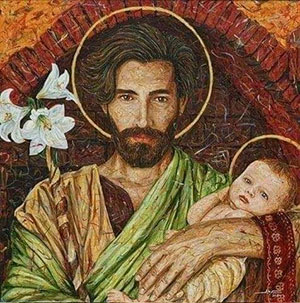 As we journey through Lent, accompanying Our Lord in the desert by fasting and praying in union with Him, it is good to have a saintly companion as our guide.
St. Joseph, whom St. Teresa of Avila called “the patron of people who seek to grow in prayer,” is an ideal saint to accompany us as we seek to grow in holiness.
Carmelite Father Michael-Joseph Paris studied in Avila, Spain for a year. He offered a reflection on St. Joseph and how St. Teresa of Avila teaches us to take St. Joseph as a father and a companion who will help us on the intense journey of the spiritual life.
He reminds us that there are no recorded words of St. Joseph in the gospels. This protector of the Holy Family and protector of the Universal Church is seen as the example of a strong, quiet presence, with a silent receptivity to the presence of God in Jesus.
“He too had a life of deep silent prayer. Always united to the presence of Jesus, nourishing and caring for Him in all of His needs, just like the body, the Church,” Father Paris said. “Because of this, St. Joseph is our model and our guide who makes sure we always stay on the right path in our prayer.”
St. Teresa says in her autobiography that, “Especially persons of prayer should always be attached to St. Joseph. Those who cannot find a master to teach them prayer should take this glorious saint for their master, and they will not go astray.”
For us too, who seek to grow in our spiritual life, we can entrust ourselves to St. Joseph as the best guide on our own unique path to divine union, Father Paris added.
This Lent we can take as our motto, “San Jose dame tu silencio,” which means “St. Joseph give me your silence.”
“We can ask for his intercession for the grace of an inner silence which listens for the will of God, and which helps us serve quietly in love without trying to be noticed or to seek our own glory,” Father Paris said. “This grace of silence will keep us united to Jesus through all the struggles of this life and will gradually transform us into Christ’s very image.”
As we move through these 40 days of Lent, let us walk in silence with St. Joseph, contemplating Christ’s love for us and ultimately His death and resurrection, which will lead us to the joys of Easter.
— SueAnn Howell
More online
Father Michael-Joseph of St. Therese is a Carmelite Friar of the Washington Province who resides at Holy Hill at the Basilica and National Shrine of Mary Help of Christians in Hubertus, Wis. His full reflection is available on YouTube at www.discalcedcarmel.org/blog/from-avila-spain-st-joseph-give-me-your-silence.