

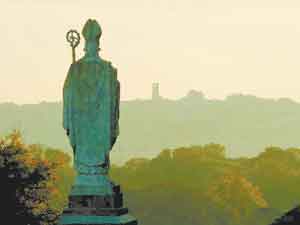
 I arise today
Through a mighty strength, the invocation of the Trinity,
Through a belief in the Threeness,
Through confession of the Oneness
Of the Creator of creation.
I arise today
Through the strength of Christ’s birth and His baptism,
Through the strength of His crucifixion and His burial,
Through the strength of His resurrection and His ascension,
Through the strength of His descent for the judgment of doom.
I arise today
Through the strength of the love of cherubim,
In obedience of angels,
In service of archangels,
In the hope of resurrection to meet with reward,
In the prayers of patriarchs,
In preachings of the apostles,
In faiths of confessors,
In innocence of virgins,
In deeds of righteous men.
I arise today
Through the strength of heaven;
Light of the sun,
Splendor of fire,
Speed of lightning,
Swiftness of the wind,
Depth of the sea,
Stability of the earth,
Firmness of the rock.
I arise today
Through God’s strength to pilot me;
God’s might to uphold me,
God’s wisdom to guide me,
God’s eye to look before me,
God’s ear to hear me,
God’s word to speak for me,
God’s hand to guard me,
God’s way to lie before me,
God’s shield to protect me,
God’s hosts to save me
From snares of the devil,
From temptations of vices,
From every one who desires me ill,
Afar and anear,
Alone or in a mulitude.
I summon today all these powers between me and evil,
Against every cruel merciless power that opposes my body and soul,
Against incantations of false prophets,
Against black laws of pagandom,
Against false laws of heretics,
Against craft of idolatry,
Against spells of women and smiths and wizards,
Against every knowledge that corrupts man’s body and soul.
Christ shield me today
Against poison, against burning,
Against drowning, against wounding,
So that reward may come to me in abundance.
Christ with me, Christ before me, Christ behind me,
Christ in me, Christ beneath me, Christ above me,
Christ on my right, Christ on my left,
Christ when I lie down, Christ when I sit down,
Christ in the heart of every man who thinks of me,
Christ in the mouth of every man who speaks of me,
Christ in the eye that sees me,
Christ in the ear that hears me.
I arise today
Through a mighty strength, the invocation of the Trinity,
Through a belief in the Threeness,
Through a confession of the Oneness
Of the Creator of creation.
— St. Patrick (ca. 377)
Feast day: March 18
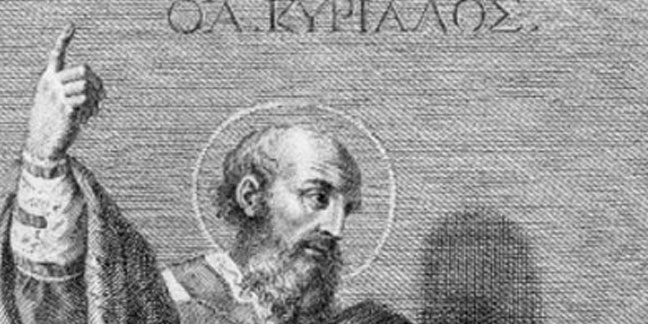
On March 18, the Roman Catholic Church honors St. Cyril of Jerusalem, a fourth-century bishop and Doctor of the Church whose writings are still regarded as masterful expressions of Christian faith.
St. Cyril is also remembered for his exhaustive Biblical knowledge, and his endurance in the face of misunderstanding and opposition. Eastern Catholics and Eastern Orthodox Christians, who likewise celebrate him as a saint on March 18, also remember him on May 7 – the date of a miraculous apparition said to have occurred soon after his consecration as a bishop.
What is known of Cyril's life is gathered from information concerning him from his younger contemporaries, Epiphanius, Jerome and Rufinus, as well as from the fifth-century historians, Socrates, Sozomen and Theodoret.
Cyril was most likely born in Jerusalem around the year 315, shortly after the legalization of Christianity throughout the Roman Empire.
Although that legalization put a stop to many of the persecutions that threatened the Church for two centuries, it indirectly gave rise to a number of internal controversies – both in regard to theology, and the jurisdiction of bishops – in which Cyril would find himself involved.
Cyril received an excellent education in classical Greek literature as well as Scripture. He was ordained a priest by Bishop Maximus of Jerusalem, and succeeded him as bishop in 348.
During his early years as a bishop, most likely around 350, he delivered a series of lectures to new initiates of the Catholic Church. Twenty-four of the lectures have survived and are studied today. In a 2007 general audience, then-Pope Benedict XVI praised the saint for providing an "integral" form of Christian instruction, "involving body, soul and spirit." St. Cyril's teaching, the pope said, "remains emblematic for the catechetical formation of Christians today."
In 351, three years after Cyril became the Bishop of Jerusalem, a large cross-shaped light appeared for several hours in the sky over the city – an event that many interpreted as a sign of the Church's triumph over heresy. It could also, however, be understood as a sign of the suffering the new bishop would undergo in leading his flock.
Unlike many other Eastern bishops and priests of the fourth century, Cyril did not allow his classical learning to lead him away from believing in the full humanity and divinity of Christ.
However, the man who consecrated Cyril as a bishop, Archbishop Acacius of Caesarea, was an ally of the Arians – who claimed that Jesus was a creature and not God. Because of his connection to the archbishop, Cyril himself was unjustly suspected of heresy by many of his brother bishops.
But he also found himself at odds with Archbishop Acacius, who claimed to have jurisdiction over the birthplace of the Church. Altogether, these disputes led to Cyril being exiled from Jerusalem three times in the course of 20 years. Cyril first took refuge with Silvanus, bishop of Taraus. He appeared at the Council of Seleucia in 359, in which the semi-Arian party was triumphant. Acacius was deposed and St. Cyril seems to have returned to his see. But the emperor was displeased at the turn of events, and, in 360, Cyril and other moderates were again driven out, and only returned at the accession of Julian in 361. In 367, a decree of Valens banished all the bishops who had been restored by Julian, and Cyril remained in exile until the death of the persecutor in 378. In 380, St. Gregory of Nyssa came to Jerusalem on the recommendation of a council held at Antioch in the preceding year. He found the faith in accord with the truth and expressed admiration of Cyril's pastoral efforts, but the city was a prey to parties and corrupt in morals.
In 381, St. Cyril participated in the Second Ecumenical Council, which condemned two different forms of Arianism and added statements about the Holy Spirit to the Nicene Creed of 325. St. Cyril of Jerusalem died in 387, and was named a Doctor of the Church by Pope Leo XIII in 1883.
— Catholic News Agency