


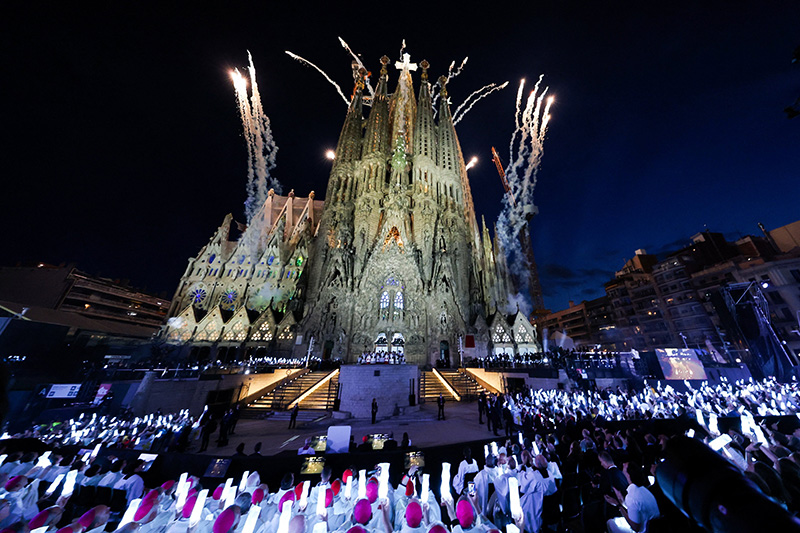
BARCELONA, Spain — Pope Leo XIV blessed the newly completed Tower of Jesus Christ at Barcelona's Sagrada Familia basilica June 10, inaugurating the crowning spire that makes the iconic church the tallest Catholic church the world and urging people to lift their gaze to Christ "who alone reveals to us the truth about God and the truth about ourselves."
Pope Leo offered Mass inside the basilica and formally inaugurated the Tower of Jesus Christ, which stands at more than 564 feet, before a crowd of thousands gathered inside and around the Sagrada Familia.
"By looking at Christ, we can see the world with renewed eyes: the tower of the cross then becomes a banner of charity, for God loves us in this way, transforming an instrument of death into a sign of hope," the pope said.
-- 100th anniversary of Gaudí's death --
Spain's King Felipe VI welcomed the pope upon his arrival at the basilica. Before Mass, Pope Leo descended to the basilica's crypt to pray at the tomb of Antoni Gaudí, the visionary Catalan architect who devoted 43 years of his life to the design and construction of the basilica before his death in 1926 at age 73.
The papal Mass fell on the 100th anniversary of Gaudí's death. Known as "God's architect," Gaudí's cause for canonization advanced last year when Pope Francis declared him venerable in April 2025.
Pope Leo paid tribute to the visionary builder in his homily, reflecting on Gaudí's intent to narrate the mysteries of Christ's life through stone and light.
-- Power of beauty to evangelize --
Light streamed through the basilica's colorful stained glass windows as the pope spoke, casting dancing colors on the soaring columns. Trumpets sounded as a choir of 500 people sang hymns from the high galleries on either side of the basilica, as multiple children's choirs harmonized around the apse.
Pope Leo pointed to the Sagrada Familia as a testament to the power of art and beauty to draw people closer to God.
"In her wisdom, the Church thus renews the 'Biblia pauperum' of the ancient cathedrals, which are in themselves rich messages of evangelization," he said, invoking the medieval tradition of visual depictions of the Scripture designed to communicate the faith to those who could not read.
"In this age in which image is so prevalent, it becomes even more evident how art and beauty are privileged channels of evangelization," he said.
The Sagrada Familia's three facades -- dedicated to the Nativity, the Passion and the Glory of Christ -- embody this vision architecturally. Gaudí designed them so that sunlight illuminates each portal at the moment most consonant with its theological meaning: dawn light for the Nativity, the setting sun for the Passion and full midday light for the Glory facade.
Gaudí's design drew inspiration from both Christian doctrines and the observation of nature. The basilica is filled with organic forms inspired by natural elements. Its central nave columns evoke a forest of trees.
-- Tower of Jesus Christ --
The Tower of Jesus Christ is now the tallest structure in Barcelona, and it makes the Sagrada Familia the tallest church in the world.
Gaudí designed the tower to stand precisely half a meter below the summit of the nearby Montjuïc hill, believing the work of human hands should not surpass the work of God. At its crown stands a four-armed cross of glass and white enameled ceramic, roughly 17 meters tall and 13 meters wide, bearing the inscription: "Tu solus Sanctus, Tu solus Dominus, Tu solus Altissimus" -- "You alone are Holy, You alone are Lord, You alone are Most High."
"In Jesus' cross, our faith reaches its summit," the pope said. "This cross shines by day, reflecting the sunlight, and shines by night, illuminating the city like a lighthouse overlooking the Mediterranean. Yes, the light of Christ shines in the darkness, even though the darkness has not received it."
-- Strong words on war, abortion, salvation --
An estimated 9,000 people attended the papal Mass inside the basilica, while an estimated 120,000 people worshipped from outside. In his homily in the Sagrada Familia, Pope Leo issued a forceful appeal against abortion, war and the exclusion of migrants.
"Dear brothers and sisters, we cannot believe in Jesus and promote war. We cannot believe in Jesus and kill the innocent even before birth. We cannot believe in Jesus and abandon those who suffer, those who weep, those who flee from misery," the pope said.
The pope reflected on the day's Gospel reading from John, in which Jesus tells the Pharisees, "you will die in your sins unless you believe that I am he" (Jn 8:24).
"These are strong words," Pope Leo said. "They are an invitation to salvation -- that is, a call to freedom extended by Christ, who desires for us the ultimate, eternal good."
"As God made man, he becomes for us Emmanuel, the source of grace and forgiveness, of salvation and new life," he said. "That is why, if we do not believe in Jesus Christ, we remain in sin, and not only do we die, but we bring about the death of our neighbor."
-- Basilica a century in the making --
Pope Leo paid tribute to Gaudí and to all who have labored on the basilica across generations.
"Together with Gaudí, as we commemorate the centenary of his death, we remember and give thanks to all the supporters and benefactors, the artists and the workers who cooperated in the construction of an architectural masterpiece, which is also an eloquent catechesis made of stones, colors and light."
The foundation stone of the Sagrada Familia was laid in 1882. The project was initially entrusted to architect Francisco de Paula del Villar before passing to Gaudí in 1883, who transformed it into one of the most ambitious building projects in modern history, comprising three facades, five naves and 18 towers. The portion built by Gaudí was declared a UNESCO World Heritage Site in 2005.
-- Unfinished masterpiece --
Despite the completion of its crowning tower, the basilica remains unfinished; work is still ongoing on the baptistery, the sacristy, the Chapel of the Assumption, the cloisters and the Glory Facade. It is projected that the basilica will not be completed until 2036.
Pope Leo embraced that incompleteness as a spiritual metaphor. "Much more than a monument, the Basilica of the Sagrada Familia remains a work in progress today, reminding us that the Christian life is always a journey, because it is a project that God is carrying out," he said.
"The fact that it is incomplete is not a flaw, for it bears witness to a desire; it does not signify a shortcoming, but rather expresses a promise that we wish to honor with consistency," he added. "Our gratitude thus becomes a commitment as we cooperate in God's plan -- that is, in the edification to which he himself calls us."
"Since we are the temple of the Holy Spirit, this work consists in our very lives, which God conceives as a masterpiece that we are to create together."
-- Fireworks celebrate the tallest church in the world --
After Mass, the pope presided over the formal blessing of the Tower of Jesus Christ. The inauguration ceremony concluded with a dazzling interactive light show and a live musical performance by the Escolanía de Montserrat, the oldest boys choir in the world, followed by fireworks from the basilica’s towering spires. A drone show in the sky illuminated the face of Gaudí, as well the architect’s words, "First you need love, then technique."
"As we lift our gaze toward him, the crucified and risen One, let us commit ourselves to lifting up those who lie in the dust," the pope said. "And let us show in this way that the Sagrada Familia is the tallest church in the world, not so as to stand out in worldly rankings, but rather to guide the steps of the people of God who make their pilgrimage in Spain, with the cross illuminating their path, like a lamp burning brightly as we await the return of the Bridegroom."
— Courtney Mares, OSV News'Be human as Christ is,' Pope Leo XIV tells half a million youth in Madrid
-
'Be human as Christ is,' Pope Leo XIV tells half a million youth in Madrid
MADRID — Pope Leo XIV urged half a million young people gathered in Madrid June 6 to reject superficiality and become "men and women of flesh and blood," telling them that the mission he entrusts to them is simply to "be human."
"The mission I entrust to you is precisely this: that you be human," the pope said during an evening prayer vigil in Madrid's Plaza de Lima. "Yes, be human: men and women of flesh and blood! Not mere appearances, but trustworthy faces."
"Be human as Christ is," he urged.
The gathering drew approximately 500,000 people and combined music, testimonies, Marian devotion and Eucharistic adoration in what organizers described as a "festival of faith." Young people began arriving hours before the pope's appearance, filling the plaza and surrounding streets in the heart of the Spanish capital.
-- Massive crowd to greet Pope Leo --
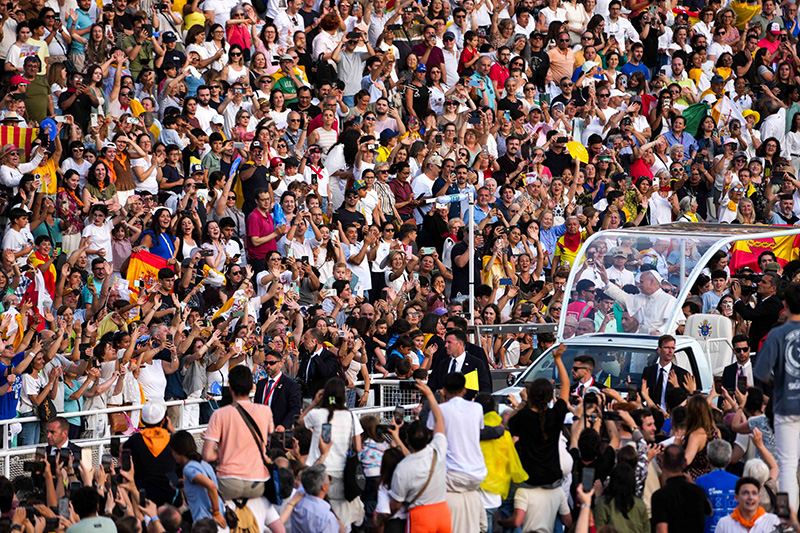
The scale of the gathering became apparent as Pope Leo tried to reach the stage. The journey along Madrid's Paseo de la Castellana stretched for more than 20 minutes as the popemobile moved slowly through the sea of pilgrims, repeatedly stopping while Pope Leo greeted the faithful. Along the route, he embraced worshippers lining the barriers and kissed dozens of babies passed forward by their parents.
Many others watched from apartment balconies and terraces overlooking the broad boulevard, creating a continuous presence along the route connecting the city center to the vigil site.
When he finally arrived at the stage in Plaza de Lima, the welcome only intensified. Thousands of young people waved Vatican and Spanish flags and broke into chants of "Esta es la juventud del Papa" ("This is the pope's youth"). Pope Leo appeared visibly moved as he paused to take in the scene before Cardinal Jose Cobo of Madrid began the final part of the evening's program.
-- Dialogue with the youth --
In a departure from the formal settings often associated with papal events, the dialogue unfolded on a stage arranged like a living room.
There, young people and the pope spoke about faith, vocation and the search for meaning, creating the impression of a conversation between generations united less by age than by a common desire to follow Christ. The exchange followed a performance from "Godspell," the musical produced by "Zorro" actor Antonio Banderas, which helped set the tone for an evening organizers described as a "festival of faith."
During a dialogue with young people, Pope Leo reflected on saints who shaped his spiritual life, including St. John Chrysostom, St. Thomas of Villanova and St. Turibius of Mogrovejo, the Spanish missionary bishop who evangelized Peru in the 16th century.
Asked about his own missionary years in Peru, the pope said he most treasured the witness of faith shown by people who faced hardship without losing hope.
"As I proclaimed the Gospel, I too was transformed by it," he said. " I have seen how the Word of God can transform conflict into peace, can be a source of reconciliation, peace, and justice."
Leo also encouraged young people to seek silence amid the noise of contemporary life.
"When we seek silence, we choose what not to listen to and which noises not to let distract us," he said. "It is in silence that we come to understand that ideologies pass away, while the truth always remains."
Pope Leo connected that invitation directly to the Eucharistic adoration that followed -- and during which the entire square fell silent.
"Eucharistic adoration, which we share this evening, is the perfect place to be silent, to open our hearts, and to 'be' ourselves in the presence of the Lord," he said.
Turning to the role of Christians in contemporary society, Pope Leo reminded the crowd that "Jesus' disciples are always people of their time, but never prisoners of a passing era."
He urged young Catholics to become missionaries in today's world, including in digital spaces, and challenged them to be "the salt of the earth and the light of the world."
-- A youth Catholic revival --
Looking around the plaza before the pope's arrival, Laura Blanco, who traveled to Madrid from Burgos with a group of 15 friends, said she sees that missionary spirit already at work among young people.
Two members of her group were baptized as children but grew up in nonreligious households, she said.
"They knew we were coming, they knew the pope was coming, and they wanted to join us," Blanco said. "One of them comes to Mass with me every day now. We study together, and we end the day by going to Mass."
Blushing, she added that faith may be playing an unexpected role in another kind of discernment.
"I think he likes me. I know I like him," she said. "Seeing how important my faith is to me, I think he's trying to get to know it well enough to see if he can live with it."
In fact, after one of the young men on the stage mentioned he was a newlywed, Pope Leo went visibly off the cuff to urge young people to "not be afraid of marriage. Do not be afraid of forming a family!"
Earlier, the pope emphasized: "Never be afraid to consider a vocation to the priesthood, religious life, or other services in the Church" -- to much applause from the crowd.
-- A blend of prayer and Spanish culture --
Before Leo arrived at Plaza de Lima, pilgrims prayed the rosary's luminous mysteries, with meditations offered by young people and accompanied by sacred art from Madrid's Prado Museum.
This part of the vigil was the prelude of the city's "White and Yellow Night," during which some of Madrid's most important museums, including the Prado, opened their doors free of charge to pilgrims and visitors ahead of the pope's Mass and the Corpus Christi procession on Sunday.
As they waited for Pope Leo's arrival, giant screens replayed images from the visits of St. John Paul II and Pope Benedict XVI to Spain. Special attention was given to the 2011 World Youth Day vigil at Madrid's Cuatro Vientos airfield, where pilgrims endured extreme heat and a violent storm before joining Pope Benedict in Eucharistic adoration.
Organizers addressed a-then-still-absent and popemobile-riding Pope Leo directly, urging him:
"Fifteen years after World Youth Day Madrid 2011, where young people discovered that together we are stronger than the elements, today more than ever we want to welcome you, Holy Father. Inspire us as your predecessors inspired our parents, grandparents and older brothers and sisters."Father José Gabriel Vera Beorlegui, spokesman for the Spanish bishops' conference, said the pope's visit comes at a moment when many people are searching for hope amid global instability.
"The visit of Pope Leo XIV to Spain is a reason for joy for the whole Church," he said. "People are anguished by war, anger, violence, lies and corruption in the world. Christ is the light that will help the Church in Spain, but also Spanish society, move forward."
As darkness settled over Madrid, the music and celebrations gave way to silence as hundreds of thousands of young people joined Pope Leo in Eucharistic adoration, bringing to a close an evening that connected Spain's Catholic past with a new generation being called to shape its future.
— Ines San Martin, OSV News Pope Leo XIV calls defense of life the measure of a nation’s moral greatness in landmark parliament speech
-
Pope Leo XIV calls defense of life the measure of a nation’s moral greatness in landmark parliament speech
MADRID — In a sweeping address to the Spanish parliament, Pope Leo XIV delivered a forceful defense of the dignity of every human life, declaring that its protection is not a partisan issue but "a goal of civilization," while addressing the issues of abortion, migration, freedom of conscience, the seal of confession and the Church’s role in public life.
"If life ceases to be recognized as a fundamental value, what future can our societies have? Can a community that casts into the shadows the unborn child, the elderly, the sick, those who suffer in silence, or those who depend entirely on the care of others be called fully just?" the pope asked the members of congress in his speech on June 8.
"The defense of human life is neither a partisan issue nor a confessional interest: it is a goal of civilization," he emphasized. "Every human life must be recognized and safeguarded from conception to its natural end, in every circumstance of its existence."
It was the first time in history that a pope addressed the Spanish parliament -- a moment met with much anticipation in a country facing deep political polarization.
Ahead of the speech there had been tension among both the right and the left in Spain over what the pope would say to the legislature, known as Las Cortes Generales. In the end, Pope Leo received a seven-minute standing ovation for remarks that did not shy away from some of the most debated issues in the country.
In the 30-minute speech, touching on issues from euthanasia to artificial intelligence, the pope underlined that "every truly just society is built upon the recognition of the inviolable dignity of the human person," warning that when that certainty is obscured, the most vulnerable suffer first and the law loses its deepest meaning.
"The moral greatness of a nation is manifested, above all, in its capacity to accompany, protect and love those lives that are most fragile," the pope said.
-- A multifaceted analysis of the issue of migration in Spain --
In addressing the highly polarizing issue of migration in Spain, Pope Leo gave a multifaceted analysis, saying no nation can handle the challenge alone and calling migration "an eminently moral and legal issue" requiring a coordinated response that addresses root causes.
"The situation of migrants and refugees calls for a response that focuses on people, addresses the root causes that force them to leave, and goes beyond the mere management of migration flows," Pope Leo said.
He described a twofold demand for social justice: offering safe and legal pathways with real integration opportunities, while also promoting the right to remain in one's homeland by addressing lack of peace, security, and decent living conditions.
The pope also called for stronger prevention and rescue efforts for trafficking victims through regional and multilateral cooperation.
"The affirmation of human dignity cannot remain abstract when so many people are forced to leave everything behind in search of peace, security, and a future," he said.
"The tragic drama of migration also challenges the conscience of nations and the ethical foundation of the international order today."
-- Freedom of conscience and the seal of confession --
Pope Leo offered a strong defense of freedom of conscience in the parliament chamber, underlining what he called the duty to protect the inner space where personal convictions, conscience and faith develop.
He described "freedom of thought, conscience and religion" as a fundamental right protecting the most intimate sphere of the person.
"The freedom upon which the contemporary state is built, if it is authentic, recognizes the religious dimension of the human person, respects it and protects it legally; and it ensures that faith is not a reason for which a person has to forfeit his or her contribution to society," he said.
"Without confusing the legal sphere with the moral one, it is also worth recalling that freedom must be understood in its fullness. Being free does not simply mean being free from coercion or having many choices; it means being able to recognize the good and commit to it responsibly," he added.
The pope connected the seal of confession to religious freedom, describing it as part of the broader space that guarantees religious communities their own sphere of life and internal discipline.
Protecting it legally, he said, preserves "a sacred space of inner freedom, where the believer can open his or her soul to God without fear of external pressures."
-- The importance of the family --
Pope Leo called the family "the primary human reality and the natural foundation of community," saying that where families are upheld, the spiritual and social stability of nations is strengthened. He described the family as "the first school of humanity," where people learn to welcome life, care for others, forgive, serve and live together.
"Educational institutions also play a decisive role in this task. In them, new generations can learn to seek and love the truth, to reflect on the meaning of life and the dignity of every person," he said.
"For this reason, many parents who wish for their children to learn to relate to others, to think critically, and to acquire solid values place great hope in these institutions, seeing them as valuable allies in their children's education."
-- The role of the Church in the public square --
Pope Leo framed his speech within a reflection on the Church's place in public life, stressing that when the Church speaks on public matters it does so while respecting the proper mission of civil institutions and the legitimate authority of those who legislate.
He challenged parliamentarians to consider what conception of the human person inspires their laws.
"Beyond the legitimate diversity of positions, every legislative task ultimately confronts a decisive question: what conception of the human person inspires laws, and what kind of society do those laws build?" he asked, arguing that human dignity must guide every legal system.
The pope warned that the world is undergoing "a profound spiritual and cultural crisis," manifesting in violence, polarization and mutual distrust, and called on leaders to foster dialogue, historical reconciliation and civic friendship.
He also cautioned politicians about their particular responsibility for language, saying words have the power to either illuminate reality or distort it.
"Those who hold public office therefore have a special obligation to be mindful of their words in order to disarm language," the pope said. "Firmness does not require contempt; disagreement does not entail humiliation."
"Remember that every decision by public authorities affects real people, especially those who have less power to make their voices heard," he said.
— Courtney Mares, OSV News
Catholic Church has message for everyone, pope says before landing in Spain
-
Catholic Church has message for everyone, pope says before landing in Spain
ABOARD THE PAPAL PLANE FROM ROME TO MADRID — Before touching down in Spain for his fourth apostolic journey abroad, Pope Leo XIV told reporters traveling with him that his plan was to meet with all facets of society: Catholics, young people, migrants, the poor and regular citizens.
"The Church has a message for everyone," he said in Spanish June 6, offering special greetings to journalists from Spain and those from other nations. "Thank you very much for your service."
The pope's June 6-12 visit to Madrid, Barcelona and the Canary Islands also comes at a time when the capital is hosting a major sporting event, -- Real Madrid is facing La Laguna Tenerife in Game 3 of their quarterfinal series --and the Puerto Rican singer and songwriter who performed at the Super Bowl LX Halftime Show, Bad Bunny, is playing six concert dates, kicking off his Spain tour the evening of the pope's arrival.
Aware that the star's shows are scheduled around the same time as the pope's prayer vigil with youth June 6 and meeting representatives of the "world of culture, art and sport" June 7, the pope said it will be interesting to see those young people who will still choose to see the pope.
"If they are confronted with the question: do they want to see Bad Bunny or do they want to see the pope, I think many will see Bad Bunny. But I think there will also be a few there to see the pope. And that says something, you know," he said in English.
Asked about reports of an increase in young people joining the Catholic Church, the pope said he was "very pleased by the reports." According to a recent blog from the Center for Applied Research in the Apostolate at Georgetown University, about half of Gen-Z raised Catholic retain that identity into adulthood.
Young people who are "looking for something more," he said, often have grown up without a "spiritual dimension in their lives. They realize there's an emptiness and a lack of a sense of meaning, and perhaps my visiting is helping to awaken" something further that they may still not be able to define.
While he has visited Spain many times, particularly during his 12 years as prior general of the Order of St. Augustine, he said he was looking forward to visiting this predominantly Catholic though increasingly-secularized country as pope: "to meet the faithful, celebrate the faith, proclaim the message of Jesus Christ."
Pope Leo is scheduled to visit Madrid, Barcelona and the Canary Islands June 6-12, visiting migrants and the poor as well as the royal family, dignitaries, representatives of the world of culture, sports and politicians, becoming the first pope to address the Spanish parliament in Madrid.
He will also meet privately with survivors of sexual abuse by clergy. Cases of abuse, he told one reporter, "are still an open wound," adding that it was "unfortunately impossible to meet everyone that wanted" a papal audience.
He told the pool reporter that he always "fought against" known cases of abuse wherever he was serving and would continue to do so as pope.
Pope Leo will lead many events with the nation's Catholics, and one of the highlights will be his blessing of the recently-completed central tower of the Basilica of the Sagrada Família in Barcelona, which now makes it the tallest church in the world at nearly 535 feet. The event also commemorates the 100th anniversary of the death of its architect, Antoni Gaudí.
But, at the same time, he was going to "greet everyone, all of society, because the Church has a message for everyone, as you have seen this very clearly, I believe, in the encyclical letter" published May 25 on safeguarding the human person in the age of artificial intelligence, he said in his main remarks.
The trip will be an opportunity to discover the "great enthusiasm" of the people, Pope Leo told reporters on the plane.
"There are many Catholics here, and I especially want to highlight the presence of young people," he said.
"By everyone sharing the joy of the faith, we can send a very positive message," he said, of "God's love, of charity, of respect for every human being."
The pope then walked down the aisle of the plane, greeting each of the 80 journalists individually, answering their questions, taking selfies and accepting gifts, such as a small wooden cross made from the wreckage of boats that had been carrying migrants to the Italian island of Lampedusa, where he will visit July 4.
One French reporter reminded him that June 6 marked the anniversary of "D-Day," when American, British and Canadian forces invaded Normandy, France, to free Western Europe of Nazi occupation during World War II. Asked whether he would like to visit the region to bring a message of peace, the pope said, "Yes, my father was there," serving in the Navy and taking part in the landings.
Asked if he will support the United States soccer team during the FIFA World Cup this summer, he replied, "I will certainly support the U.S., though I am not sure how many games I will be able to see."
When asked which of the two highest-ranked Spanish squads he was a fan of: Real Madrid or Barcelona, he responded: "That's easy...the pope is for all teams, but Prevost is Real Madrid!"
— Carol Glatz, Catholic News Service
 BARCELONA, Spain — Flying from Spain's capital of Madrid to Barcelona June 9, Pope Leo XIV shifted his focus to the deeper and darker existential questions punctuating human life.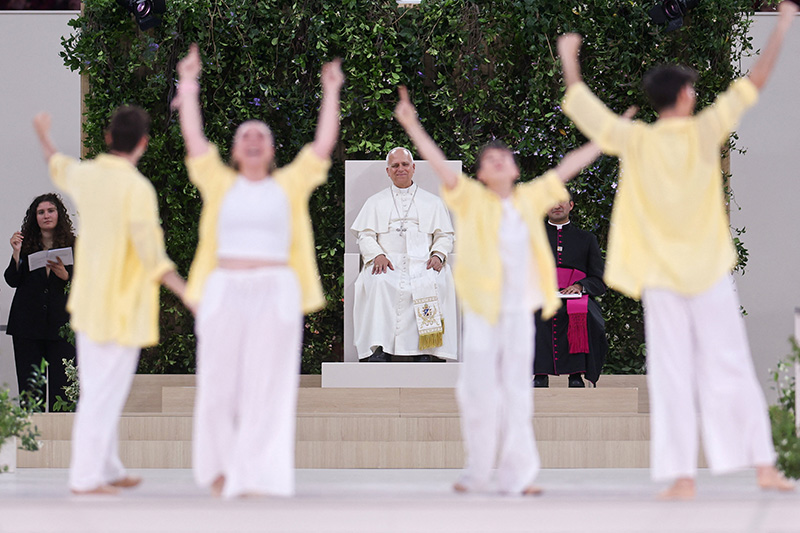
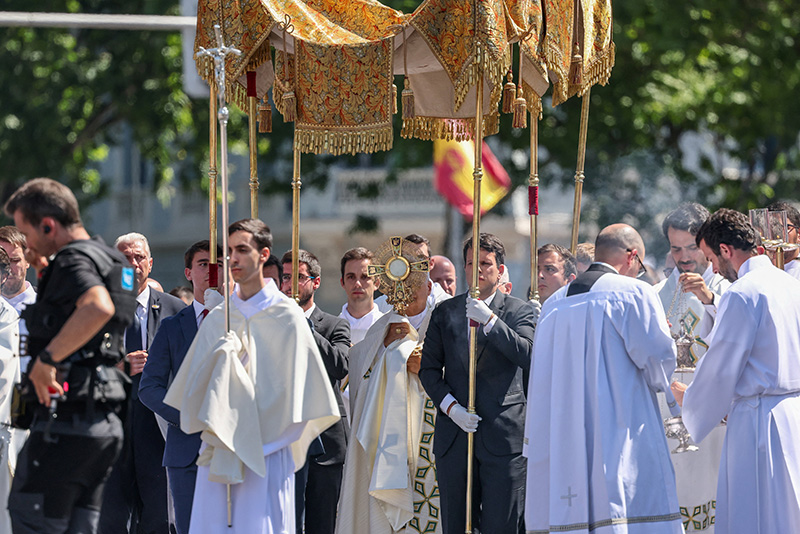 MADRID — More than 1.2 million people filled the streets of Madrid as Pope Leo XIV celebrated Mass and led a Eucharistic procession through the heart of the Spanish capital June 7 for the solemnity of Corpus Christi, the liturgical feast celebrating the Most Holy Body and Blood of Christ.