


VATICAN CITY — Pope Leo XIV published his landmark encyclical on artificial intelligence "Magnifica Humanitas" May 25, comparing the attempt to build an AI future that excludes God to the "Tower of Babel" and underlining the need to safeguard human dignity as it is "threatened by new forms of dehumanization."
"The risk of dehumanization – of building a future that excludes God and reduces the other to a means -- is an ancient and ever-new temptation that today takes on a technical guise," Pope Leo wrote in his first encyclical, "Magnifica Humanitas: On Safeguarding the Human Person in the Time of Artificial Intelligence."
"In the era of artificial intelligence, when human dignity is threatened by new forms of dehumanization, ours is the pressing duty to remain profoundly human. We must lovingly safeguard the grandeur of humanity bestowed upon us and revealed in its fullness in Christ, the splendor of which no machine can ever replace," he said.
Learn more about the encyclical
The Vatican’s Dicastery for Promoting Integral Human Development has launched a new website for the encyclical, featuring a summary, chapter-by-chapter infographics in several languages, and an introductory video. Visit: magnificahumanitas.org/en
Bishop Martin praises pope’s encyclical for its focus on human dignity
CHARLOTTE — On Monday, Bishop Michael Martin, OFM Conv., offered this reaction to Pope Leo XIV's encyclical on artificial intelligence:
Pope Leo’s first encyclical "Magnifica humanitas" is so helpful at this historic time in our world. Like the Industrial Revolution of his namesake Pope Leo XIII in the 19th century, Artificial Intelligence is revolutionizing the world as we know it, and the Church then and now stands ready to offer safeguards that value human dignity above all else. As important as technology can be, our Holy Father shows us that we are likely to miss the mark when we place production over process. Pope Leo calls us to value truth, freedom and work as we utilize technologies that can make the world a better place. This isn’t the Catholic Church lamenting progress; rather, it is our pontiff calling humanity to live into its best expression for the common good while never disregarding the importance of the person. He reminds us that technologies meant to empower can also enslave, as all of us know who have found ourselves lost at times without our phones! At a time when so many people struggle with the effects of isolation, some of which can be caused by technological overdependence, Pope Leo challenges us to uphold the human connection as paramount as we utilize artificial means in appropriate ways.
AI misuse compared to 'Tower of Babel'
Pope Leo opens the first encyclical of his pontificate by saying that humanity today faces a pivotal choice -- "either to construct a new Tower of Babel or to build the city in which God and humanity dwell together." Using the Biblical Genesis narrative, the pope warns against the "'Babel syndrome,' namely the idolatry of profit that sacrifices the weak" and the pretense that everything, "including the mystery of the person," can be translated into "data and performance."
"Calling for prudence, rigorous evaluation and even, at times, a slower pace in adopting AI does not mean opposing progress; instead, it is an exercise of responsible care for the human family," Pope Leo wrote.
From cryptocurrency to the 'Lord of the Rings'
The lengthy papal document is divided into five chapters and touches on wide ranging issues related to AI, including the prospect of massive unemployment, the future of education, the protection of human freedom, excessive screen time for young people, cryptocurrencies, economic disparities, transhumanism, cyberattacks and the application of Catholic social teaching principles.
Pope Leo dedicated the final chapter of the encyclical to AI in warfare and the need for "rigorous ethical constraints" and proactive peacebuilding "to curb the technological arms race."
The American pope points to Martin Luther King Jr., St. Teresa of Kolkata, Dorothy Day, St. Maximilian Kolbe and others as examples that "history can also change when individuals truly take the dignity of everyone seriously."
In "Magnifica Humanitas," Latin for "Magnificent Humanity," the pope calls on Christians not to be "passive spectators" or "mere commentators on what is crumbling," but to take a proactive role in building the future by cultivating community and in-person relationships, educating young people to love wisdom, spending time with the poor and the lonely, being a voice for justice, defending objective truth, and treating the digital world as "a new continent to be evangelized."
"It is not our part to master all the tides of the world, but to do what is in us for the succour of those years wherein we are set, uprooting the evil in the fields that we know, so that those who live after may have clean earth to till," the pope wrote, quoting J.R.R. Tolkien's "Lord of the Rings: The Return of the King." He added that it is "small and steadfast acts of fidelity that serve as a bulwark against dehumanization."
'Slowing things down when everything is accelerating'
In the encyclical, Pope Leo says that the idea of a "more moral AI" is not enough if that morality is only determined by a few.
"What is needed is a more active political involvement that is capable of slowing things down when everything is accelerating, and of protecting the opportunities for communities still to be able to participate and ask questions," he said.
The pope argues that "we cannot consider AI to be morally neutral" and underlines that ethical discernment cannot be limited to "asking whether we are using a system for good or bad purposes," but must also "examine how that system is designed and what vision of the human person and society is embedded in the data and models that guide it."
Pope Leo added that data cannot be left solely in private hands and "should not be treated as something to be sold off or entrusted to a select few," calling for appropriate regulation and creative thinking to "manage data as a common or shared good."
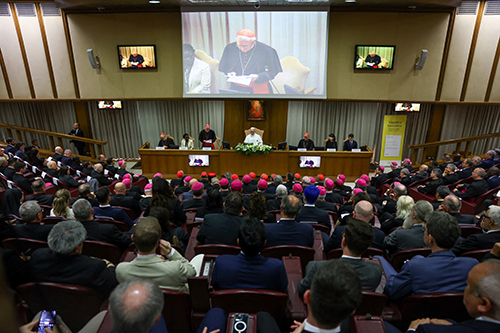 Pope Leo XIV attends the presentation of "Magnifica Humanitas" at the Vatican's Synod Hall May 25, 2026, the first encyclical of his papacy, which focuses on the rise of artificial intelligence. Also pictured on the panel are Cardinal Michael Czerny, prefect of the Dicastery for Promoting Integral Human Development; Léocadie Lushombo; Cardinal Víctor Manuel Fernández, prefect of the Dicastery for the Doctrine of the Faith; Cardinal Pietro Parolin, Vatican secretary of state; Anna Rowlands; and Anthropic co-founder Christopher Olah. (OSV News /Yara Nardi, Reuters)
Unemployment as a 'grave evil' and 'social calamity'
Pope Leo addresses the looming specter of mass unemployment due to the adoption of AI, saying this would be "a true social calamity that especially requires the State to exercise responsibility." He cites St. John Paul II's 1981 encyclical on human work "Laborem Exercens," noting that his predecessor recognized that unemployment is "a grave evil," with Pope Leo adding that "exposing many to forced inactivity, a lack of responsibility and the absence of daily tasks and stimuli" could lead to "human and cultural impoverishment."
"The pursuit of greater profits cannot justify choices that systematically sacrifice jobs, because the human person is an end, not a means, and the economic order must remain subordinate to human dignity and the common good," Pope Leo said.
"Without bold decisions, the prospect of greater poverty and inequality looms large, which would leave many individuals marginalized, stranded and surrounded by the machines and automated systems that have replaced them," he added.
God created humans for communion, not efficiency
Pope Leo writes that AI promises efficiency but the "new ways" of working are not necessarily better, describing how "contrary to the advertised benefits of AI, current approaches to technology can paradoxically de-skill workers, subject them to automated surveillance and relegate them to rigid and repetitive tasks."
"When efficiency becomes the ultimate measure of value, human beings are tempted to see themselves as a project to be optimized rather than as persons called to relationship and communion," Pope Leo said.
A defense of objective truth
Truth is a major theme in the encyclical by the Augustinian pope. He said that in the face of incessant flows of information, opinions, images and sophisticated algorithms that can influence decisions, it is imperative to "cultivate hearts that love the truth, prefer what is right despite the most appealing content and pursue wisdom rather than immediate results."
"We must always keep before us the truth about God and humanity, just as Christ has revealed them to us. We must lay aside an individualistic and technical view of humanity," he said.
Quoting Pope Benedict XVI, he added, "Modern man is wrongly convinced that he is the sole author of himself, his life and society. This is a presumption that follows from being selfishly closed in upon himself."
The pope underlined that "the search for truth is an essential element of democracy," and that "indifference to the truth leads, slowly but surely, to a descent into totalitarianism."
He said people must "promote an ecology of communication," in which public policy establishes norms "so that the decision-making behind content selection and its development becomes more transparent and protects personal data." On a cultural level, he called for "a strengthening of intermediary organizations, serious journalism and forums for debate," for families and schools to gain formation in using digital tools, and for universities to strive for the "integration of knowledge."
"Our first task is neither to demonize nor idolize technological tools, but to utilize them on the basis of a fundamental principle, namely that truth is a common good and not the property of those with power or influence," he said.
Social control and the 'digital attention economy'
Pope Leo called for "education in digital sobriety" due to subtle forms of addiction in today's "digital attention economy," in which digital platforms that are "designed to capture users' time and attention" weaken "their inner freedom."
He warned of the risk of "social control made possible by the massive collection of data and use of algorithmic systems."
"When every action -- movements, purchases, relationships and preferences -- leaves a trace, a new form of power emerges, namely the power to profile, predict and influence behavior, often without individuals being fully aware of it," he said. "If such kinds of data are used to make decisions affecting concrete opportunities -- such as access to credit, employment or essential services -- there is a risk of undermining freedom and discriminating against the most vulnerable."
Pope Leo XIII and Catholic social doctrine
Pope Leo XIV places his writing on the age of artificial intelligence within the context of the magisterial tradition of Catholic social doctrine, also known as Catholic social teaching. The first chapter of the encyclical provides an overview of what each pope has contributed to the Church's social magisterium from Pope Leo XIII to present, highlighting key ideas that are particularly relevant today. The second chapter provides definitions of key principles of Catholic social doctrine from the "common good" to "subsidiarity." Pope Francis and St. John Paul II are both frequently quoted throughout the encyclical.
Pope Leo XIV signed "Magnifica Humanitas" on May 15, the 135th anniversary of "Rerum Novarum," Pope Leo XIII's foundational 1891 social encyclical on labor and capital written during the first Industrial Revolution.
"While new economic and technological networks can generate exclusion, isolation and dependencies, the Church -- nourished by the Eucharist -- is called to make visible a different paradigm, one that preserves human connections, gives a voice to the invisible and ensures that processes are aimed at respecting people's dignity," Pope Leo said.
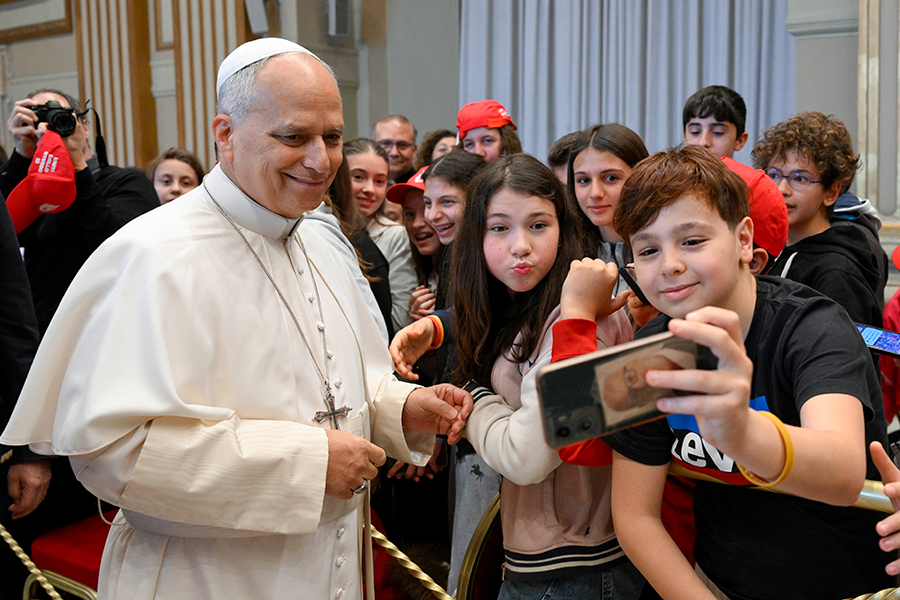
— Courtney Mares, OSV News. Pictured at top: Pope Leo XIV poses for a selfie as he meets May 16, 2026, with young Catholics from the Italian Archdiocese of Genoa at the Vatican who are preparing to receive the sacrament of confirmation. (OSV News/Simone Risoluti, Vatican Media)
Learn more about the encyclical
The Vatican’s Dicastery for Promoting Integral Human Development has launched a new website for the encyclical, featuring a summary, chapter-by-chapter infographics in several languages, and an introductory video. Visit: magnificahumanitas.org/en
10 quotes from Pope Leo's first encyclical
-
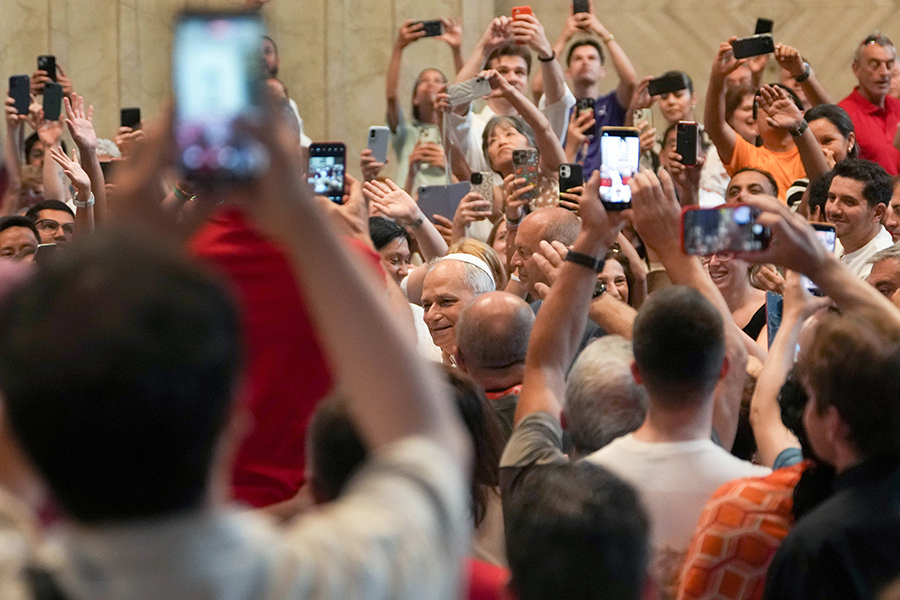
 In this file photo from June 14, 2025, Pope Leo XIV greets people as they hold up cellphones to take photos and videos as he enters St. Peter’s Basilica for an audience with pilgrims in Rome for the Holy Year 2025. (CNS/Lola Gomez)
10 quotes from Pope Leo’s first encyclical you should know for the era of AI
"Humanity, created by God in all its grandeur, is today facing a pivotal choice: either to construct a new Tower of Babel or to build the city in which God and humanity dwell together."
This line starts "Magnifica Humanitas" ("Magnificent Humanity") and sets the tone for Pope Leo XIV's first encyclical, promulgated May 25, which outlines two potential futures for humanity in the era of artificial intelligence, or AI.
Here are 10 quotes that provide a glimpse into what the encyclical contains:
- "Like the natural environment, the 'digital ecosystem' can be preserved or exploited, shared or monopolized. Solidarity demands that decisions regarding data, algorithms, platforms and artificial intelligence take into account not only the immediate benefit for a few, but also the impact on all peoples and on future generations" (paragraph 76).
- "In one sense, technological innovation can represent human participation in the divine act of creation. Developers, therefore, bear a particular ethical and spiritual responsibility, for every design choice reflects a vision of humanity" (paragraph 111).
- "For an algorithm, an error is a flaw to be corrected; for a person, however, an error can be a catalyst for profound change" (paragraph 128).
- "Those who control digital platforms and means of communication have a considerable ability to affect the collective imagination and to present a particular vision of reality as desirable. Such power should be constantly guided by the pursuit of truth and respect for human dignity, so that the culture fostered on the internet does not become an instrument of excessive distraction, homogenization or dominance, but rather a setting in which inner freedom and critical thought can mature" (paragraph 136).
- "Our first task is neither to demonize nor idolize technological tools, but to utilize them on the basis of a fundamental principle, namely that truth is a common good and not the property of those with power or influence. We must therefore promote an ecology of communication" (paragraph 137).
- "We must learn, then, how to exercise restraint in the use of AI and to protect our young people from the promise of the perfect machine, from that subtle temptation which renders human thought seemingly superfluous precisely when it is most needed" (paragraph 140).
- "In the short term, it may seem advantageous to reduce labor costs or maximize financial efficiency, but in the long term this undermines the very foundations of social coexistence. While technological successes are celebrated, the social fabric is progressively eroded, as if by a silent virus" (paragraph 166).
- "No algorithm can make war morally acceptable. AI does not remove the intrinsic inhumanity of conflict; indeed it can only bring about conflict more quickly and render it more impersonal, lowering the threshold for resorting to violence, transforming defense into threat prediction and thus reducing victims to data" (paragraph 198).
- "Even in the darkest nights, the Lord raises up men and women who refuse to give up, who persevere in doing good, who protect the vulnerable and open pathways to reconciliation. The memory of the saints, righteous people and the oft-forgotten peacemakers, show us that grace does not magically eliminate conflict, but instead it inspires active resistance to evil and an astonishing creativity in doing good" (paragraph 211).
- "We all need to learn how to engage with the digital world in a human way, as an integral part of our education in the faith and in a life lived according to the Gospel. Indeed, we must consider the digital world as a new continent to be evangelized, one that requires generous missionaries who are mature in the faith" (paragraph 238).
— OSV News
Learn more about the encyclical
The Vatican’s Dicastery for Promoting Integral Human Development has launched a new website for the encyclical, featuring a summary, chapter-by-chapter infographics in several languages, and an introductory video. Visit: magnificahumanitas.org/en
13 things to know about Pope Leo's encyclical on AI
-
13 things to know about Pope Leo’s encyclical on AI
What does it mean to safeguard our humanity? That question is at the heart of Pope Leo XIV's much anticipated first encyclical, "Magnifica Humanitas: On Safeguarding the Human Person in the Time of Artificial Intelligence," released May 25. The following are some key things to know about this weighty papal letter.
1. Latin for "Magnificent Humanity," the title is drawn from the opening words of the text as rendered in Latin, as is customary for papal encyclicals. Those words state, in its English translation, "Humanity, created by God in all its grandeur, is today facing a pivotal choice: either to construct a new Tower of Babel or to build the city in which God and humanity dwell together." Throughout the encyclical, Pope Leo points to "the grandeur of humanity," with men and women created by God for relationship with him and each other, cooperating in God's creative work and guided by the Holy Spirit.
2. The document is about 42,000 words long, including footnotes, making it roughly the size of a novella. It spans five chapters sandwiched between a robust introduction and conclusion. The first chapter traces the development of Catholic social doctrine, or social teaching, especially since "Rerum Novarum," Pope Leo XIII's seminal 1891 encyclical on the dignity of labor. The second chapter dives into the substance of Catholic social teaching. The third chapter explores the challenges artificial intelligence presents to humanity; the fourth chapter hones in on safeguarding truth, work and freedom; and the fifth chapter focuses on the implications of AI in warfare.
3. From education and jobs to private tech companies and families, "Magnifica Humanitas" is wide-ranging. It touches on the prospect of massive unemployment, the future of education, the protection of human freedom, excessive screen time for young people and technology addiction, data ownership, cryptocurrencies, economic disparities, environmental impacts, transhumanism and posthumanism, and cyberattacks and other forms of warfare. Pope Leo addresses the idea of "moral AI," and argues that the basis for "alignment of AI with human values" requires "openly discussing the ethical frameworks involved and subjecting them to shared standards of social justice" in a conversation inclusive to all communities.
4. The document includes references to an array of influential thinkers. Beyond Pope Leo's papal predecessors, the letter points to or quotes Dorothy Day, Maria Montessori, Martin Luther King Jr., J.R.R. Tolkien, Plato, the U.S. Conference of Catholic Bishops and the American humanist thinker Hannah Arendt, among others. And, of course, Pope Leo weaves in St. Augustine, the patron of Pope Leo's Augustinian religious order and Pope Leo's ever-present guide, particularly through the African bishop's important fifth-century book, "The City of God."
5. It uses biblical imagery, imploring people to examine what humanity is building in "the construction site of our time." The Tower of Babel and the City of God are contrasted throughout the encyclical to illustrate the two possible directions that the era of AI could take: a path of arrogance, artificial sense of self-sufficiency and chaos, or a path towards communion, relationship and God. Pope Leo underlines the critical need for developing a process for discernment to guide the development of AI. "The task of building today must place our relationship with God at its center," Pope Leo writes.
6. Despite its challenges, AI is not to be inherently feared. "Technology should not be considered, in itself, as a force antagonistic to humanity," he writes. "Over the centuries, technological development has significantly improved the living conditions of humanity. At the same time, each phase of progress has also revealed the ambiguity of tools that can cause harm when not oriented toward the good." He speaks directly to AI developers, telling them that "technological innovation can represent human participation in the divine act of creation," and therefore they "bear a particular ethical and spiritual responsibility, for every design choice reflects a vision of humanity."
7. Taking time for discernment is critical in our path forward. The encyclical invites people of goodwill into "a shared discernment process for identifying the spiritual and cultural roots of ongoing transformations" as they relate to AI. "We are living through a rapid phase of transition, a 'change of era,' in which ... most people are watching and waiting, observing from afar and merely hoping for the best," Pope Leo writes. "For this very reason, crucial questions impose themselves on our conscience and can no longer be avoided: Where are we going? Toward what goal do we wish to orient ourselves? What direction should we choose as people and as a human community?"
8. It explains the principles of Catholic social teaching and why they are important in building a future where humanity flourishes. Pope Leo explains central tenets of Catholic social teaching -- the dignity of the person, the common good, the universal destination of goods, subsidiarity, solidarity and justice -- as he makes the case for their use as guiding principles for AI. "The Social Doctrine of the Church is a legacy of wisdom, where we find principles for thought, criteria for discernment and judgment, and concrete guidelines for action," Pope Leo writes. "Founded on Sacred Scripture and Tradition, and in engagement with the sciences, it helps us clearly interpret the challenges of the present and identify appropriate ways for living out a clear Christian witness, with joy and in service to the world. It is not an inert set of concepts, but a living corpus of truth that safeguards and interprets humanity’s vocation to a full and just life." As AI has exponentially advanced and become part of daily life, people of goodwill must "face the challenges of our time with clarity of thought and responsibility," he writes.
9. People cannot be reduced to machines, measured for their efficiency and valued for their "optimization." Artificial intelligence "threatens to normalize an anti-human vision," Pope Leo writes. "In that vision, the fullness of life is equated with having more, reducing weakness, eliminating uncertainty and exerting total control. When efficiency becomes the ultimate measure of value, human beings are tempted to see themselves as a project to be optimized rather than as persons called to relationship and communion." Instead, "the quality of a civilization," he writes, "is measured not by the power of its means, but by the care it is able to offer, by its ability to recognize the other as a face not merely as a function."
10. Robust ethical consideration should be given to AI's impact on war. Pope Leo is particularly concerned that AI, "detached from ethics and responsibility, will render decisions about life and death more rapid and impersonal, and will present the use of force as an immediate and viable option." In calling for the principles of Catholic social teaching to serve as decision-making guidelines, he condemns "the spread of a culture of power characterized by polarization and violence." Instead, he calls humanity to "the civilization of love," which is "no naïve utopia, but a demanding project, which consists in translating charity into structures of justice, giving institutional form to fraternity, and regarding others -- whether individuals or peoples -- as allies necessary for building the common good." He also gives criteria for using AI in war.
11. "Magnifica Humanitas" is actually all about relationship. Throughout the encyclical, Pope Leo points to humanity's relationship to God and relationship to each other. In this area, he underscores action over passivity, and urges people to work toward "a willed and chosen solidarity." He writes, "This is the guiding principle for technological processes: it is not enough for artificial intelligence to make us more efficient or connected; it must also serve to build a universal human family, with shared rights and duties, where digital proximity becomes a real opportunity for encounter and mutual care."
12. Whatever the future holds, humanity's meaning is rooted in Jesus Christ. The document's conclusion includes a compelling reflection on the Incarnation through the "face of the Son of God, the grandeur of humanity that shines a light also on the era of AI." "No computational system, however sophisticated, can create a heart that gives itself, or a conscience that discerns good from evil. Even when machines excel in efficiency, a human face that asks to be gazed upon remains the center of our history," Pope Leo writes. "This human face is the fullness toward which history is moving."
13. The encyclical calls for personal conversion. The pope proposes for the Christian "a sober yet demanding program of Christian life with which we can navigate this epochal change in the light of the Gospel" centered on "contemplating God's plan," receiving the Eucharist, "building a world centered on the common good," and praying in union with Mary. He encourages people to cultivate community and in-person relationships, educate young people to love wisdom, spend time with the poor and lonely, be a voice for justice, defend objective truth, and treat the digital world as "a new continent to be evangelized." His final reflection centers on the "Magnificat," Mary's famous canticle glorifying God, recounted in the first chapter of the Gospel of Luke. Pope Leo writes: "In the humble fidelity of daily life, even the era of AI can become a time in which the Holy Spirit brings about the civilization of love in our lives."
— Maria Wiering, OSV News
Learn more about the encyclical
The Vatican’s Dicastery for Promoting Integral Human Development has launched a new website for the encyclical, featuring a summary, chapter-by-chapter infographics in several languages, and an introductory video. Visit: magnificahumanitas.org/en
'Magnifica Humanitas': Reading Pope Leo's vision between the lines
-
‘Magnifica Humanitas’: Reading Pope Leo’s vision between the lines
Pope Leo XIV's widely anticipated first encyclical on artificial intelligence is here, and it offers a clear path forward to one of the most pressing challenges of our age. But the 42,000-word "Magnifica Humanitas" also serves as a formal launching point for Pope Leo's vision for contemporary application of Catholic social teaching.
The text provides answers to questions pertaining to the "new things" of our modern age following in the footsteps of Pope Leo XIII's treatment of the advancements in technology, industry and economics at the turn of the 19th century, which birthed modern Catholic social doctrine. But "Magnifica Humanitas" also reveals some aspects of who Pope Leo is, how he governs, and what he brings to the Petrine office. Reading between the lines, the encyclical can be seen also as a roundup of what has been learned about Pope Leo so far and sheds perspective on what might lie ahead.
A particular word that Pope Leo repeats, as he frequently has even since his first address to the world as the newly elected 266th Successor of Peter, can serve as a key to these latent aspects of "Magnifica Humanitas." In fact, "to disarm," Pope Leo says in the encyclical, is an expression "close to my heart" (No. 110). Closer, perhaps, than it might appear at first glance?
A pivotal moment
Pope Leo begins his encyclical in stark terms, arguing that the modern world is at risk of heading down the path of the architects of the Tower of Babel -- where the descendents of Noah chose their own glorification over that of God, as recounted in Chapter 11 of Genesis -- and facing similar disastrous consequences.
Countering the cautionary tale with an example of a positive path forward, Pope Leo offers Nehemiah's plan for rebuilding Jerusalem's walls, as recounted in the first and second chapters of the Book of Nehemiah. Where the inhabitants of Babel attempted to build a single vision for the future -- one that put the self and not God at the center -- Nehemiah's vision facilitated progress through collaboration with God and others, bringing together society, with its various talents, to achieve a common purpose. In many ways, "Magnifica Humanitas" serves as Pope Leo's desire to bring Nehemiah's vision to the modern world.
This is achieved, Pope Leo proposes, when we disarm our own priorities, plans and projects by choosing to put Jesus Christ at their center rather than ourselves. This message is congruent with the Christocentrism that has pervaded Pope Leo's words and actions from the earliest moments of his pontificate.
"Whenever humanity is in danger of marring its true identity, we Christians lift our eyes to the Incarnate God, knowing that it is 'only in the mystery of the Word made flesh that the mystery of humanity truly becomes clear,'" he writes, quoting Vatican II's "Gaudium et Spes." "In Jesus Christ, this humanity in its grandeur becomes the Way, the Truth and the Life, opening the path for each of us to grow toward fullness" (No. 1).
Citing his beloved St. Augustine, Pope Leo wants to help humanity understand its innate desire for the happiness found only in God. As he writes, "Like Saint Augustine, we too can say, 'You have made us for yourself, O Lord, and our heart is restless until it rests in you'" (No. 11).
A call to embrace the Church's vision
In a world so polarized and ideological, so unable to find a common language, purpose or vision -- and too often defined by a growing absence of objective truth and moral relativism -- Pope Leo holds up the Church's social doctrine as a much-needed means to disarm current growing divisions, tensions and threats.
Pope Leo is clear that this time of rapid change in technology, economics and politics warrants revisiting this tradition comprehensively and boldly. Pope Leo's choice of papal name itself, as he explained to the College of Cardinals just two days after his election, was "mainly" because of how Pope Leo XIII "addressed the social question in the context of the first great industrial revolution" in his groundbreaking 1891 encyclical "Rerum Novarum."
"In our own day, the Church offers to everyone the treasury of her social teaching in response to another industrial revolution and to developments in the field of artificial intelligence that pose new challenges for the defense of human dignity, justice and labor," Pope Leo XIV told the cardinals.
"Magnifica Humanitas" is Pope Leo's magisterial contribution to this tradition -- even signed on the 135th anniversary of "Rerum Novarum," his namesake's monumental text. It is his invitation for humanity to disarm itself against self-interest. It is a call to step back, see the bigger picture, and work together to overcome collective challenges and plot the course ahead.
Through keen pastoral insights, Pope Leo underscores how the Church possesses the truth that the world needs to address the great social questions of our time; that we hold the blueprint for the way ahead. He argues that "building for the common good requires an evangelical language" and that "we must lovingly safeguard the grandeur of humanity bestowed upon us and revealed in its fullness in Christ, the splendor of which no machine can ever replace." (No. 14-15).
A call to unity
In order for humanity to work toward the peace God wills, Pope Leo stresses the importance of collaboration to advance the common good. The theological and anthropological implications of humanity's creation in God's image lies at the heart of human fraternity, communion and unity. Observers of his public schedule will note how available Pope Leo has made himself. Those who meet with him remark what a keen listener he is. Pope Leo promotes the implementation of synodality as a means to foster dialogue and co-responsibility in ecclesial life. He advocates for diplomacy and multilateralism.
Pope Leo's own episcopal motto -- "In Illo uno unum," which means "In the One, we are one" -- is taken from a commentary of St. Augustine on the psalms and stresses unity in Jesus Christ. Echoing Christ's own call to unity -- an innate desire for which is written into human consciousness as made in the image of the Triune God -- ought to permeate our answers to social questions.
As we await the fulfillment of the heavenly Jerusalem described by St. John in the Book of Revelation, Pope Leo draws attention to this vision as it serves "as an encouragement, a call to overcome our divisions and to work together, for this is the way of Jesus Christ, yesterday, today, and forever" (No. 242). In essence, Pope Leo teaches that the path of Christ is the way to disarm humanity from that which competes with God's vision for humanity.
Of course, the Church is not immune from reflecting the divisions, polarization and ideological defects of the wider society. And it is no secret that these realities plague the Church in a host of ways. While these divisions deepened under the pontificate of Pope Francis -- and were in some ways exacerbated by him -- Pope Leo has been a disarming presence since Day 1. When he chose to wear the traditional red mozetta, or cape, on the loggia after his election, it was a signal of his beginning down the path that comes full circle with this encyclical.
This makes particularly significant Pope Leo's extensive treatment of many of his papal predecessors' contributions to Catholic social teaching, beginning with Pope Leo XIII, who reigned as pope from 1878 to 1903. The former Robert Prevost, who grew up in Chicago and became a missionary priest and bishop in Peru, has receded into the Petrine office to such a degree that Pope Leo is who we now see. By his lengthy commentary of what recent popes have contributed to the social questions of their age, Pope Leo situates himself squarely within those confines.
And, through Pope Leo's generous quoting of Pope Francis, he accomplishes the same for his predecessor, highlighting the best of what Pope Francis contributed to the Church's magisterium. He has found a way, in "Magnifica Humanitas" and other official texts in his brief pontificate, to position his predecessor's contributions more securely within the tradition.
With his disarming style -- allowing the office and the One he represents to take center stage -- Pope Leo is leading the Church into a new age of unity, thereby making room for the Church to find its voice in a world so constantly at odds with its mission.
A shift in priorities?
Naturally, any document of this sort comes with its own limitations. The subjective nature of any kind of teaching document addressing timely issues will naturally lend itself to criticism, especially from those more prone to agendas.
Rather than giving into the temptation of ideology, though, listening to Pope Leo and heeding what he has to say to humanity at this moment would be the wiser path. From what we have seen and heard from Pope Leo, it seems like he is encouraging us to avoid constructing such Babel-like towers in the Church, and instead is offering the vocabulary and blueprint for humanity to collaborate in rebuilding the walls of a fractured world at risk of collapse.
Pope Leo's life as a priest and bishop put him in contact often with the global poor, a people whose faith greatly shaped his own. Their daily reality dictated that they be less concerned with such internal debates in Church life. Is Pope Leo not encouraging us to actually live Christianity instead of trying to tinker with revelation and trivialize sanctity?
Perhaps that is really the call of "Magnifica Humanitas": that those of us in the Church disarm ourselves of our own preoccupations and proclivities for nothing short of the life of the world.
— Michael R. Heinlein, OSV News
What the pope's new encyclical on AI Is asking of you
-
What the pope’s new encyclical on AI is asking of you
Near the end of his new encyclical "Magnifica Humanitas," Pope Leo XIV senses that his reader may be feeling overwhelmed. "At this point," the Holy Father writes, "a subtle temptation may emerge, namely the thought that the problems are too big and we are too small, and that our choices, therefore, cannot make a difference."
And here he turns to, of all people, J.R.R. Tolkien and "The Lord of the Rings": "It is not our part to master all the tides of the world, but to do what is in us for the succor of those years wherein we are set, uprooting the evil in the fields that we know, so that those who live after may have clean earth to till."
The Holy Father just quoted Gandalf in an encyclical. And it was pitch perfect.
If you don't yet understand why a pope would feel the need to offer that kind of reassurance, then you aren't paying close enough attention to what AI is doing and may do to our world.
Many have heard that this new technology threatens to displace all sorts of workers, but such a threat, as real and profound as it is, is by no means the only one. The U.S. Department of War has sued an AI company to make sure it can create autonomous weapons which kill without any human oversight.
AI-generated child porn is now one of the fastest-growing categories of online demonic debauchery. The most recent version of Anthropic's AI, Claude Mythos, was not only able to hack into virtually any phone or computer in the world, during safety testing it was regularly able to discover it was under observation and act differently.
This is not a future problem. This is a now problem.
Over the past few months, I have had the privilege of getting to know several people at Anthropic, including via two convenings at their San Francisco headquarters for Christian scholars and leaders.
During these months, I developed a friendship with Chris Olah, one of Anthropic's co-founders, and the same person who stood alongside Pope Leo at the Vatican press conference to mark the encyclical's release and called for critical dialogue and cooperation between the Church and the AI industry.
I can tell you with confidence that he means it. There is a great mystery underlying the nature of what it is they are building and the worries Chris and others have about what the future may hold as AI systems get exponentially more powerful quite rightly keep them up at night.
Their existential fears, and their need for help, underscore why the encyclical matters so much.
Leo builds his argument on three foundations Catholics should sit with carefully. The first is that something genuinely new is happening here. AI is not just a faster calculator or a smarter search engine. It "challenges the categories of Social Doctrine from within," the encyclical says, in ways that require not just new applications of old principles but the development of those principles themselves. Human dignity is under a threat that we have not faced before, and Leo knows it.
The second is that labor should be at the heart of our concern. Leo XIV signed "Magnifica Humanitas" on the 135th anniversary of "Rerum Novarum," Leo XIII's great encyclical on behalf of workers being ground up by the previous industrial-technical revolution.
That anniversary is not rhetorical decoration. The new encyclical insists that work is "a fundamental good for the person, a principle of economic activity and the key to the entire societal question." When AI systems mass-displace workers in the service of being more efficient and extracting more profit, this constitutes a foundational attack on human dignity.
Work, says Leo, is not merely an instrument or a source of income; on the contrary, "it expresses and enhances the dignity of our lives." The pope calls work "a requirement of the human condition" and he quotes the U.S. bishops who insist that it provides "a crucial sphere in which identity is formed, friendships and relationships are forged, practical responsibilities are learned and one's vocation is discerned."
The third is that the Church has a unique and urgent role to play at this hinge moment in history. Leo quotes his predecessor, Pope Francis, directly: "No one can demand that religion should be relegated to the inner sanctum of personal life, without influence on societal and national life, without concern for the soundness of civil institutions, without a right to offer an opinion on events affecting society."
The Church is the guardian and promoter of a 2,000-year tradition of thinking about what human beings are and what they are for. That tradition, not least because it has navigated these kinds of dramatic moments in the past, is exactly what we need right now. And the fact that some of the most important AI researchers in the world are actively engaging it should give added confidence to act in light of our tradition.
But what, specifically, is Leo asking of us?
First, he is channeling his inner St. John Paul II in urging us not to be afraid in spreading the good news in the midst of the AI revolution. "I encourage all members of the Church not to be afraid of the present challenges," the Holy Father says. The truth which the Church has to offer at this historical moment "is a gift to be shared" with the world.
Second, he is asking us to begin with ourselves. The encyclical returns repeatedly to the following question: Does this technology "make human life on earth 'more human' in every aspect of that life? Does it make it more worthy of man?" That question, first, is a personal one. How am I using AI in my own life? What habits is it building or eroding in me? Am I using it in ways that deepen my attention and my relationships, or in ways that outsource my judgment and thin out my humanity? We must evangelize ourselves before we bring this message to the world.
Third, he is asking us to get to work. The biblical image Leo returns to again and again is Nehemiah rebuilding the walls of Jerusalem: Everyone is given their own section. Scientists and researchers. Entrepreneurs and workers. Educators and legislators. Faith communities. Each in their own field, doing what is in them to do.
Perhaps you are being called to organize a labor union for workers in your school or hospital? Especially if you work in a Catholic institution, perhaps you are being called to ask, right now, whether anyone has evaluated the AI tools your institution is adopting, and against what criteria. The encyclical gives you both the standing and the obligation to ask that question. If no one is asking it, then this may be your section of the wall to get started on.
Leo writes: "The civilization of love will not arise from a single or spectacular gesture, but from the sum total of small and steadfast acts of fidelity."
We have our marching orders. Time to get to work.
— Charles Camosy teaches moral theology and bioethics at The Catholic University of America in Washington, D.C.
Anthropic's Christopher Olah urges global moral oversight of AI at Vatican presentation
-
Anthropic’s Christopher Olah urges global moral oversight of AI at Vatican presentation
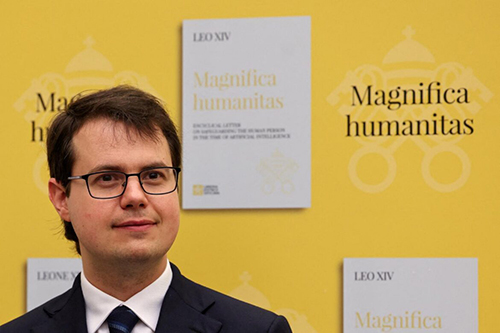
 Christopher Olah, co-founder of the U.S. artificial intelligence company Anthropic, attends a news conference in the Vatican's Paul VI Hall May 25, 2026, after the presentation of "Magnifica humanitas," Pope Leo XIV's first encyclical. (OSV News/Yara Nardi, Reuters)
The May 25 speech of Anthropic's co-founder Christopher Olah at the presentation of the first encyclical of the pontificate of Pope Leo XIV ended with a special request: "We need more of the world -- religious communities, civil society, scholars, governments -- to do what His Holiness has done here: to take this seriously, to look closely, and to push events in a better direction."
Olah, sitting in the Synodal Hall for the presentation of "Magnifica Humanitas," Pope Leo's encyclical on safeguarding the human person in the time of artificial intelligence, said the world of technology needs "informed critics who will tell the labs when we are failing," and "moral voices that the incentives cannot bend."
"Today is just the beginning," he said, "the start of a long collaboration between those of us who are building this and those who can see what we, from inside, cannot."
He said the event "is a powerful illustration of the form this global project of goodwill might take. Let it also be a decisive first step toward a hopeful future for magnificent humanity," he said.
His speech, while humble and open to collaboration on ethical dimensions, also showed stark differences between the realities of the industry and what Pope Leo asked in the encyclical.
Olah admitted that as he was sitting in the same room with the pope, these words "may sound strange coming from the co-founder of an AI company -- and someone who chose this work out of a desire to help things go well for humankind," but every frontier AI lab, he said, including his own, "operates inside a set of incentives and constraints that can sometimes conflict with doing the right thing."
The incentives -- geopolitical, commercial or research-oriented -- influence the industry, he explained.
Three challenges have emerged as immediate in the world of AI, he said.
First, "there is a real possibility that AI will displace human labor at a very large scale."
If that happens, Olah said, "supporting those displaced will be a moral imperative of historic proportions."
Pope Leo wrote in "Magnifica Humanitas" that the dignity of work at a time of digital transition is of fundamental concern.
"The pursuit of greater profits cannot justify choices that systematically sacrifice jobs, because the human person is an end, not a means, and the economic order must remain subordinate to human dignity and the common good," Pope Leo wrote.
"For young people, job insecurity is particularly devastating. ... When access to work is hindered ... many young people find the path to their human and professional fulfillment blocked."
The task of keeping jobs "will be difficult enough," Olah said May 25 at the Vatican, "but I worry most dialogue misses an even harder challenge," he added.
"AI development is concentrated in a handful of wealthy nations. How can we ensure the gains of AI are shared globally?" Olah asked. "We do not have a mechanism for this. It is an unsolved problem, and it is the kind of problem the Church has historically refused to let the world ignore."
In fact, Pope Leo wrote in his encyclical that "protecting freedom of men against commercialization" is an urgent task.
"When business models thrive on human weakness, the person is treated as a means rather than as an end," the pope said, stressing that "if technology becomes the ultimate criterion, the human person risks being reduced to data, a cog in a machine or a commodity."
"It is not enough for artificial intelligence to make us more efficient or connected; it must also serve to build a universal human family, with shared rights and duties," Pope Leo wrote, stressing that the Church is called to be "capable of listening to the cry of the poor, migrants and victims of new forms of slavery."
Olah said another challenge is "the need for moral imagination and ambition regarding human flourishing."
If AI models are going to be widespread, he said, the question remains open on "what does it look like for humans, families and the world to flourish?"
Today, Olah said, "parents are already worried about their children's minds; individuals about the future of their work. These are not questions a lab can answer. They are questions traditions like yours have carried for millennia, and we need you to keep carrying them into this new moment in history."
The encyclical outlines the severe psychological and social harms of early and unsupervised digital exposure, which can negatively impact sleep, attention spans and emotional control, while opening the door to online exploitation, cyberbullying and manipulation by AI tools.
Acknowledging the immense pressure on the modern family, the pope conceded that "it is difficult for parents by themselves to resist the influence of business models that monetize attention and time."
Because of that, he called for an "alliance among policy-makers, educational institutions and families that is capable of concretely supporting adults in this task."
Olah pointed out the third challenge of "the nature of AI models."
"I am a scientist," he said, "I lead a research team that studies the internal structure of these models -- what is actually happening inside them. And I will be honest: we keep finding things that are mysterious, even unsettling," he said, pointing out that researchers find "structures that mirror results from human neuroscience. We find evidence of introspection. We find internal states that functionally mirror joy, satisfaction, fear, grief and unease. I don't know what that means, but I think it warrants ongoing discernment."
"If we want this technology to go well," he pointed out, "it is enormously important that there be people outside those incentives -- people who care about things going well, who are paying close attention, who are willing to say hard things, who are willing to be our earnest, thoughtful, critics," Olah said before bowing his head for the papal blessing.
The pope thanked Olah for his presence at the presentation and "accepting our invitation in turn in the name of the church."
"I accept your invitation to walk together, to listen and to speak, and together to find a way for humanity in this time of artificial intelligence," the pope said.
"What a great sign of hope it is that with our differences we can listen to one another. This interchange clearly bespeaks the gravity of the moment as well as confidence that together we can discern the major questions of our time," Pope Leo stressed.
"At key moments in history, the Church is called to decipher the new things in the light of the Gospel and the dignity of the human being."
— Paulina Guzik, OSV News
Bishops welcome Pope Leo's encyclical as 'crystal' clear guidance for the AI era
-
Bishops welcome Pope Leo’s encyclical as ‘crystal’ clear guidance for the AI era
Catholic bishops are welcoming Pope Leo XIV's first encyclical, dedicated to safeguarding human dignity by invoking Catholic social teaching as a framework for anchoring artificial intelligence.
The document is a "powerful reminder that no technology can replace a child of God, and all technology should be placed at the service of helping humanity thrive," said Archbishop Paul S. Coakley of Oklahoma City, president of the U.S. Conference of Catholic Bishops.
The archbishop shared his thoughts in a May 25 statement issued minutes after the official release of the pope's highly anticipated encyclical on AI "Magnifica Humanitas: On Safeguarding the Human Person in the Time of Artificial Intelligence."
Pope Leo joined senior Vatican officials, theologians and Christopher Olah, one of the founders of the AI research and safety firm Anthropic, for a press conference at the Vatican at which the encyclical was publicly presented.
"Magnifica Humanitas" invokes the wisdom of the Church's social teaching -- which articulates the means of building a just society and living out holiness in modern life -- as a framework for shaping AI amid rapid technological advances, a fractured global order and accelerating threats to human dignity.
"The Holy Father's teaching on safeguarding human dignity in the age of artificial intelligence speaks to a critical need and brings clarity to a confusing landscape," said Archbishop Nelson J. Pérez of Philadelphia said in a May 25 statement posted to CatholicPhilly.com, the digital news outlet of that archdiocese.
"Pope Leo emphasizes with crystal clarity that the sanctity of human life must remain paramount as artificial intelligence systems continue to develop and become more closely integrated into nearly every aspect of our lives," said Archbishop Pérez.
AI's benefits to healthcare, education and evangelization are accompanied by the technology's "significant moral and ethical pitfalls that must be navigated and reflected upon," he said. He encouraged "all people to read it with care and reflect on its vital message."
Bishop Michael F. Burbidge of Arlington, Virginia, also exhorted the faithful to read the document, which is available online at the Vatican website.
In his May 25 statement, posted to Arlington Diocese's website, Bishop Burbidge said he was "grateful" for Pope Leo's attention to "issues of profound concern to the human person, most especially our innate desire for God and everlasting happiness."
He said the encyclical is "especially welcome in this time of tremendous social and technological change, especially concerning artificial intelligence and the right use of such tools."
 Bishop Michael T. Martin of Charlotte, North Carolina, said Pope Leo's text was "so helpful at this historic time in our world."
In a May 25 statement emailed to OSV News, Bishop Martin, a Conventual Franciscan, observed that like the Industrial Revolution -- which Pope Leo XIII addressed in his 1891 encyclical "Rerum Novarum" -- AI is "revolutionizing the world as we know it."
The Church "then and now stands ready to offer safeguards that value human dignity above all else," said Bishop Martin.
He clarified that Pope Leo's new encyclical "isn't the Catholic Church lamenting progress," but it is "our pontiff calling humanity to live into its best expression for the common good while never disregarding the importance of the person."
In a May 25 post in Spanish on the X social media platform, Mexico's Catholic bishops said the encyclical "offers a profound and enlightening perspective on our times, demonstrating that emerging technologies can become allies of human dignity when oriented toward the common good."
"The text combines lucidity with hope: it analyzes real risks, but, above all, points to concrete paths for safeguarding the human element in the age of Artificial Intelligence (AI)," said the Mexican bishops. "Its strength lies in its capacity to integrate doctrine, discernment, and social responsibility."
"It is too early to say how the AI revolution will pan out," Ukrainian Catholic Metropolitan Archbishop Borys A. Gudziak of Philadelphia told OSV News, "but the optimism and embrace for human discovery that Pope Leo combines with deep anthropological, cultural, social, moral and spiritual reflection is something that is welcomed -- because it is deeply needed."
— Gina Christian, OSV News
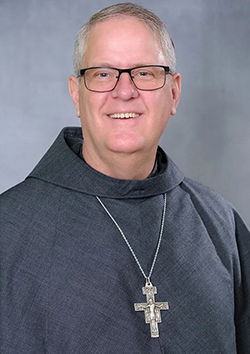 Bishop Michael T. Martin of Charlotte, North Carolina, said Pope Leo's text was "so helpful at this historic time in our world."