


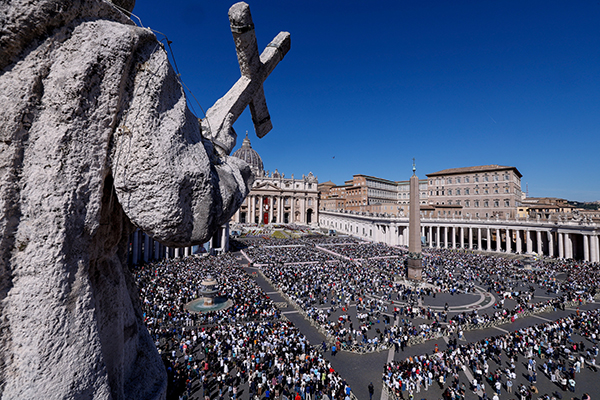
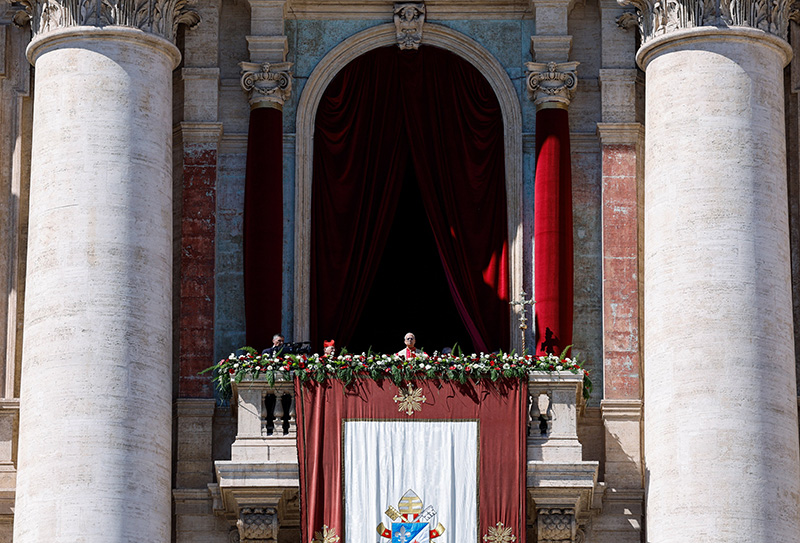
VATICAN CITY — Speaking from the loggia of St. Peter's Basilica on Easter, Pope Leo XIV delivered a passionate appeal for peace, declaring that the power of the risen Christ is "entirely nonviolent" and calling on world leaders to lay down their weapons and choose dialogue over domination.
The address came moments after the pope offered Easter Mass in St. Peter's Square with more than 50,000 people present and preceded his solemn blessing, "urbi et orbi," meaning "to the city and to the world," in which the pope offers an indulgence to Catholics around the world who receive the blessing with the proper dispositions.
"In the light of Easter, let us allow ourselves to be amazed by Christ! Let us allow our hearts to be transformed by his immense love for us! Let those who have weapons lay them down! Let those who have the power to unleash wars choose peace! Not a peace imposed by force, but through dialogue! Not with the desire to dominate others, but to encounter them!" Pope Leo said on April 5.
The pope repeated the word peace 13 times in his address, underlining that the peace the risen Christ offers "is not merely the silence of weapons, but the peace that touches and transforms the heart of each one of us."
"Let us allow ourselves to be transformed by the peace of Christ! Let us make heard the cry for peace that springs from our hearts!"
In a surprise announcement, Pope Leo revealed he will host a prayer vigil for peace in St. Peter's Basilica on Saturday, April 11.
At the heart of his message was a meditation on the nature of Christ’s power in the resurrection, which he contrasted with the violence that marks the modern world.
"The power with which Christ rose is entirely nonviolent," Pope Leo said.
That strength, the pope added, "is God himself, for he is Love who creates and generates, Love who is faithful to the end and Love who forgives and redeems."
"On this day of celebration, let us abandon every desire for conflict, domination, and power, and implore the Lord to grant his peace to a world ravaged by wars and marked by a hatred and indifference that make us feel powerless in the face of evil. To the Lord we entrust all hearts that suffer and await the true peace that only he can give," he said.
The pope warned against the "globalization of indifference," a phrase he credited to his predecessor, Pope Francis, who gave his final "urbi et orbi" blessing from the same loggia on Easter Sunday one year ago the day before he died. Pope Leo invoked the words from Pope Francis' Easter blessing last year, in which the late pope lamented "what a great thirst for death, for killing, we witness each day in the many conflicts raging in different parts of the world."
"We are growing accustomed to violence, resigning ourselves to it, and becoming indifferent," Pope Leo said. "Indifferent to the deaths of thousands of people. Indifferent to the repercussions of hatred and division that conflicts sow."
"We cannot continue to be indifferent! And we cannot resign ourselves to evil!" he added.
Quoting a sermon by St. Augustine, Pope Leo said, "If you fear death, love the resurrection!"
Easter, the pope said, "is the victory of life over death, of light over darkness, of love over hatred."
"It is a victory that came at a very high price," he added. "Christ, the Son of the living God (cf. Mt 16:16), had to die – and die on a cross – after suffering an unjust condemnation, being mocked and tortured, and shedding all his blood. As the true immolated Lamb, he took upon himself the sin of the world (cf. Jn 1:29; 1 Pet 1:18–19) and thus freed us all – and with us, all creation – from the dominion of evil."
"Evil is not the last word, because it has been defeated by the Risen One," he said.
After giving the "urbi et orbi" blessing in Latin, Pope Leo offered Easter greetings in 10 different languages, including Chinese and Arabic, with loud cheers as he spoke in English and Spanish.
"May you bring the joy of Jesus, who is risen and present in our midst, to all you meet," he said in English. The pope then joined the joyful crowd in St. Peter’s Square in the popemobile.
At Easter Mass, Pope Leo proclaims Resurrection conquers 'the power of death'
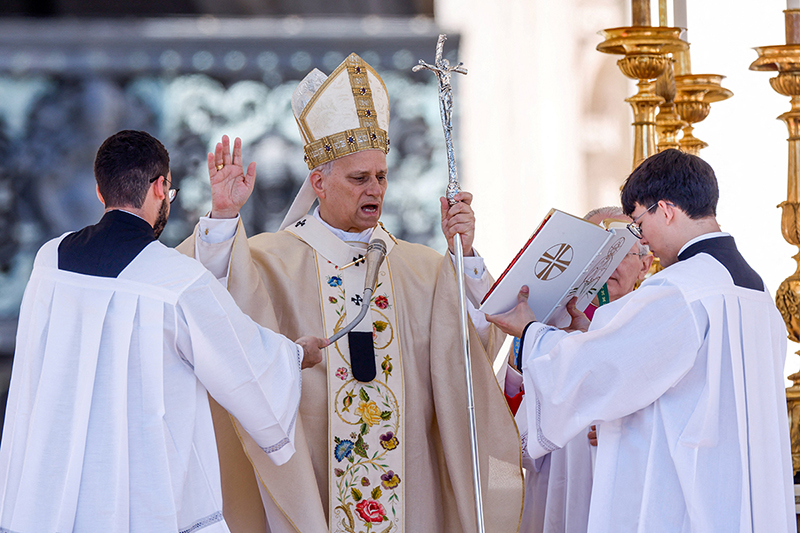
VATICAN CITY — Pope Leo XIV offered Easter Mass in St. Peter's Square Sunday proclaiming that with Christ's resurrection "death has been conquered forever” and "no longer has power over us."
"Today all of creation is resplendent with new light, a song of praise rises from the earth, and our hearts rejoice: Christ is risen from the dead, and with Him, we too rise to new life," the pope said.
Pope Leo declared that Easter "embraces the mystery of our lives and the destiny of history, reaching us even in the depths of death, where we feel threatened and sometimes overwhelmed. It opens us up to a hope that never fails, to a light that never fades, to a fullness of joy that nothing can take away."
Tens of thousands gathered under the bright Roman sun on April 5 in a flower-adorned St. Peter's Square for the first Easter Mass of Pope Leo XIV's pontificate. The square was transformed for the occasion by thousands of blooms in vivid colors on the stairs leading up to the Renaissance basilica.
The Mass opened with the choir's joyful proclamation: "O sons and daughters of the King, whom heavenly hosts in glory sing, today the grave has lost its sting. Alleluia!"
In his homily, Pope Leo declared that the resurrection of Christ has conquered the power of death, which he said "constantly threatens us” both from within, our feelings, doubts, disappointments, fears, and from outside, where war, injustice, selfishness and violence are prevalent.
From within, he said, that power manifests in sin, loneliness, doubt and exhaustion. "The weight of our sins prevents us from 'spreading our wings' and taking flight, or when the disappointments or loneliness we experience drain our hope," he said.
"When we have to come to terms with our weakness, with the sufferings and the daily grind of life, we can feel as if we have ended up in a tunnel with no end in sight."
But the pope also turned his gaze outward, describing a world marked by suffering and injustice.
"We see it present in injustices, in partisan selfishness, in the oppression of the poor, in the lack of attention given to the most vulnerable," he said. "We see it in violence, in the wounds of the world, in the cry of pain that rises from every corner because of the abuses that crush the weakest among us, because of the idolatry of profit that plunders the earth's resources, because of the violence of war that kills and destroys."
Yet Easter, Pope Leo insisted, refuses to allow despair to be the final word. The feast "invites us to lift our gaze and open our hearts," he said, and announces that "the power of death is not the final destiny of our lives. We are all directed, once and for all, on the path to fulfillment, because in Christ we also have risen."
During the Mass, the Gospel of John was proclaimed in both Latin and Greek, and the prayers of the faithful were offered in Arabic, Chinese, Spanish, Vietnamese, and Portuguese. Pope Leo offered the consecration in Latin.
The pope called on Christians to carry that message into the wider world, like St. Mary Magdalene, who ran to announce the risen Christ to the disciples.
"Brothers and sisters, Easter gives us this hope, as we remember that in the risen Christ a new creation is possible every day," Pope Leo said.
"We need this song of hope today. It is ourselves, risen with Christ, who must bring him into the streets of the world. Let us then run like Mary Magdalene, announcing him to everyone, living out the joy of the resurrection, so that wherever the specter of death still lingers, the light of life may shine," he said.
– Courtney Mares, OSV News
Pope Leo XIV's Easter 'urbi et orbi'
This is the full text of Pope Leo XIV's "urbi et orbi" address given on Easter April 5, 2026, from the central loggia of St. Peter's Basilica.
Brothers and sisters,
Christ is risen! Happy Easter!
For centuries, the Church has joyfully sung of the event that is the origin and foundation of her faith: "Yes, Christ my hope is arisen / Christ indeed from death is risen / Have mercy, victor King, ever reigning" (Easter Sequence).
Easter is the victory of life over death, of light over darkness, of love over hatred. It is a victory that came at a very high price: Christ, the Son of the living God (cf. Mt 16:16), had to die -- and die on a cross -- after suffering an unjust condemnation, being mocked and tortured, and shedding all his blood. As the true immolated Lamb, he took upon himself the sin of the world (cf. Jn 1:29; 1 Pet 1:18–19) and thus freed us all -- and with us, all creation -- from the dominion of evil.
But how was Jesus able to be victorious? What is the strength with which he defeated once and for all the ancient adversary, the prince of this world (cf. Jn 12:31)? What is the power with which he rose from the dead, not returning to his former life, but entering into eternal life and thus opening in his own flesh the passage from this world to the Father?
This strength, this power, is God himself for he is Love who creates and generates, Love who is faithful to the end and Love who forgives and redeems.
Christ, our "victorious King," fought and won his battle through trusting abandonment to the Father's will, to his plan of salvation (cf. Mt 26:42). Thus he walked the path of dialogue to the very end, not in words but in deeds: to find us who were lost, he became flesh; to free us who were slaves, he became a slave; to give life to us mortals, he allowed himself to be killed on the cross.
The power with which Christ rose is entirely nonviolent. It is like that of a grain of wheat which, having rotted in the earth, grows, breaks through the clods, sprouts, and becomes a golden ear of wheat. It is even more like that of a human heart which, wounded by an offense, rejects the instinct for revenge and, filled with compassion, prays for the one who has committed the offense.
Brothers and sisters, this is the true strength that brings peace to humanity, because it fosters respectful relationships at every level: among individuals, families, social groups, and nations. It does not seek private interests, but the common good; it does not seek to impose its own plan, but to help design and carry out a plan together with others.
Yes, Christ's resurrection is the beginning of a new humanity; it is the entrance into the true promised land, where justice, freedom, and peace reign, where all recognize one another as brothers and sisters, children of the same Father who is Love, Life, and Light.
Brothers and sisters, through his resurrection, the Lord confronts us even more powerfully with the dramatic reality of our freedom. Before the empty tomb, we can be filled with hope and wonder, like the disciples, or with fear like the guards and the Pharisees, forced to resort to lies and subterfuge rather than acknowledge that the one who had been condemned is truly risen (cf. Mt 28:11–15)!
In the light of Easter, let us allow ourselves to be amazed by Christ! Let us allow our hearts to be transformed by his immense love for us! Let those who have weapons lay them down! Let those who have the power to unleash wars choose peace! Not a peace imposed by force, but through dialogue! Not with the desire to dominate others, but to encounter them!
We are growing accustomed to violence, resigning ourselves to it, and becoming indifferent. Indifferent to the deaths of thousands of people. Indifferent to the repercussions of hatred and division that conflicts sow. Indifferent to the economic and social consequences they produce, which we all feel. There is an ever-increasing "globalization of indifference," to borrow an expression dear to Pope Francis, who one year ago from this loggia addressed his final words to the world, reminding us: "What a great thirst for death, for killing, we witness each day in the many conflicts raging in different parts of the world!" (Urbi et Orbi Message, 20 April 2025).
The cross of Christ always reminds us of the suffering and pain that surround death and the agony it entails. We are all afraid of death, and out of fear we turn away, preferring not to look. We cannot continue to be indifferent! And we cannot resign ourselves to evil! Saint Augustine teaches: "If you fear death, love the resurrection!" (Sermon 124, 4). Let us too love the resurrection, which reminds us that evil is not the last word, because it has been defeated by the Risen One.
He passed through death to give us life and peace: "I leave you peace; I give you my peace. Not as the world gives it, I give it to you" (Jn 14:27). The peace that Jesus gives us is not merely the silence of weapons, but the peace that touches and transforms the heart of each one of us! Let us allow ourselves to be transformed by the peace of Christ! Let us make heard the cry for peace that springs from our hearts! For this reason, I invite everyone to join me in a prayer vigil for peace that we will celebrate here in Saint Peter's Basilica next Saturday, April 11.
On this day of celebration, let us abandon every desire for conflict, domination, and power, and implore the Lord to grant his peace to a world ravaged by wars and marked by a hatred and indifference that make us feel powerless in the face of evil. To the Lord we entrust all hearts that suffer and await the true peace that only he can give. Let us entrust ourselves to him and open our hearts to him! He is the only one who makes all things new (cf. Rev 21:5).
Happy Easter!