


 VATICAN CITY — In his first Palm Sunday homily, Pope Leo XIV proclaimed that Jesus, the King of Peace, embraces all suffering in human history and cries out from the cross against war.
"Brothers and sisters, this is our God: Jesus, King of Peace, who rejects war, whom no one can use to justify war," the pope said in St. Peter's Square March 29.
"He does not listen to the prayers of those who wage war, but rejects them, saying: 'Even though you make many prayers, I will not listen: your hands are full of blood' (Is 1:15)."
Pope Leo repeated the phrase "King of Peace" seven times throughout his homily, weaving it through different moments of the Passion of Christ, pointing to Jesus as a victim of unjust violence who never took up arms in his own defense.
"Christ, King of Peace, cries out again from his cross: God is love! Have mercy! Lay down your weapons! Remember that you are brothers and sisters," Pope Leo said.
He emphasized that Jesus, in allowing himself to be nailed to the cross embraced "every cross borne in every time and place throughout human history."
"As we set our gaze upon him who was crucified for us, we can see a crucified humanity. In his wounds, we see the hurts of so many women and men today," the pope said.
"In his last cry to the Father, we hear the weeping of those who are crushed, who have no hope, who are sick and who are alone. Above all, we hear the painful groans of all those who are oppressed by violence and are victims of war."
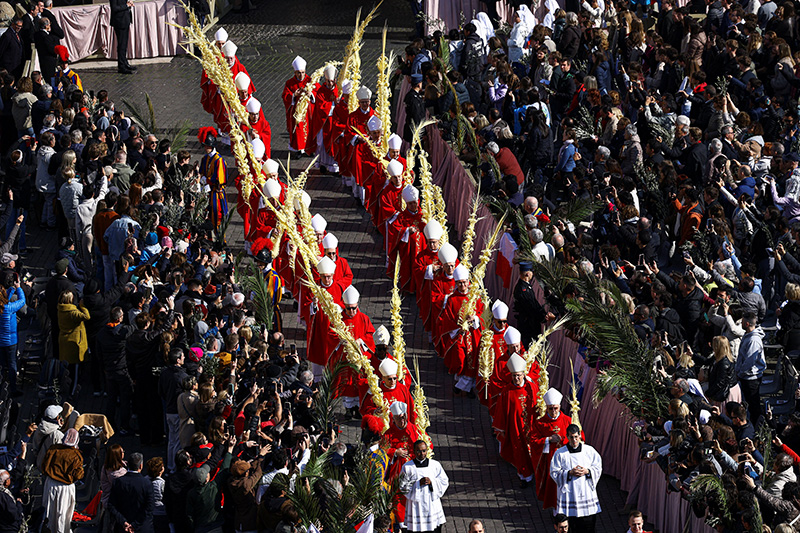
Pope Leo's first Holy Week began under sunny skies with a solemn Palm Sunday procession through St. Peter's Square, where cardinals, bishops and lay people carried large palm branches. The congregation held olive branches, as is customary in Italy.
The Passion narrative from the Gospel of Matthew was solemnly chanted during the Mass; at the moment of Jesus' death, the square fell silent as tens of thousands of people, including the pope, knelt down in prayer.
At the end of the Mass, Pope Leo led the crowd in the Angelus prayer in Latin and made an impassioned appeal for Christians in the Holy Land, where the Latin Patriarchate of Jerusalem has had to cancel or postpone key Holy Week liturgies, including Palm Sunday due to wartime restrictions.
Cardinal Pierbattista Pizzaballa, the Latin patriarch of Jerusalem, and Father Francesco Ielpo, the custos of the Holy Land, were prevented from entering the Church of the Holy Sepulcher by Israeli police on Palm Sunday, the Latin patriarchate said March 29.
"At the beginning of Holy Week, our prayers are more than ever with the Christians of the Middle East, who are suffering the consequences of a brutal conflict and, in many cases, are unable to observe fully the liturgies of these holy days," Pope Leo said at the Angelus.
"Just as the Church contemplates the mystery of the Lord's Passion, we cannot forget those who today are truly sharing in his suffering," he said, adding "their ordeal challenges all our consciences."
The pope also prayed for migrants who have died at sea, particularly those who perished recently off the coast of Crete.
In his homily, Pope Leo quoted Servant of God Antonio "Tonino" Bello, an Italian bishop and vocal critic of the Gulf War who died of cancer in 1993 and is on the path to sainthood.
"'Holy Mary, woman of the third day, grant us the certainty that, in spite of all, death will no longer hold sway over us; that the injustices of peoples are numbered; that the flashes of war are fading into the twilight; that the sufferings of the poor are breathing their last. And grant, finally, that the tears of all the victims of violence and pain will soon be dried up like frost beneath the spring sun,'" the pope said, quoting Bello, whom he referred to by his nickname "Tonino."
Pope Leo has a busy Holy Week schedule ahead, which includes a return to the tradition of Holy Thursday Mass in St. Peter's Basilica and includes Stations of the Cross in the Colosseum.
— Courtney Mares, OSV News
'Lay down your weapons," pope says in Palm Sunday call for peace
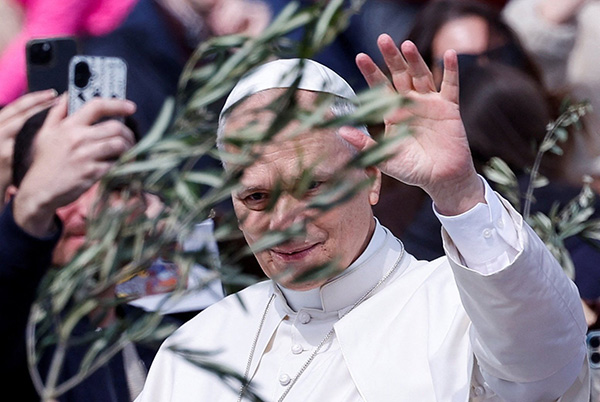
VATICAN CITY — Marking the start of Holy Week, Pope Leo XIV used his first Palm Sunday Mass to issue a forceful plea for peace, urging an end to war as he reflected on Christ’s Passion.
During his homily opening Holy Week at St. Peter's Square, the pope said the faithful must follow Jesus, as he embraced humanity "even as others raise swords and clubs."
"We turn our gaze to Jesus, who reveals himself as King of Peace, even as war looms around him," he said March 29. "He remains steadfast in meekness, while others are stirring up violence."
Pope Leo continued, recounting Jesus' final words to God, saying that in that moment we can see a "crucified humanity."
"Above all, we hear the painful groans of all those who are oppressed by violence and are victims of war," he said. "Christ, King of Peace, cries out again from his cross: God is love! Have mercy! Lay down your weapons! Remember that you are brothers and sisters!"
In his appeal at the close of the Mass, he went on further to press for peace, especially in the Middle East. He called on prayers for Christians in the Middle East, whose "ordeal challenges all our consciences," as the conflict between the United States, Israel and Iran enters its fifth week.
"Just as the Church contemplates the mystery of the Lord’s Passion, we cannot forget those who today are truly sharing in his suffering," he said. "Let us raise our prayer to the Prince of Peace that he may sustain the peoples wounded by war and open concrete paths to reconciliation and peace."
On a sunny and windy day, thousands attended the Mass, which began with a solemn procession of hundreds of people carrying green palm branches, followed by about 60 cardinals and bishops, carrying "palmurelli," pale green palm branches that were woven and braided.
In the center of the square, the procession circled the ancient obelisk, brought to Rome by Emperor Caligula in 37 AD and later erected in St. Peter’s Square, traditionally marking the site of early Christian martyrdom, including that of St. Peter.
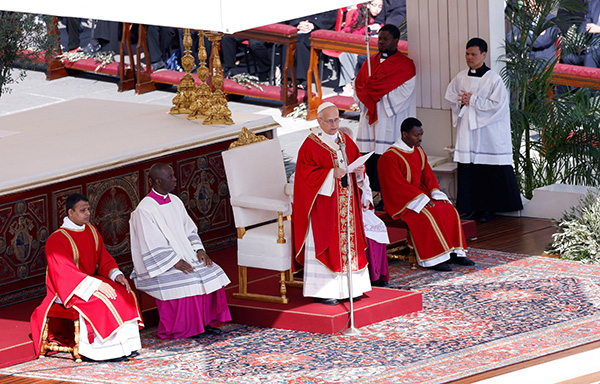
Dressed in red vestments, the color of the Passion, Pope Leo followed, opening Mass underneath the obelisk. After the opening prayer and hymns, the procession made its way through the crowd to the altar in front of St. Peter’s Basilica.
Palm Sunday marks the solemn beginning of Holy Week, commemorating Jesus’ entry into Jerusalem and leading to his passion, death and resurrection. The liturgy includes the reading of Christ’s suffering and crucifixion, setting the tone for the days leading to Easter.
In closing, the pope ended his Palm Sunday homily recalling the words of the late Bishop Tonino Bello, who was known as a pacifist and social justice advocate.
"'And grant, finally, that the tears of all the victims of violence and pain will soon be dried up like frost beneath the spring sun,'" the pope said.
Bishop Bello died in 1993, and Pope Francis recognized him as venerable as his sainthood cause was advanced in 2021.
— Josephine Peterson, Catholic News Service
Pope Leo XIV's first Palm Sunday homily
VATICAN CITY — Pope Leo XIV, OSV NewsThe following is the full text of Pope Leo XIV's Palm Sunday homily given March 29, 2026, in St. Peter's Square.
Dear brothers and sisters,
As Jesus walks the Way of the Cross, we place ourselves behind him, following in his footsteps. As we walk with him, we contemplate his passion for the sake of humanity, his broken heart, and his life as a gift of love.
We turn our gaze to Jesus, who reveals himself as King of Peace, even as war looms around him. He remains steadfast in meekness, while others are stirring up violence. He offers himself to embrace humanity, even as others raise swords and clubs. He is the light of the world, though darkness is about to engulf the earth. He came to bring life, even as plans unfold to condemn him to death.
King of Peace. Jesus' desire is to bring the world into the Father's arms, tearing down every barrier that separates us from God and from our neighbor, for "He is our peace" (Eph 2:14).
King of Peace. Jesus enters into Jerusalem not upon a horse, but upon a donkey, fulfilling the ancient prophecy that calls for rejoicing at the arrival of the Messiah: "Lo, your king comes to you; triumphant and victorious is he, humble and riding on a donkey, on a colt, the foal of a donkey. He will cut off the chariot from Ephraim and the war-horse from Jerusalem; and the battle bow shall be cut off, and he shall command peace to the nations" (Zech 9:9–10).
King of Peace. When one of his disciples drew his sword to defend him and struck the high priest's servant, Jesus immediately stopped him, saying: "Put your sword back into its place, for all who take the sword will perish by the sword" (Mt 26:52).
King of Peace. While he was burdened with our sufferings and pierced for our sins, Jesus "did not open his mouth, like a lamb that is led to the slaughter, and like a sheep that before its shearers is silent" (Is 53:7). He did not arm himself, or defend himself, or fight any war. He revealed the gentle face of God, who always rejects violence. Rather than saving himself, he allowed himself to be nailed to the cross, embracing every cross borne in every time and place throughout human history.
Brothers and sisters, this is our God: Jesus, King of Peace, who rejects war, whom no one can use to justify war. He does not listen to the prayers of those who wage war, but rejects them, saying: "Even though you make many prayers, I will not listen: your hands are full of blood" (Is 1:15).
As we set our gaze upon him who was crucified for us, we can see a crucified humanity. In his wounds, we see the hurts of so many women and men today. In his last cry to the Father, we hear the weeping of those who are crushed, who have no hope, who are sick and who are alone. Above all, we hear the painful groans of all those who are oppressed by violence and are victims of war.
Christ, King of Peace, cries out again from his cross: God is love! Have mercy! Lay down your weapons! Remember that you are brothers and sisters!
In the words of the Servant of God, Bishop Tonino Bello, I would like to entrust this cry to Mary Most Holy, who stands beneath the cross of her Son and weeps also at the feet of those who are crucified today:
"Holy Mary, woman of the third day, grant us the certainty that, in spite of all, death will no longer hold sway over us; that the injustices of peoples are numbered; that the flashes of war are fading into the twilight; that the sufferings of the poor are breathing their last. And grant, finally, that the tears of all the victims of violence and pain will soon be dried up like frost beneath the spring sun" (Maria, donna dei nostri giorni).
— Pope Leo XIV, OSV News