


A hymn to Asheville
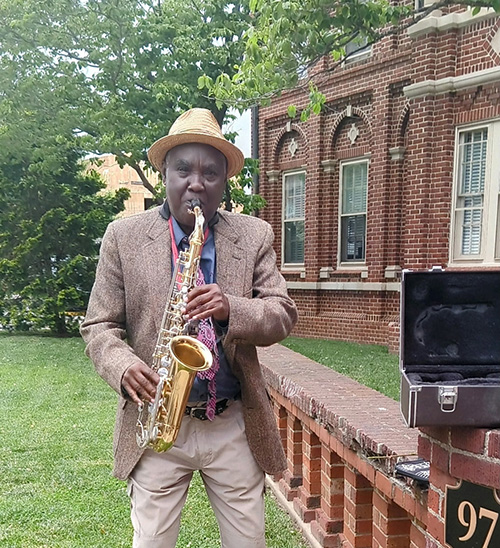 Saxophone player Bobby Hughes has been serenading churchgoers at St. Lawrence Basilica and other area churches for 25 years. He reflects on decades of getting to know the parishioners and the community that he now considers home. (Lisa M. Geraci | Catholic News Herald)ASHEVILLE — Busker Bobby Hughes, aka Bobby Sax, has a soundtrack that’s filled the streets of downtown Asheville for the past 25 years.
Typically, he can be spotted playing his saxophone on the sidewalks of McCormick Field, Pack Square Park and all the churches in between.
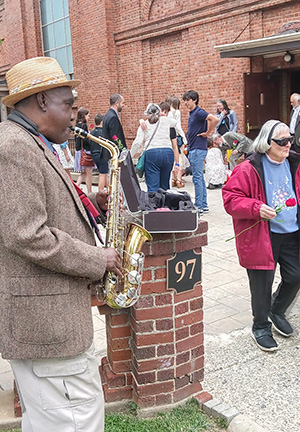
Sax, now 82, is slowing down a bit, yet he never fails to fill the mountain air with notes after noon Mass on Sundays as 400 parishioners exit St. Lawrence Basilica. After the last church hymn is sung, Sax’s performance begins.
“It’s great that I am able to make them smile and be an inspiration for them,” said Sax. “I’ve been doing the basilica for at least 15 years.”
He has learned to furrow his brow, blow up his cheeks, and sway his hips while playing classics like “Over the Rainbow” and “Amazing Grace.” People call it tone, but Sax said it is about working the crowd, an audience he understands, responds to and loves.
“A good player knows how to read their audience. I play all flavors all the way from the oldies down to the babies,” said Sax. “That’s what kept me alive straight across the board all these years.”
Recently, Sax had an inspiration he thinks came from God: “The Lord has spoken to me about it. He said that I should be playing ‘Ave Maria.’ I’m learning. Especially for the people at the basilica, a lot of people asking for that one.”
Lifetime friends
Newer parishioners at St. Lawrence may not remember Father Wilbur Thomas, the diocese’s first African American priest, who served at the basilica from 2000 to 2018 and passed away in 2022. Sax counted him as a friend.
“I miss Father Thomas. He knew what I was going through. He wrote me checks sometimes so I could get by with my rent, and he even visited me when I went to the hospital,” explained Sax.
Sax calls Asheville home because of the people and their love. His supporters donated a bicycle when his was stolen and saxophones when his trailer burned to the ground.
“They ran a story about me and the fire in the local paper, and people donated saxophones to me,” said Sax. “I lost four saxophones in the fire and was given five afterward.”
For Sax, compliments are more inspiring than gifts. He’ll never forget the woman who said his rendition of “Amazing Grace” changed her day. Or when the pastor at Central
United Methodist Church on Church Street invited him to come worship after the police said he couldn’t play there anymore.
He also made enduring friends, like two sisters who crossed the street to listen to him play in front of the church. They stayed an hour and kept coming back each time he was there.
“I had this relationship with those two old ladies. They used to visit me for years, and I’d play for them,” said Sax. “One of the sisters got sick and then died. The other sister went into the old person’s home. Well, I went there and took a job there because of her. I loved her.”
In his youth, he learned from the best, taking gigs at nightclubs throughout D.C. and Detroit and playing alongside Marvin Gaye.
“I played with him for four gigs in 1977 right before his daddy killed him,” said Sax.
Sax played at Carnegie Hall with The Floaters and recorded his own record. He toured military bases up and down the East Coast and played in Montego Bay, Jamaica, but nothing quite felt like home until he reached Asheville.
“An old friend asked me if I wanted to play for a while where he lived in Asheville, and I did. I am still here,” smiled Sax.
Southern roots
 Sax was no stranger to the South. He grew up in Monroe and returned in the 1990s to care for his mother, who had cancer. But this was a New South, much different from his childhood memories.
Growing up in Monroe back then had meant dealing with the injustices of segregation. Being a black child, his skin color played a role in where he could go and what he could do.
He watched movies by entering through back doors and standing on the balcony at Center Theatre Downtown and ordered sandwiches from Oasis through a window for black customers. Local black activists jumped into white swimming pools as a form of protest, and Sax watched as the whites squirmed out of the water as if it were shark infested.
His small heart started swelling with rage that eventually and unexpectedly led him to become a Christian.
He walked down the sidewalk at age 10, spotting a white child around his age.
“I made it look like an accident, but I ran into the kid so hard, he fell to the ground. I could tell I really injured him,” Sax remembered. “I expected him to yell at me, downgrade me, insult me, just like all the others, but he looked up and was so apologetic, so full of love. I felt so awful about it, I knocked on his door later that night to make sure he was OK. That’s the day I really started believing in God. That’s why I love music. Music has no color, so there are only two kinds to me: good and bad.”
Seeing God in music
Sax was also around 10 when he heard the rhythm and blues of Joe Turner’s hit “Shake, Rattle and Roll” blaring from the local Wadesboro radio channel.
“The sax would come on in that song, and it was so good,” Sax reminisced. “I would race home every day at the same time just to hear it.”
He begged his mom for a saxophone, but she said, “Bobby, you’re not gonna do anything with a saxophone.”
Sax persisted by asking his biggest fans, his grandparents, who couldn’t resist.
“We had a special bond; that’s where I saw God,” said Sax. “My grandmother was 101 when she passed, and all she did, morning, noon and night, was pray.”
When he left his childhood home, he took his music teacher’s sax and headed to Washington, D.C., where he was further schooled.
“We got off our jobs every day and practiced. But after a while, I was like, ‘We’ve practiced enough. I think it’s time for us to go ahead and perform,’” said Sax.
Sax moved on and has been filling the streets with music ever since.
Sax has plans for the future. He wants a $500 mouthpiece and a three-wheel electric bike to get around a little better.
“I’ll perform as long as I can breathe. I feel good. People keep me inspired,” he said. “They have been coming to listen to me for years and will be listening to me for years to come.”
— Lisa M. Geraci